[This blog started out in the first week of November as a reflection of the week following the 6.6 earthquake we had on October 30th. But not long after that, several events dwarfed its newsworthiness and provided a distraction that prevented its completion: first, the political earthquake in the US on November 8th, then the big "natural" earthquake in New Zealand on the 13th, and finally the 6.9-7.4 (depending on which report you read) Japanese event on the 21st, which interestingly was experienced by two friends who happened to be in Tokyo. (One of them is from this area and was here during all our recent earth movements, and the other is a South African who just happened to be on the throne when his hotel building started swaying.) But now I've come back to it, having absorbed the added dimension of the significant seismic happenings in various places around the globe, along with the similarly-significant aftermath locally of the 24th August and 30th October quakes.]
About 10 days ago I wrote to a friend that, after a week or so of mild but numerous shakes - almost all of which we didn't feel - things were quietening down (tectonically). So much so that we moved from sleeping in the safety of our wood house back into our stone-walled bedroom. Naturally, that was a signal to the gods of the profound earth to nudge my complacency. Since then, we've been reminded daily - more than once on most days - that things are unlikely to be quiet when you live in a country whose very shape is more or less defined by the disharmonious meeting of several tectonic plates - the African, moving north at a rate of a cm or two per year and subducting under the massive Eurasion plate in the Mediterranean Sea, along with the Adriatic "microplate", which broke off from Africa plate some time ago (by way of understatement), and which is moving in an anti-clockwise direction; in fact the Apennine mountains - Italy's backbone - were formed by the Adriatic plate subducting under the Eurasion, which essentially scraped up the mountains as the two plates ground against each other.
In any event, the shocks have been coming, and after numerous 3-plus events (including a 3.9 on 27th Nov which made the house shudder), we had a 4.4 last Tuesday, which bumped its shoulder against the house and sent waves running through it for more seconds than I would have liked. A 4.0 followed on Thursday, in the dead of night yesterday morning there was a 3.8 (which I slept through), and from midnight until 10am this morning there have been a total of 40 shakes in our earthquake zone with a magnitude greater than 2.0. According to the local Istituto Nazionale di Geofisica e Vulcanologia, in our area there were 7,816 seismic events in October - an average of more than 250 a day - of which 32 were between 4 and 5 in magnitude, and nearly 400 between 3 and 4. Of those that we feel, most tend to be a bump and shudder, with the odd creak as the stone and woodwork flex themselves. In short, we're reminded on a daily basis that things are not "quietening down".
Life has changed. In social circles, the vernacular has grown to register instant recognition when conversation tends towards single-digit numbers with one decimal place. If you hear someone saying "4.4" or "5.7" or "3.6", you know they're talking about things seismic rather than a wan, wishful hope for the growth of Italy's economy in percentage terms.
As an aside, the local online gravitation towards the Italian earthquake site (cnt.rm.ingv.it) - which now holds a permanent position on many browsers in the area, including mine - has served to educate at least me, if not many others. I grew up thinking of earthquakes being measured against the Richter scale, so I was more than interested to discover that it was replaced some time ago by the Moment Magnitude and Mercalli Intensity scales. It seems that, to the uneducated masses (such as yours truly), these contemporary measurements are not that different from those of the Richter, making it somewhat confusing when trying to distinguish readings from the different scales. However, at the same time this similarity also tends to remove this layman confusion, ushering in blissful ignorance in its place. These new measures have also retained Richter's relative scale - a one-step difference in the scale (e.g. 4.0 to 3.0) is produced by a shake that is 10 times the magnitude, but 32 times the intensity in terms of energy released. Given its logarithmic nature, that means a 7.0 quake releases around 1,000 times more energy than a measly 5.0.
Back to the thread - life has changed. It's no wonder that earthquakes continue to be the major topic of conversation around here. The number of people that can't (or won't) sleep in their houses due to their being declared uninhabitable, or simply being deemed unstable, is in the many, many thousands. Just in my own municipality of Tolentino, 11,000 are staying in caravans, gyms, tents, and other undamaged centres, as well as sleeping in their cars; the town's total population is only around 20,000. It didn't even make the national and international news, which has justifiably focused on epicentres such as the village Castelantangelo sul Nera (which, I heard recently, cannot be rebuilt on its current location because it lies directly over the newly active fault that flexed its muscles on 30th October).
One of our neighbours, Sergio, moved from his digs just a few hundred metres from us to the town of Colmurano, visible from our house some 3,5km distant, after the 24th August earthquake. But after the 6.6 shock on 30th October, his rental in Colmurano was declared uninhabitable, leaving him homeless. Claudia Maria, in her generosity and unique position of caretaking several houses of mostly-absent owners, managed to find him a caravan on one of the properties to sleep in. Another neighbour moved into the same property owner's house last week, having scrambled around for somewhere to live since the beginning of November. A good friend who lives near San Ginesio, about 15km away, has had to rent a house since her own will need to be demolished and rebuilt before she can move back into it. Another's house near Servigliano faces the same fate as the one in San Ginesio. The list goes on...
Then there are those that have also lost their livelihoods - stores, restaurants, bars in the red zones of cordoned-off city centres, as well as ex-pats whose whole existence here is predicated on the summer rental of properties that have now been declared uninhabitable. In the small town of Urbisalgia just a few km from here, 150 people from its biggest employer are now out of work after its premises were declared unusable. These are just the anecdotal cases.
When will this bout of tremors end? It's anybody's guess. In the meantime people try to find reasons and make predictions. Catholic priest Giovanni Cavalcoli suggested it was God's punishment
for Italy's recent legalization of gay marriage; Israeli Deputy Foreign
Minister Ayoub Kara claimed that the quakes were divine retribution for
Italy’s abstention
on a Unesco resolution about the status of Jerusalem’s holy sites; and others raise their eyebrows at offshore drilling in the Adriatic as a
destabilizing factor (after wastewater disposal from fracking was directly connected to increased seismic activity in Oklahoma, which included a 5.0 on 5th November). Elsewhere, CERN's Large Hadron Collider (LHC) in
Geneva has also been linked to the earthquakes: apparently, new super high energy experiments
have been sending neutrinos underground from the LHC to the Gran Sasso
nuclear physics laboratory in Italy's central Apennines, some 400km away
and a stone's throw from this year's biggest quakes. As for me, I'm more apt to ascribe it to the same origins as those expressed in deadpan fashion by a keen vulcanologist friend of mine: "Tectonics happens" (sic).
Online earthquake predictor Dutchsinse has also become something of a regular on our computer screens, having displayed some degree of accuracy with his forecasts. For example, he was extremely accurate in terms of timing, location, and magnitude with the big shake in New Zealand, and frequently gets our local 4-pluses relatively close. There are those that dispute his accuracy (as one would expect in the mishmash of an online world), and I must confess that his verbosity, manner of delivery, and constant defence of his predictions require a certain degree of patience and tolerance to wade through in order to get to the useful info. One of his basic theories is that deep, low-magnitude upheavals below the earth's crust tend to manifest themselves in the subsequent 24-72 hours with stronger, shallower shakes in the crust itself, following the fault lines from east to west (in our case; they travel west to east in the Americas). So, for example, if there is some relatively significant seismic activity anywhere from Greece to Iran, we can expect something in the Apennines in fairly short order.
Dutchsinse aside, experts in the field of geophysics and vulcanology universally refer to the geological and tectonic activity of the Apennine region as "complex". In a field that has made several quantum leaps over the past four decades, there is still an honest amount of head-scratching when it comes to explaining - much less predicting - earthquake activity. So there's that ...
So the best we can do is simply acknowledge the fact that it has been (and still is) a strange, eventful year, from Japan to New Zealand, and Peru to Italy. And that's just seismically; woe betide us if we also factor in the human impact ...
Sunday, December 04, 2016


Tuesday, November 01, 2016
Earthquakes part 1
Literally as I started writing this, the house shook, ever so slightly. We've become "sensitized" to these movements over the past couple of months. Naturally the main earthquake events - the ones that make news - are the ones that become etched into memory, but it's the aftershocks that set one on edge, jumping at every little sound - a breeze blowing a door closed, glasses clinking in the dishwasher - and spawning an attitude of ultra-readiness, of permanent alertness, primed to go scarpering for the safety of the garden at a moment's notice.
When the whole house shook this past Sunday morning, waking us to full consciousness instantaneously, dreams, past, future all gave way to the immediate present, the now. Claudia Maria scrambled for the door to get outside, I hauled myself up into the well-reinforced window frame behind my pillow as the plaster rained down from the ceiling and the quake, barrelling loudly and vibrating like a speeding train, eventually petered out after about 15 seconds. The silence that followed was heavy, suggestive, eerie.
And in that moment, the terra firma contract of security was broken and replaced with uncertainty. The earth feels different now, at least in our minds, and the solid terrain that we took for granted as an unquestioned, grounded haven has developed a new side to its character - it most certainly lives. Sinister? Only if you want it to be. Unsettling? Indeed. Exhilarating? Unquestionably.
This new realization was both confirmed and emphasized in the half-hour after the Sunday morning quake with 7 shocks ranging from 4.0 to 4.6 in strength. After the initial 6.6 shake at 7:40am, during the rest of the day until midnight, we had a total of 16 aftershocks of 4.0-4.6 and 172 of 3.0-3.9 magnitude. All of the epicentres were in the area between Norcia in Umbria and Visso in Marche, a distance of about 30-40km from our house as the crow flies. Close enough.
Of course, Sunday's event came on the heels of last Wednesday evening's two quakes of 5.4 and 5.9, which struck just 2 hours apart, and were enough to shake us up considerably (pun intended). These caused enough damage in themselves - the mayor of Ussita (near the epicentres) said his village is "finished" - but it's the proximity in time of those two and the third big one on Sunday that has been most unsettling. And coming just 2 months after the 6.2 quake that levelled nearby Amatrice (amongst other villages) and killed some 300, one can imagine the population's sense of insecurity. This past Sunday both Claudia and I were left walking around in a dreamlike daze, as if we weren't quite present, and I uncharacteristically took several wrong turns on my way to & from watching Julius play rugby in Abruzzo, adding considerable time to an already-long journey.
But we've been fortunate. Our house has developed a number of hairline cracks, which aren't structural (we hope), but five of our good friends have had their houses declared uninhabitable - in several cases they can't even go inside, at least not without fireman. Along with thousands of others, they are now forced to find other accommodation. I read that 15,000 are now in temporary shelter organized by the civil defence authorities, and that excludes those, like our friends, who have found places on their own.
It's going to take years to recover from this. Towns like Visso, Preci, Castelsantangelo sul Nera, Castelluccio, Ussita, Norcia, Camerino are not only destroyed, most of them are deserted save emergency workers sifting through rubble. The University of Camerino has been closed indefinitely, and a friend from the town suspects that it won't be able to open again for at least 2 years. General restoration is likely to take closer to 10. Many of the people from those mountain villages have spent their entire lives there, as their parents and grandparents did, tending their vegetable patches and drinking their coffees in smoky conversation at the local Bar Centrale. Many have now been relocated to the Adriatic coast - yes, far from the threat of earthquakes, but even further way from the lives that they know. If we're in a daze, what state must these people be in, many of them in their sixties and older?
And it's not over yet, at least as far as the analysis and predictions foretell. These are new faults, or at least offshoots of the main fault lines that spawned the August quake. [More on this in a subsequent blog.] So we've taken to sleeping in our seismic-proof wooden cottage. For good reason too - this morning as we were having breakfast in the main house, we were hit by a 4.8 shake that sent us scurrying outside for safety. Small tremors have continued throughout the morning. Turns out that these epicentres are about 10km closer to us. Gulp...
When the whole house shook this past Sunday morning, waking us to full consciousness instantaneously, dreams, past, future all gave way to the immediate present, the now. Claudia Maria scrambled for the door to get outside, I hauled myself up into the well-reinforced window frame behind my pillow as the plaster rained down from the ceiling and the quake, barrelling loudly and vibrating like a speeding train, eventually petered out after about 15 seconds. The silence that followed was heavy, suggestive, eerie.
And in that moment, the terra firma contract of security was broken and replaced with uncertainty. The earth feels different now, at least in our minds, and the solid terrain that we took for granted as an unquestioned, grounded haven has developed a new side to its character - it most certainly lives. Sinister? Only if you want it to be. Unsettling? Indeed. Exhilarating? Unquestionably.
This new realization was both confirmed and emphasized in the half-hour after the Sunday morning quake with 7 shocks ranging from 4.0 to 4.6 in strength. After the initial 6.6 shake at 7:40am, during the rest of the day until midnight, we had a total of 16 aftershocks of 4.0-4.6 and 172 of 3.0-3.9 magnitude. All of the epicentres were in the area between Norcia in Umbria and Visso in Marche, a distance of about 30-40km from our house as the crow flies. Close enough.
Of course, Sunday's event came on the heels of last Wednesday evening's two quakes of 5.4 and 5.9, which struck just 2 hours apart, and were enough to shake us up considerably (pun intended). These caused enough damage in themselves - the mayor of Ussita (near the epicentres) said his village is "finished" - but it's the proximity in time of those two and the third big one on Sunday that has been most unsettling. And coming just 2 months after the 6.2 quake that levelled nearby Amatrice (amongst other villages) and killed some 300, one can imagine the population's sense of insecurity. This past Sunday both Claudia and I were left walking around in a dreamlike daze, as if we weren't quite present, and I uncharacteristically took several wrong turns on my way to & from watching Julius play rugby in Abruzzo, adding considerable time to an already-long journey.
But we've been fortunate. Our house has developed a number of hairline cracks, which aren't structural (we hope), but five of our good friends have had their houses declared uninhabitable - in several cases they can't even go inside, at least not without fireman. Along with thousands of others, they are now forced to find other accommodation. I read that 15,000 are now in temporary shelter organized by the civil defence authorities, and that excludes those, like our friends, who have found places on their own.
It's going to take years to recover from this. Towns like Visso, Preci, Castelsantangelo sul Nera, Castelluccio, Ussita, Norcia, Camerino are not only destroyed, most of them are deserted save emergency workers sifting through rubble. The University of Camerino has been closed indefinitely, and a friend from the town suspects that it won't be able to open again for at least 2 years. General restoration is likely to take closer to 10. Many of the people from those mountain villages have spent their entire lives there, as their parents and grandparents did, tending their vegetable patches and drinking their coffees in smoky conversation at the local Bar Centrale. Many have now been relocated to the Adriatic coast - yes, far from the threat of earthquakes, but even further way from the lives that they know. If we're in a daze, what state must these people be in, many of them in their sixties and older?
And it's not over yet, at least as far as the analysis and predictions foretell. These are new faults, or at least offshoots of the main fault lines that spawned the August quake. [More on this in a subsequent blog.] So we've taken to sleeping in our seismic-proof wooden cottage. For good reason too - this morning as we were having breakfast in the main house, we were hit by a 4.8 shake that sent us scurrying outside for safety. Small tremors have continued throughout the morning. Turns out that these epicentres are about 10km closer to us. Gulp...
Tuesday, May 17, 2011
Claudia Maria's garden


Youth football ... Italian style
Football is big in this country. In fact, it rivals the Pope in its popularity, perhaps even going a step further in being the only thing that has the pull to galvanize its citizens into something approaching unity when the national team plays. Take a look at the sports pages - 12 on football, one or two on other sports. It permeates the entire fabric of society, from the teflon caricature prime minister (whose Rossi Neri have just won Serie A) all the way to every schoolyard in the most remote reaches of its borders.
Julius (or HRH as he has been referred to previously on this blog) plays for a local youth team, Corridonia. They're quite good, having won every league game in the pre-Christmas league, and challenged for the leadership in the next-level, post-New Year league. Until one fateful Sunday in March, that is ...
The previous weekend in an away game they had been bludgeoned to defeat in something of an upset against a mediocre team, with several of the Corridonia team needing more than casual medical attention as a result of the home team's 'robust' approach. The referee took no action against several blatant acts of aggression, and quite naturally incurred the ire of coaches and parents. After the game I stood by intrigued as they (the parents & coaches from both sides) went at it hammer and tongs (verbally) arguing about the home team's physical approach. I thought it was all quite passionate, albeit not without foundation, given the strong support these teams enjoy. However, it was nothing compared to the following weekend ...
Corridonia returned to their home ground faced with the prospect of having to beat the league leaders in order to still have a sniff at the winning the league and graduating to the next (regional) level competition. They had lost the away leg rather convincingly, 4-0, their first loss - and one of only two - of the season. The ground - a rather unatmospheric place bordered one one side by a concrete parking lot and on the other a steep, ungainly tiered bank leading up to the main road - was as packed as I've seen it in Julius' 2 years of playing there. Having recently returned from injury, he was left on the bench, coming on as a second-half substitute.
That weekend one of my longest-standing friends (John) was visiting from South Africa, and he came along. A sports lover himself, he had taken to watching schoolboy rugby in his home town of Cape Town, but had stopped going due to the aggressive and at times ugly behaviour of the teams' passionate parents. Ten minutes into the game, which Corridonia was bossing, I turned to him and said: "Thank heavens the referee is reasonable, unlike last week's paluka."
I should have known better. My comment was the kiss of death, sparking a Jekyll-Hyde metamorphosis in him, almost as if he (the referee) had heard me and felt like being otherwise. What had been up until then a competent performance on his part, transformed itself into a veritable mockery of the football arbiter's trade. Herewith a selection of his decisions that followed:
- the award of a free kick outside the area to Corridonia instead of a penalty for a rugby tackle-like foul that happened at least 1-2 metres inside the big box
- the turnover of at least 2 obvious free kicks for Corridonia, in which at first he indicated in favour of Corridonia, and then changed his decision, pointing in the other direction
- the award of a penalty to the opposition for a mild bump in a 50-50 challenge, where the opponent didn't even go to ground (thankfully it was missed)
- the issue of multiple yellow cards to Corridonia players and none to the opponents, even though the physicality and remonstrations were equally passionate on both sides of the ball, and resulting in Corridonia being reduced to 9 players by the end of the game
Bear in mind that this is just a selection. Worse was to follow, however, as in the last minute of the game, with Corridonia leading 1-0, the opponents launched an attack in the home team's area. The local goalkeeper game out to collect a routine ball, and was promptly taken out with a shoulder charge. What happened next is hard to believe - the referee blew the whistle before the ball entered the goal, indicating a free kick for Corridonia, and then changed it to the award of a goal for their opponents as the ball nestled into the back of the net.
Following all the other injustices he had already inflicted on the home team, it was all too much for all the locals - players, coaches, and supporters alike. The place erupted into a cacophony of indignation, so passionate and gesticulative that it lasted several minutes until he blew up for the end of the game without another ball being kicked. In the process, he issued a second red card to a player previously sent off, who had charged on to the field to register his displeasure with the referee's latest decision. He was surrounded and jostled by the home team as he tried to make his way back to the change rooms, but he never made it there. In the meantime, the crowd, now a furious, seething mass, had swarmed around to the entrance to the changeroom area, baying for the blood of the young referee, prompting the managerial staff of the two teams to extricate him from the clutches of the home team players and escort him to the relative safety of the centre of the pitch, the field being fenced in apparently for precisely such circumstances. The local police were eventually called in to ensure the ref's safe passage from the ground.
While all this was happening, John and I stood rooted and open-mouthed, the only two spectators left on the tiered stand, watching the events unfold in disbelief. Finally we dragged ourselves away, collected a disgruntled and despondent Julius - who I'm proud to say abstained from the type of remonstration his teammates were engaging in - and headed home.
When I asked John how the whole display compared with the scenes he'd witnessed at the schoolboy rugby games in Cape Town, he responded - with no small measure of understatement - that the Italian version was perhaps "a bit more emotional". On reflection, it's probably as accurate and succinct a verdict as one could conjure - I've seen the ugly outbursts amongst South African rugby fans, and the spontaneous vein-popping reactions of some sports fans in the US, with outcomes that can be unpredictable and at times violent. In Italy, however - or at least in our small corner of it - it was just as John said: emotional. Sure it was bubbling, red-hot even, but you can also encounter this kind of emotion when discussing the best ragù recipe for tagliatelle (albeit without the anger). Punches, fisticuffs? Close, but not in this case - the most extreme I've seen - and while there is certainly football hooliganism in Italy, in general this kind of episode will see voices rather than fists raised. Who knows, maybe the two coaches shared a plate of vincisgrassi for lunch, although my suspicion is the referee dined alone ...
Julius (or HRH as he has been referred to previously on this blog) plays for a local youth team, Corridonia. They're quite good, having won every league game in the pre-Christmas league, and challenged for the leadership in the next-level, post-New Year league. Until one fateful Sunday in March, that is ...
The previous weekend in an away game they had been bludgeoned to defeat in something of an upset against a mediocre team, with several of the Corridonia team needing more than casual medical attention as a result of the home team's 'robust' approach. The referee took no action against several blatant acts of aggression, and quite naturally incurred the ire of coaches and parents. After the game I stood by intrigued as they (the parents & coaches from both sides) went at it hammer and tongs (verbally) arguing about the home team's physical approach. I thought it was all quite passionate, albeit not without foundation, given the strong support these teams enjoy. However, it was nothing compared to the following weekend ...
Corridonia returned to their home ground faced with the prospect of having to beat the league leaders in order to still have a sniff at the winning the league and graduating to the next (regional) level competition. They had lost the away leg rather convincingly, 4-0, their first loss - and one of only two - of the season. The ground - a rather unatmospheric place bordered one one side by a concrete parking lot and on the other a steep, ungainly tiered bank leading up to the main road - was as packed as I've seen it in Julius' 2 years of playing there. Having recently returned from injury, he was left on the bench, coming on as a second-half substitute.
That weekend one of my longest-standing friends (John) was visiting from South Africa, and he came along. A sports lover himself, he had taken to watching schoolboy rugby in his home town of Cape Town, but had stopped going due to the aggressive and at times ugly behaviour of the teams' passionate parents. Ten minutes into the game, which Corridonia was bossing, I turned to him and said: "Thank heavens the referee is reasonable, unlike last week's paluka."
I should have known better. My comment was the kiss of death, sparking a Jekyll-Hyde metamorphosis in him, almost as if he (the referee) had heard me and felt like being otherwise. What had been up until then a competent performance on his part, transformed itself into a veritable mockery of the football arbiter's trade. Herewith a selection of his decisions that followed:
- the award of a free kick outside the area to Corridonia instead of a penalty for a rugby tackle-like foul that happened at least 1-2 metres inside the big box
- the turnover of at least 2 obvious free kicks for Corridonia, in which at first he indicated in favour of Corridonia, and then changed his decision, pointing in the other direction
- the award of a penalty to the opposition for a mild bump in a 50-50 challenge, where the opponent didn't even go to ground (thankfully it was missed)
- the issue of multiple yellow cards to Corridonia players and none to the opponents, even though the physicality and remonstrations were equally passionate on both sides of the ball, and resulting in Corridonia being reduced to 9 players by the end of the game
Bear in mind that this is just a selection. Worse was to follow, however, as in the last minute of the game, with Corridonia leading 1-0, the opponents launched an attack in the home team's area. The local goalkeeper game out to collect a routine ball, and was promptly taken out with a shoulder charge. What happened next is hard to believe - the referee blew the whistle before the ball entered the goal, indicating a free kick for Corridonia, and then changed it to the award of a goal for their opponents as the ball nestled into the back of the net.
Following all the other injustices he had already inflicted on the home team, it was all too much for all the locals - players, coaches, and supporters alike. The place erupted into a cacophony of indignation, so passionate and gesticulative that it lasted several minutes until he blew up for the end of the game without another ball being kicked. In the process, he issued a second red card to a player previously sent off, who had charged on to the field to register his displeasure with the referee's latest decision. He was surrounded and jostled by the home team as he tried to make his way back to the change rooms, but he never made it there. In the meantime, the crowd, now a furious, seething mass, had swarmed around to the entrance to the changeroom area, baying for the blood of the young referee, prompting the managerial staff of the two teams to extricate him from the clutches of the home team players and escort him to the relative safety of the centre of the pitch, the field being fenced in apparently for precisely such circumstances. The local police were eventually called in to ensure the ref's safe passage from the ground.
While all this was happening, John and I stood rooted and open-mouthed, the only two spectators left on the tiered stand, watching the events unfold in disbelief. Finally we dragged ourselves away, collected a disgruntled and despondent Julius - who I'm proud to say abstained from the type of remonstration his teammates were engaging in - and headed home.
When I asked John how the whole display compared with the scenes he'd witnessed at the schoolboy rugby games in Cape Town, he responded - with no small measure of understatement - that the Italian version was perhaps "a bit more emotional". On reflection, it's probably as accurate and succinct a verdict as one could conjure - I've seen the ugly outbursts amongst South African rugby fans, and the spontaneous vein-popping reactions of some sports fans in the US, with outcomes that can be unpredictable and at times violent. In Italy, however - or at least in our small corner of it - it was just as John said: emotional. Sure it was bubbling, red-hot even, but you can also encounter this kind of emotion when discussing the best ragù recipe for tagliatelle (albeit without the anger). Punches, fisticuffs? Close, but not in this case - the most extreme I've seen - and while there is certainly football hooliganism in Italy, in general this kind of episode will see voices rather than fists raised. Who knows, maybe the two coaches shared a plate of vincisgrassi for lunch, although my suspicion is the referee dined alone ...
Tuesday, January 11, 2011
The gas man
When the big black Audi pulled unannounced into the driveway, and the tall dark man who got out was wearing black shirt, black pants, black shoes, and black sunglasses, I knew I was in for an experience. When he announced - looking down at me from his higher vantage point and imaginary pedestal - that he is the regional manager of the gas company, I knew it wasn't going to be a particularly pleasurable experience.
You see, the gas company and us have something of a history - they screw up their bills to us, and we don't pay until they are sorted out. Franco had arrived to "sort it out" as clearly he (as regional manager) was capable of doing, and his bespectacled, subservient underling - who Franco treated as such - was not.
But first off, what made him believe that I would even be at home on a Tuesday afternoon? And even though I was, what made him think that I would drop everything and attend to him? Home-based as I am, and sucker to boot, Franco had guessd right on both counts, as people like him are apt to do and people like me are not.
His opening salvo was so clearly intended to soften me up that it almost had me openly chuckling: "I have good news for you. You know that long-outstanding bill for €678 you received and haven't paid yet?" Clearly a rhetorical question, I assumed. "Well, don't worry about it, it's taken care of." My deadpan reaction prompted a follow-up question: "Does this make you happy?" Naturally it did, although not from the perspective that he suspected - I was simply relieved that we would no longer be pestered for the money by the gas company for an error that their own field agents (now moved on) had clearly documented on multiple occasions.
But this wasn't the reason for him to come out all the way from wherever to share this news. It was for another unpaid bill, this one rather less, around €170. We had not paid it because it was so obviously another mistake that we wanted it sorted out first - a bill four times the normal, for a period that included a good chunk when we weren't even in Italy. Franco had come to "sort us out."
When I pointed out that such anomalous consumption levels could not be accurate, he claimed they were, and that we had clearly consumed the gas. When I pointed out that we only used gas for cooking, he didn't believe me, and told me that we must have used it for hot water. He even turned to his sidekick underling and asked him how much gas he used for cooking, aiming to demonstrate that our historic consumption levels - which I was able to demonstrate over a two-year period - were simply not possible. [As it turns out, they are, we are simply watchful and frugal.] When I showed him - physically - that there is simply no connection between the gas tank and the heating and hot water system, he said there was obviously another connection somewhere. Without dropping his bella figura for an isntant, he delivered his ultimatum (the details aren't important) and told me that customers like us were simply too much trouble for the gas company. [Naturally, this gave me pause - when a regional manager is spending his time trying to collect a €170 bill from its smallest customer, they must be in some kind of trouble.]
Once he'd done that, he did something that I couldn't believe he would think I'd take in, given the acrimonious atmosphere. He leaned forward conspiratorially, and in a lowered voice - we were in our house, alone, some 500m from the next house - told me that he was going to share something that he shouldn't, and in fact hadn't to anyone else. Uh-huh, no-one else, huh? But you'd open up to me, a guy you've just met who won't pay his bill, with an insider's secret.
He then proceeded to make such a ludicrous claim that it was almost as laughable as his opening gambit. He told me that water from solar panels are physically incapable of rising above 25°C from October to March in this area. This was early November. Amid the glorious sunshine we were having, the water from our soalr panels had reached 50°C the day before, and I'd had a long, luxurious, hot shower ... from the solar panels - other than ligthing a fire, we simply have no other source for hot water. I shared this with him. He told me it wasn't possible, and then proceeded to explain that the overflow tank for our solar panel water reservoir was actually an electric heater that warmed the water on its way to the house. This was so idiotic that I was simply silenced - how could such a man be a manager of anything? Worse still, how could the sidekick underling take him seriously, and treat him with such respect? I was dumbfounded.
From there he asked me what our electrical bills are - obviously hoping to demonstrate that the electrical water ehater was the cause of high monthly charges - and when I gave him the number, he couldn't believe that it was half of his and his sidekick's. Clearly, in his mind I was delusional - who could possibly live of so little electricity and so little gas? My tangible, healthy flesh and printed invoice evidence were clearly elements of a twisted, alternate world that he'd never encountered before.
When he left, insisting that he would follow through with his ultimatum, he blithely ignored my comment that it's such a shame that I, as a bona fide customer of his company's for over two years, did not appear to have a voice, and that he simply wouldn't listen to me. So when he left in his black clothes and black car, I was prompted into action, and did what I do well - an analysis.
I pulled all previous bills and consumption figures together, and was finally able to make a coherent and rock-solid case for my position - the company had screwed up the figures and the bills. I sent it to him in an email. He sent a reply saying that he would get back to me as soon as they had conducted their own analysis. That was two months ago, and I haven't heard from him since. No doubt he's still maintaining his bella figura, along with his clear conscience ...
You see, the gas company and us have something of a history - they screw up their bills to us, and we don't pay until they are sorted out. Franco had arrived to "sort it out" as clearly he (as regional manager) was capable of doing, and his bespectacled, subservient underling - who Franco treated as such - was not.
But first off, what made him believe that I would even be at home on a Tuesday afternoon? And even though I was, what made him think that I would drop everything and attend to him? Home-based as I am, and sucker to boot, Franco had guessd right on both counts, as people like him are apt to do and people like me are not.
His opening salvo was so clearly intended to soften me up that it almost had me openly chuckling: "I have good news for you. You know that long-outstanding bill for €678 you received and haven't paid yet?" Clearly a rhetorical question, I assumed. "Well, don't worry about it, it's taken care of." My deadpan reaction prompted a follow-up question: "Does this make you happy?" Naturally it did, although not from the perspective that he suspected - I was simply relieved that we would no longer be pestered for the money by the gas company for an error that their own field agents (now moved on) had clearly documented on multiple occasions.
But this wasn't the reason for him to come out all the way from wherever to share this news. It was for another unpaid bill, this one rather less, around €170. We had not paid it because it was so obviously another mistake that we wanted it sorted out first - a bill four times the normal, for a period that included a good chunk when we weren't even in Italy. Franco had come to "sort us out."
When I pointed out that such anomalous consumption levels could not be accurate, he claimed they were, and that we had clearly consumed the gas. When I pointed out that we only used gas for cooking, he didn't believe me, and told me that we must have used it for hot water. He even turned to his sidekick underling and asked him how much gas he used for cooking, aiming to demonstrate that our historic consumption levels - which I was able to demonstrate over a two-year period - were simply not possible. [As it turns out, they are, we are simply watchful and frugal.] When I showed him - physically - that there is simply no connection between the gas tank and the heating and hot water system, he said there was obviously another connection somewhere. Without dropping his bella figura for an isntant, he delivered his ultimatum (the details aren't important) and told me that customers like us were simply too much trouble for the gas company. [Naturally, this gave me pause - when a regional manager is spending his time trying to collect a €170 bill from its smallest customer, they must be in some kind of trouble.]
Once he'd done that, he did something that I couldn't believe he would think I'd take in, given the acrimonious atmosphere. He leaned forward conspiratorially, and in a lowered voice - we were in our house, alone, some 500m from the next house - told me that he was going to share something that he shouldn't, and in fact hadn't to anyone else. Uh-huh, no-one else, huh? But you'd open up to me, a guy you've just met who won't pay his bill, with an insider's secret.
He then proceeded to make such a ludicrous claim that it was almost as laughable as his opening gambit. He told me that water from solar panels are physically incapable of rising above 25°C from October to March in this area. This was early November. Amid the glorious sunshine we were having, the water from our soalr panels had reached 50°C the day before, and I'd had a long, luxurious, hot shower ... from the solar panels - other than ligthing a fire, we simply have no other source for hot water. I shared this with him. He told me it wasn't possible, and then proceeded to explain that the overflow tank for our solar panel water reservoir was actually an electric heater that warmed the water on its way to the house. This was so idiotic that I was simply silenced - how could such a man be a manager of anything? Worse still, how could the sidekick underling take him seriously, and treat him with such respect? I was dumbfounded.
From there he asked me what our electrical bills are - obviously hoping to demonstrate that the electrical water ehater was the cause of high monthly charges - and when I gave him the number, he couldn't believe that it was half of his and his sidekick's. Clearly, in his mind I was delusional - who could possibly live of so little electricity and so little gas? My tangible, healthy flesh and printed invoice evidence were clearly elements of a twisted, alternate world that he'd never encountered before.
When he left, insisting that he would follow through with his ultimatum, he blithely ignored my comment that it's such a shame that I, as a bona fide customer of his company's for over two years, did not appear to have a voice, and that he simply wouldn't listen to me. So when he left in his black clothes and black car, I was prompted into action, and did what I do well - an analysis.
I pulled all previous bills and consumption figures together, and was finally able to make a coherent and rock-solid case for my position - the company had screwed up the figures and the bills. I sent it to him in an email. He sent a reply saying that he would get back to me as soon as they had conducted their own analysis. That was two months ago, and I haven't heard from him since. No doubt he's still maintaining his bella figura, along with his clear conscience ...
Wednesday, November 10, 2010
Going postal ... again
I started writing this post a couple of days ago, but I had to stop, because there was this loud ringing in my ears. It must have been my blood pressure soaring into the stratosphere with such speed that it rendered a high-pitched resonance, making rational thought a lost cause.
The ringing's now gone, and thinking has now lost the certifiable edge that prompted my early misgivings, so I can get on with it.
It's the Italian postal service. Again. Or perhaps more precisely, it's the misnamed mail/package delivery industry at large, this time in the (dis)guise of UPS, who, after this episode, I might take to referring to as UPyourS.
Now I never had a problem with UPS in the USA, but it seems once a piece of mail floats into Italian air space, it changes composition. Packages are condemned to dark corners because, well, I'm not really sure why, although this most recent episode did offer a hint.
To tell the truth, my envelope wasn't ignored, it was simply maltreated - one glance at the address, quite obviously out in the country, and it was labelled as undeliverable because it didn't have a valid street address. Now our big red letterbox with its official municipal plaque, not to mention the official cadastral record, would clearly beg to differ. But official records be damned, what did they do? Mark it for return to sender. They simply didn't want to have to drive all the way out to our place, a mere 10 minutes from the nearest town.
A desperate phone call to the HQ in Milan, and things were rectified. Our error (yes, ours)? No phone number on the address label. Now duly supplied, they called to get us to drive into town to pick it up. My wife (who took the call) refused: "This is your job. You are paid to deliver it to our door." Still they resisted: "It's out in the country." "So what? It's your job." Eventually - in the interests of actually getting our hands on said package - a compromise was reached: drop it off at the local store, about 1km from our home. In the end, the store owner, who we obviously know, brought it to our house, in spite of our protestations that we'd pick it up.
When you relate the story to locals, in a rising crescendo, all you get in response are sympathetic smiles, but no surprise: "This is how it is". We've been through it before: falsified delivery attempts ... mis-transcribed telephone numbers when they stick their own labels over the carefully-written number ... tracking numbers that change when they enter Italian postal space ... and parcels that disappear into the ether of post office neverland. And whenever we transgress the most important rule of Italian addresses, we get burned - there is only necessary piece of information necessary on an Italian address: the phone number.
But I still can't help myself, and I get upset. I know this is the ultimate test of integration into the culture here - accept it, it's not going to change, and because of this, it serves no purpose to get upset.
As almost every book on Italians written by Italians will tell you, there are no set rules in Italy - everyone has their own set, and they believe in them unquestioningly. Nothing is set in stone either - last week's rules are just that: last week's rules. This week things are different.
Things work the way they work, not the way you think they ought to. And if someone follows a different set of rules from your own, you need to change yours to accommodate them. In some perverse way, I guess this is why we came to this country - to become more tolerant, accepting, and calm about everything. If only we'd known...
The ringing's now gone, and thinking has now lost the certifiable edge that prompted my early misgivings, so I can get on with it.
It's the Italian postal service. Again. Or perhaps more precisely, it's the misnamed mail/package delivery industry at large, this time in the (dis)guise of UPS, who, after this episode, I might take to referring to as UPyourS.
Now I never had a problem with UPS in the USA, but it seems once a piece of mail floats into Italian air space, it changes composition. Packages are condemned to dark corners because, well, I'm not really sure why, although this most recent episode did offer a hint.
To tell the truth, my envelope wasn't ignored, it was simply maltreated - one glance at the address, quite obviously out in the country, and it was labelled as undeliverable because it didn't have a valid street address. Now our big red letterbox with its official municipal plaque, not to mention the official cadastral record, would clearly beg to differ. But official records be damned, what did they do? Mark it for return to sender. They simply didn't want to have to drive all the way out to our place, a mere 10 minutes from the nearest town.
A desperate phone call to the HQ in Milan, and things were rectified. Our error (yes, ours)? No phone number on the address label. Now duly supplied, they called to get us to drive into town to pick it up. My wife (who took the call) refused: "This is your job. You are paid to deliver it to our door." Still they resisted: "It's out in the country." "So what? It's your job." Eventually - in the interests of actually getting our hands on said package - a compromise was reached: drop it off at the local store, about 1km from our home. In the end, the store owner, who we obviously know, brought it to our house, in spite of our protestations that we'd pick it up.
When you relate the story to locals, in a rising crescendo, all you get in response are sympathetic smiles, but no surprise: "This is how it is". We've been through it before: falsified delivery attempts ... mis-transcribed telephone numbers when they stick their own labels over the carefully-written number ... tracking numbers that change when they enter Italian postal space ... and parcels that disappear into the ether of post office neverland. And whenever we transgress the most important rule of Italian addresses, we get burned - there is only necessary piece of information necessary on an Italian address: the phone number.
But I still can't help myself, and I get upset. I know this is the ultimate test of integration into the culture here - accept it, it's not going to change, and because of this, it serves no purpose to get upset.
As almost every book on Italians written by Italians will tell you, there are no set rules in Italy - everyone has their own set, and they believe in them unquestioningly. Nothing is set in stone either - last week's rules are just that: last week's rules. This week things are different.
Things work the way they work, not the way you think they ought to. And if someone follows a different set of rules from your own, you need to change yours to accommodate them. In some perverse way, I guess this is why we came to this country - to become more tolerant, accepting, and calm about everything. If only we'd known...
Tuesday, October 19, 2010
Little guy
One of the ubiquitous sights on the winding roads of the central Italian hills is of cats - hundreds, even thousands of them, scurrying off into the brush as you approach, crouching in apprehension as you pass, eyes glinting like lights in the night when they can see us and but for their eyes we wouldn't see them. Many of them are wild, living off whatever they can find in the small clutches of forest that separate their other larder, the ploughed fields. Others are domesticated, but not in the sense that I'm familiar - they're working cats, earning their keep by supplementing the meagre diet their owners allow them by hunting rodents, thereby serving a purpose. The locals don't impose any form of birth control - apart from the hassle of getting it done, the €80 cost to neuter/spay a cat most certainly plays a role in an area where incomes are low - and so the population runs unchecked.
It's a tough life, and I feel sorry for them. "Rescuing" our Luna from an existence as a contadino cat, where she would have had to scrap for every morsel she might come across, has been a telling experience. All you have to do is look at her, and the story tells itself - she's big, furry, and purry ... and at least twice the size of her mother, who still lives the contadino life a few km from here.
So when the little guy started sleeping in our unrestored shed, we took pity ... and started feeding him. Of course we knew the rule - feed a cat, you own it - but we took it on knowingly. Like most of the wild cats, he was small and under nourished, but with a beautiful, unusual striped-grey colouring that reminded me of a snow leopard. Timid to the point of being startled when we approached him, we eventually realized why - he was completely deaf. What a challenge for an animal that has to live by its wits. Not only that, but he had breathing problems, with a wheeze to his respiration that seemed something of a struggle. As we got to know him better, his paltry, pathetic meouw - like a strangled parrot at low volume - led me to better understand his precarious condition.
Over time he let me get closer, even allowing a gentle stroke when I gave him his food, and purring with a pleasure I'm sure these cats rarely have the opportunity to enjoy. One afternoon his constricted squeals drew us out of the house to find another, bigger male with his jaws around his throat - had we not arrived to drive the other cat away, it would have been curtains for him. He and Luna became friends of sorts, occasionally cavorting together in the garden, with Luna contracting a cold from interacting with him. He was kept outside to try and create a limit, but we often caught him sneaking in the back door to finish off the uneaten food in Luna's bowl.
Eventually, however, such became his dependence on his meals twice a day that he didn't live any kind of life of his own. When we got up in the morning, he was outside the back door, and he stayed there most of the day, croaking out his mews every time we left the house, hoping for a morsel (even if he'd just eaten). It even got to the point of being a nuisance as he practiced the cat habit of walking right in front of your feet, presenting a wonderful tripping opportunity.
For him, what we offered was a drug, and he became hooked, his life reduced to waiting for the next fix - a bowl of cat food. Perhaps he had a tapeworm and was constantly hungry, I don't know, or perhaps he knew something else. Maybe his constant meowing was a plea for something.
I had been meaning to write this blog entry for some time, and to take a photo of him to post with the article. But two days ago he disappeared, and he hasn't been back. After feeding him now for over six months, and having developed his dependency on our food, he most certainly hasn't made the decision to move on. I've searched garden and its surrounds, but I can't find him, and I suspect like all cats he took himself off to somewhere secluded to die.
A local told me that dying was a better option than living the way he did, with all his problems. I don't agree. For a few months he felt he belonged somewhere, and he had a protector. He even purred a few times. Suddenly, though, he's no longer around, and I'm sad that we couldn't do more for him. Sad that his little spirit had to struggle so through the brief period of his life. I hope I continue to remember him for all these things. If only I had taken that photo ...
It's a tough life, and I feel sorry for them. "Rescuing" our Luna from an existence as a contadino cat, where she would have had to scrap for every morsel she might come across, has been a telling experience. All you have to do is look at her, and the story tells itself - she's big, furry, and purry ... and at least twice the size of her mother, who still lives the contadino life a few km from here.
So when the little guy started sleeping in our unrestored shed, we took pity ... and started feeding him. Of course we knew the rule - feed a cat, you own it - but we took it on knowingly. Like most of the wild cats, he was small and under nourished, but with a beautiful, unusual striped-grey colouring that reminded me of a snow leopard. Timid to the point of being startled when we approached him, we eventually realized why - he was completely deaf. What a challenge for an animal that has to live by its wits. Not only that, but he had breathing problems, with a wheeze to his respiration that seemed something of a struggle. As we got to know him better, his paltry, pathetic meouw - like a strangled parrot at low volume - led me to better understand his precarious condition.
Over time he let me get closer, even allowing a gentle stroke when I gave him his food, and purring with a pleasure I'm sure these cats rarely have the opportunity to enjoy. One afternoon his constricted squeals drew us out of the house to find another, bigger male with his jaws around his throat - had we not arrived to drive the other cat away, it would have been curtains for him. He and Luna became friends of sorts, occasionally cavorting together in the garden, with Luna contracting a cold from interacting with him. He was kept outside to try and create a limit, but we often caught him sneaking in the back door to finish off the uneaten food in Luna's bowl.
Eventually, however, such became his dependence on his meals twice a day that he didn't live any kind of life of his own. When we got up in the morning, he was outside the back door, and he stayed there most of the day, croaking out his mews every time we left the house, hoping for a morsel (even if he'd just eaten). It even got to the point of being a nuisance as he practiced the cat habit of walking right in front of your feet, presenting a wonderful tripping opportunity.
For him, what we offered was a drug, and he became hooked, his life reduced to waiting for the next fix - a bowl of cat food. Perhaps he had a tapeworm and was constantly hungry, I don't know, or perhaps he knew something else. Maybe his constant meowing was a plea for something.
I had been meaning to write this blog entry for some time, and to take a photo of him to post with the article. But two days ago he disappeared, and he hasn't been back. After feeding him now for over six months, and having developed his dependency on our food, he most certainly hasn't made the decision to move on. I've searched garden and its surrounds, but I can't find him, and I suspect like all cats he took himself off to somewhere secluded to die.
A local told me that dying was a better option than living the way he did, with all his problems. I don't agree. For a few months he felt he belonged somewhere, and he had a protector. He even purred a few times. Suddenly, though, he's no longer around, and I'm sad that we couldn't do more for him. Sad that his little spirit had to struggle so through the brief period of his life. I hope I continue to remember him for all these things. If only I had taken that photo ...
Thursday, October 14, 2010

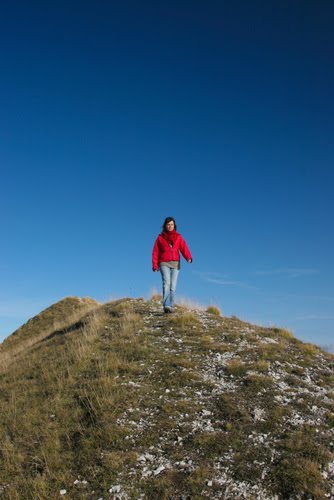


This is why we're here - in words
So what does one do on a Sunday out here in the rolling hills of central Italy? If your son plays football - as in our case - you go and watch him. It's a pastime I get tremendous enjoyment from, even if the season lasts from September to May. But when a gap opens in the schedule - as it did this past weekend - we snatch at it and use the time to pursue one of our other passions: the mountains.
Now when I say "snatch", I guess I should qualify - given the six-day school week with 6:15am risings and Sundays with their early football wakeup calls, any day off that offers a bit of a sleep-in to a family that loves its shut-eye and doesn't aspire to "bright and cheery" labels (at least the pre-9 am ones) is "snatched at" with equal enthusiasm to the pull of the mountains. So we compromise ... and take advantage of the very reason we moved here - we sleep in, have an early(-ish) lunch, and take off for an afternoon hike.
This past weekend I chose Monte Rotondo, a 2,102-metre mountain we frequently see, but have never scaled (OK, walked up). This involves a drive up a rocky road of about 6km with some very steep slopes on its up- and down-sides, and that is likely soon to close for the winter. At the end of it - which is joined by another dirt road coming from the other side of the saddle - is a concrete monstrosity of a refugio, which serves meals to rocky road adventurers and offers beds to hikers in the summer (albeit only on the weekend except for August). It's also the trailhead for numerous great hikes up to the airy Sibillini ridges, including a short 40-minute climb to Monte Rotondo.
The day was crisp with a brisk breeze that blew the thick low-hanging mist over the surrounding peaks, creating constantly-changing vistas of white-out alternating with clear skies. Puffs of mist drifted through the air like sailing ships into the blue beyond, and cascaded over cliffs, magically dissolving as they fell down the sheer rock faces. On the way up we found a lone purple wildflower and the decomposing remains of two sheep - "I'm thinking wolf," reflected HRH, engaging his wild side. We also came across a plaque remembering two young Italians who lost their lives here in the winter of 2004, a day apart.
The views from the top were stupendous. Apart from the shifting scenes created by the armadas of mist, the central Apennine peaks stretched southward in a panorama unlike any other we've seen before on our many excursions on these ridges. To the west, the light refracted into a stark and surreal line, as if we were on the surface of the sea - below it, waves of mountains were tainted in a hazy blue, and above it the air was vividly clear. We had it all to ourselves - there wasn't another soul around.
On the way down, Maria picked some mushrooms which the owner-cooks of the refugio were surprisingly and disappointingly unable to identify, not only regarding their species, but whether or not they were edible. We reluctantly dragged ourselves away from what promised to be a sunset of banded colours and shifting red shades in order not to have to drive down the rocky road in the dark. On the way we filled our water bottles and slaked the bitterly cold mountain water rolling down from the peaks, and stopped to look over the sheer drop where a cyclist fell to his death on an April day two years ago when we started up the road on our own bicycles and turned back because of the deep snow.
Back home a hot soup warmed our satisfied souls as we reflected on our good fortune - a day like this one is always there for us, just an hour away whenever we might make a snap decision to head up there. And as we find every time we go up there, it's always different, there's always a surprise waiting to be uncovered for those who choose to look for it. Thankfully all three of us have the eyes to find the surprises, and to drink in the liberating sensations of this alpine world with its cleansing air, infinite views, and the unmistakable message that it always whispers - there is nothing else but the here and now.
(If you're interested, there are photographs of our excursion here.)
Now when I say "snatch", I guess I should qualify - given the six-day school week with 6:15am risings and Sundays with their early football wakeup calls, any day off that offers a bit of a sleep-in to a family that loves its shut-eye and doesn't aspire to "bright and cheery" labels (at least the pre-9 am ones) is "snatched at" with equal enthusiasm to the pull of the mountains. So we compromise ... and take advantage of the very reason we moved here - we sleep in, have an early(-ish) lunch, and take off for an afternoon hike.
This past weekend I chose Monte Rotondo, a 2,102-metre mountain we frequently see, but have never scaled (OK, walked up). This involves a drive up a rocky road of about 6km with some very steep slopes on its up- and down-sides, and that is likely soon to close for the winter. At the end of it - which is joined by another dirt road coming from the other side of the saddle - is a concrete monstrosity of a refugio, which serves meals to rocky road adventurers and offers beds to hikers in the summer (albeit only on the weekend except for August). It's also the trailhead for numerous great hikes up to the airy Sibillini ridges, including a short 40-minute climb to Monte Rotondo.
The day was crisp with a brisk breeze that blew the thick low-hanging mist over the surrounding peaks, creating constantly-changing vistas of white-out alternating with clear skies. Puffs of mist drifted through the air like sailing ships into the blue beyond, and cascaded over cliffs, magically dissolving as they fell down the sheer rock faces. On the way up we found a lone purple wildflower and the decomposing remains of two sheep - "I'm thinking wolf," reflected HRH, engaging his wild side. We also came across a plaque remembering two young Italians who lost their lives here in the winter of 2004, a day apart.
The views from the top were stupendous. Apart from the shifting scenes created by the armadas of mist, the central Apennine peaks stretched southward in a panorama unlike any other we've seen before on our many excursions on these ridges. To the west, the light refracted into a stark and surreal line, as if we were on the surface of the sea - below it, waves of mountains were tainted in a hazy blue, and above it the air was vividly clear. We had it all to ourselves - there wasn't another soul around.
On the way down, Maria picked some mushrooms which the owner-cooks of the refugio were surprisingly and disappointingly unable to identify, not only regarding their species, but whether or not they were edible. We reluctantly dragged ourselves away from what promised to be a sunset of banded colours and shifting red shades in order not to have to drive down the rocky road in the dark. On the way we filled our water bottles and slaked the bitterly cold mountain water rolling down from the peaks, and stopped to look over the sheer drop where a cyclist fell to his death on an April day two years ago when we started up the road on our own bicycles and turned back because of the deep snow.
Back home a hot soup warmed our satisfied souls as we reflected on our good fortune - a day like this one is always there for us, just an hour away whenever we might make a snap decision to head up there. And as we find every time we go up there, it's always different, there's always a surprise waiting to be uncovered for those who choose to look for it. Thankfully all three of us have the eyes to find the surprises, and to drink in the liberating sensations of this alpine world with its cleansing air, infinite views, and the unmistakable message that it always whispers - there is nothing else but the here and now.
(If you're interested, there are photographs of our excursion here.)
Subscribe to:
Posts (Atom)