A couple of weeks before Christmas, Maria got a call from an employment agency that she’d registered with, for a German-speaking job in Civitanova Marche, a half-hour from here. After the interview, she was hired on a probationary basis, and so our lives changed.
The job entailed talking on the phone to German car sellers for an Italian who buys them and resells them to his clients here. The cars are identified on an online German website, and then drivers are sent up to bring the cars back. The proprietor is a 30-something-year-old choleric who walks about the office yelling and screaming, and has yet to direct a word Maria’s way. Apparently he’s been inside the clink.
Also in the office are an Italian (a qualified schoolteacher), and a Croatian. They are the first responders to phone calls coming in from the Italian clients. Leticia, the Italian, is friendly and an ally. Maurizia, the Croatian, is sullen and prone to outbreaks of tears and frustration, and, as it turns out, not to be trusted.
The atmosphere is barely short of a penitentiary – cameras monitor every move, phone calls are recorded, and all work on the computers is tracked. Talk about Big Brother! Here’s a man who clearly doesn’t trust himself.
When Maria returned from Germany, she discovered that she didn’t have a contract for January, and so decided to stay home until they resolved it (given that she wouldn’t be paid without a contract). The boss wanted to make it the Croatian’s decision so that she could be blamed if something went wrong either way. The Croatian didn’t want the decision because she’d be blamed if something went wrong. Wonderful situation.
It’s now been 3 days, and they haven’t even bothered to call. Chances are they’ve decided not to continue with Maria, but they simply don’t have the guts or the courtesy to pick up the phone and let her know.
Not that she’s sweating it. Having someone peer over your shoulder at your every move for €7 an hour isn’t exactly what I’d call motivating…
Friday, January 12, 2007


Daily update - parte quattro
A lot has happened – or not happened, as the case may be – in the month-plus since last posting a general update. The events relating to Mr Young have dominated, but these are documented in other postings, so I won’t spend any words on them here.
On the building side, the official absolutely last day (according to our contract) that renovations would start – December 11th – came and went neither hide nor hair of Paolo (the builder). Finally, the day before we left for Germany (December 22nd), a platform was built for the crane. When we came back two weeks later, the crane had been delivered and installed, but nothing more. Another week later, and we’re still waiting for some real activity, although there have been a few symbolic hammerings coming from down there.
The story on the Internet, telecommunications, and postal fronts are no better, but then who would have expected these services to change their attitudes in the space of two weeks. I’ve railed enough in the past about their ability to take incompetence, indifference, and laziness to a whole new, mind-boggling level. So I won’t spend too much time on it, except for one thing that I must confess I simply marvel at – the Italian’s propensity and unscrupulous tendency to simply put the phone down when things aren’t going their way. This doesn’t apply just to government agencies like the telecommItalia or posteItaliano, but to private companies as well. I am astounded by this. But I also realize that if I am to be happy living in this country, I will simply have to accept it, and live with it.
On the car front, we finally found an insurance company that gave us some credit for our period of coverage in the US – and a break on the premium – on the Honda that we bought. It’s a German-based company, perhaps not surprisingly.
Julius returned to school on Monday (8th), to a brand new building, renovated after earthquake damage in 1993. Apparently it took this long to complete because some of the relief money was only released in 2006. It’s beautiful, with high ceilings, arched windows, and a fully-functioning, commercial-level kitchen and canteen. On the Sunday before school started, the whole village turned out for speeches, food, and wine to celebrate its opening.
Monday was also Julius’ 11th birthday, an uneventful and somewhat sad one this year. Given the events of the past few weeks, the only presents we were able to muster were some brightly-coloured flowers for Julius to tend and plant in the spring in remembrance of Mr Young. It’s been a tough week for him, but our borrowing of The Two Towers (Lord of the Rings) has helped to distract him.
Today he called to be picked up early because of a headache. This was really a euphemism for claustrophobia, and a ruse to get out and about on a gorgeous, 15°C (60°F) day. Given their freewheeling approach to life, the Italian attitude to the outdoors is a little surprising – at the slightest hint of cold weather, they recoil and run scurrying for cover. And the fact that it’s January (winter) seems to taint every consideration of the weather, regardless of what’s actually happening outside. As a result, Julius was severely scolded for opening the window “to get some fresh air”.
It’s a cause for concern – boys of his age need a channel to expend energy, but the schools here don’t even let them go outside, regardless of what it’s like or how they are dressed. And they keep them there until 4:30pm, often sending them home with homework, leaving precious little time for activity when they get home. In Columbus, Ohio, as a 4 and 5-year-old, Julius went outside for several hours a day, whether rain, sleet, or snow. Not sure what we’re going to do about this one…
On the building side, the official absolutely last day (according to our contract) that renovations would start – December 11th – came and went neither hide nor hair of Paolo (the builder). Finally, the day before we left for Germany (December 22nd), a platform was built for the crane. When we came back two weeks later, the crane had been delivered and installed, but nothing more. Another week later, and we’re still waiting for some real activity, although there have been a few symbolic hammerings coming from down there.
The story on the Internet, telecommunications, and postal fronts are no better, but then who would have expected these services to change their attitudes in the space of two weeks. I’ve railed enough in the past about their ability to take incompetence, indifference, and laziness to a whole new, mind-boggling level. So I won’t spend too much time on it, except for one thing that I must confess I simply marvel at – the Italian’s propensity and unscrupulous tendency to simply put the phone down when things aren’t going their way. This doesn’t apply just to government agencies like the telecommItalia or posteItaliano, but to private companies as well. I am astounded by this. But I also realize that if I am to be happy living in this country, I will simply have to accept it, and live with it.
On the car front, we finally found an insurance company that gave us some credit for our period of coverage in the US – and a break on the premium – on the Honda that we bought. It’s a German-based company, perhaps not surprisingly.
Julius returned to school on Monday (8th), to a brand new building, renovated after earthquake damage in 1993. Apparently it took this long to complete because some of the relief money was only released in 2006. It’s beautiful, with high ceilings, arched windows, and a fully-functioning, commercial-level kitchen and canteen. On the Sunday before school started, the whole village turned out for speeches, food, and wine to celebrate its opening.
Monday was also Julius’ 11th birthday, an uneventful and somewhat sad one this year. Given the events of the past few weeks, the only presents we were able to muster were some brightly-coloured flowers for Julius to tend and plant in the spring in remembrance of Mr Young. It’s been a tough week for him, but our borrowing of The Two Towers (Lord of the Rings) has helped to distract him.
Today he called to be picked up early because of a headache. This was really a euphemism for claustrophobia, and a ruse to get out and about on a gorgeous, 15°C (60°F) day. Given their freewheeling approach to life, the Italian attitude to the outdoors is a little surprising – at the slightest hint of cold weather, they recoil and run scurrying for cover. And the fact that it’s January (winter) seems to taint every consideration of the weather, regardless of what’s actually happening outside. As a result, Julius was severely scolded for opening the window “to get some fresh air”.
It’s a cause for concern – boys of his age need a channel to expend energy, but the schools here don’t even let them go outside, regardless of what it’s like or how they are dressed. And they keep them there until 4:30pm, often sending them home with homework, leaving precious little time for activity when they get home. In Columbus, Ohio, as a 4 and 5-year-old, Julius went outside for several hours a day, whether rain, sleet, or snow. Not sure what we’re going to do about this one…
Christmas in Germany
Aside from the cheap airfares, another advantage of living in Europe is that you can get in your car in the morning and be in another country in the afternoon. Of course, being in relative proximity to Maria’s parents, Christmas in Germany was a given.
It took 10 hours to get there, driving through northern Italy, western Austria, and Bavaria in southern Germany, a relatively pain-free passage. Traffic going the other way was stopped dead, in some places, for 10km, without any apparent reason. Driving on European expressways is a pleasure, too, since, unlike the US, people know what lanes are for, and “the fast lane” has true meaning.
The two-week visit was tainted by Mr Young’s death within an hour of arriving, but in some ways it was the best place it could have happened, with loving and caring family and friends around to provide solace to Julius and Maria.
The Advent calendar is very big in Germany, and many towns – Forcheim near Maria’s parents being a great example – have larger-than-life calendars in the central plaza, accompanied by the ubiquitous Christkindlmarkt. Niklaus (Santa Claus) himself comes on December 6th, and the tree is decorated and gifts are exchanged on the 24th. We enjoyed venison and goose with Maria’s sister on the 24th, attended a (long and laborious) Christmas service at 10pm, and the next day stuffed ourselves again with duck at Maria’s parents.
New Year’s eve was spent with friends of Maria, culminating in fireworks all over the village at midnight. Fireworks are freely available to the public, and Germans spend some €60M on the stuff at New Year. Amazingly, there are very few incidents of injury. Imagine the same in the US – it would be pandemonium, if not life-threatening, providing ample reason enough to stay at home on New Year’s eve.
Aside from the obvious value time with family, we enjoyed good beer, schnapps, and food, with fish – carp (a local specialty), mackerel, and “waller” – on a few occasions providing welcome relief from the ever-present carnivorous diet. Also played some great tennis (for the first time in years) with some 40- and 50-something-year-olds. Strolls in the woods and exploring on bicycles with Julius were amazingly (in comparison with rural Italy) free of barking and attacking dogs – on one occasion as we approached a particularly large yet obedient and unexcited German shepherd, I said to Julius: “If we were in Italy, I’d turn around and flee.”
Julius didn’t want to leave, wanting to make sure that the candle on Mr Young’s grave was kept alight, and the fact that it would just “be easier” to stay in Germany. Maria’s parents were of the same opinion, and I heard from her mother about the folly of our Italian escapade on a few occasions.
Parting is always hard, and it was no easier on this occasion – I have this picture in my mind of Maria’s aging and frail parents standing tearfully and forlornly in their doorway as we drove away. The 1,057km drive took 11 hours coming back, with one long 25km stop-start stretch around Munich costing us the extra hour. Getting back to the house without Mr Young was, of course, wrenching, and it felt totally empty.
But being back in Italy helped also to highlight the stark differences between these two countries separated by a mountain range and a cultural chasm. Here are just a few:
- In Italy, strangers – men or women – greet you with kisses, while Germans stand their distance and extend only their hands.
- After clean streets for two weeks I’m now back to dodging excretory mines on the sidewalk.
- After the cold, grey, German weather, the sunny skies and blustery winds are welcome indeed, even if there’s no snow to please Julius.
Walking through the streets in Germany I was struck by how, well, Germanic everyone looks – square jaws, thin lips, deep-set eyes, strong bones. Duh? I guess somehow I don't subscribe to generalizations. In this sense, though, the Germans seem to conform to their caricature.
However, in another sense – efficiency, reliability – they did not, although I’m not sure if it was the Internet curse I brought with me that was the cause. The network of the only wireless hotspot I found was not working on the day I dedicated to catching up …
Trip to England
One of the advantages of living in Europe is the cheap air fares that facil itate shuttles between countless countries and cultures. At the end of November, we took advantage of one, from Ancona (our closest airport, an hour or so away) to Liverpool. €1 per person each way, plus tax, making it a total of €118 for all 3 of us. (That, however, is where the economic side of things ends – England, with its super-strong pound, is very expensive in euros, never mind dollars!)
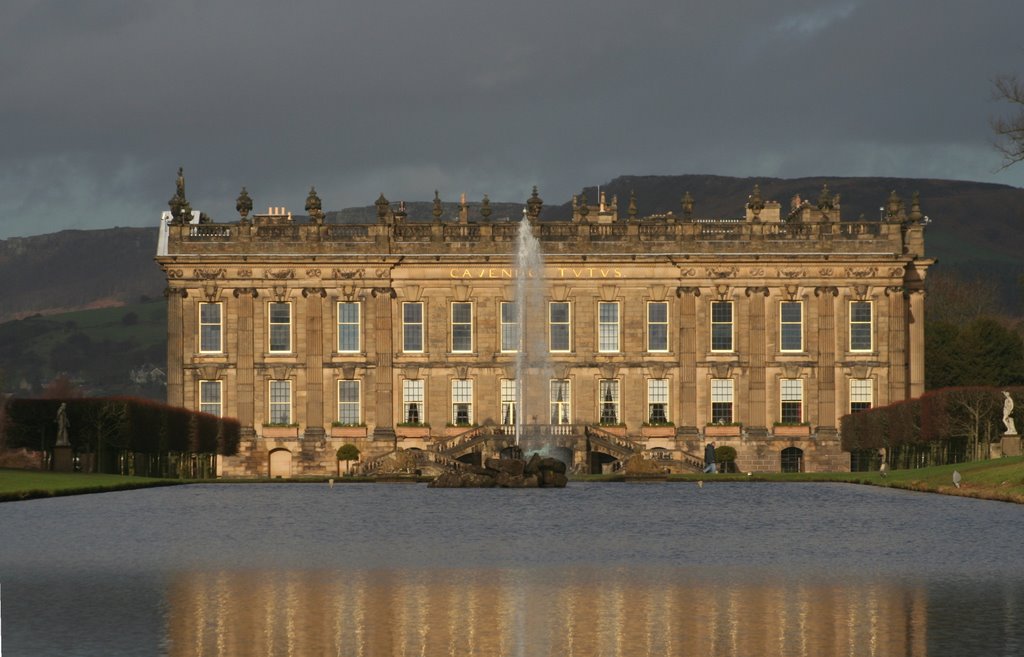
 We flew in and out of Liverpool, and were treated to the warm and welcoming hospitality of our friends and landlords, Al and Vron, in West Yorkshire in the High Peaks area. Aside from being just a bloody good time being together, we got to see York and its Minster, Whitby with its moody abbey ruins on the blustery coast, and the stately Chatsworth, home of the Duke of Northumberland. Had fish ‘n chips in Whitby, Yorkshire pudding at home (along with several other superb meals), drank some good bitter in a few warm pubs, and watched the SA vs World XV rugby game live on TV (going to the game was the original impetus for the trip, but it just didn’t work out).
Leaving Liverpool airport introduced us to the new UK, uncompromisingly and unflinchingly unmovable on the “no liquids” rule. We tried to travel light and not check baggage, taking everything on board the plane. Big mistake.

Granted, I can see how my Gillette Sensor razor blades could slice off the plane’s wing in mid-flight, so I gave them up willingly. But marmalade and a tape measure? Into the bin they went, along with the peanut butters, lip glosses, and other weapons of the terrorist’s arsenal. The shaved-headed twenty-somethings that conducted the pillage even took one tiny bottle away (a very expensive essential oil) because “I don’t know what it is, luv.”
Perhaps it’s our own fault in the end – we should have known – but we really didn’t think that the English could match, let alone surpass, the security zealots in the US. But then again, who’s to say that the marmalade made by the Housewives League of Holmfirth isn’t packed choc-a-bloc with explosive ingredients, or that they are secretly funding Al Qaeda operations? The England of olde – friendly bobbies without weapons – is clearly a thing of the past. Apparently, there is more surveillance in the UK than anywhere else in the world. Perhaps this is all necessary. I don’t know. All I know is that it’s a shame.
The eventful nature of our return didn’t stop there. Ancona was fogged in, so we were diverted to Pescara in Abruzzo. Thankfully buses were laid on by Ryanair, and we were on the road in short order, finally getting home around midnight instead of 9:30pm.
We were then greeted with another stark reality – Mr Young was nowhere to be found. We had left him with enough food and water for the 5 days, and left the upstairs bedroom window open so he could at least get outside on to the roof of the patio. But it was too long for him – he had fled. We searched all around, calling and pleading, but no response. So we went to bed, anxious and concerned.

Maria found him the next day, perched high in a neighbour’s tree. He probably got down from the roof after a few days, and then, when he found he couldn’t get back into the house, sought out the safest place to him in a hostile environment of roving dogs and wild cats. For a highly-strung creature like a cat, it must have been terrifying. Apparently severe stress like this can cause a thrombosis, and this could well have been the cause of his mysterious affliction a week later, and ultimately, his death on December 23rd.
Now that he’s gone, I’m constantly brought back to this incident. What were we thinking, for 5 days leaving a totally dependent creature that identifies so strongly with its family that it relies on them for not only food, but also for comfort, security, and general wellbeing? And what goes through an animal’s mind at times like this? Was he going to look for us? Did he think we had abandoned him?
There are no answers, only haunting questions …
 itate shuttles between countless countries and cultures. At the end of November, we took advantage of one, from Ancona (our closest airport, an hour or so away) to Liverpool. €1 per person each way, plus tax, making it a total of €118 for all 3 of us. (That, however, is where the economic side of things ends – England, with its super-strong pound, is very expensive in euros, never mind dollars!)
 We flew in and out of Liverpool, and were treated to the warm and welcoming hospitality of our friends and landlords, Al and Vron, in West Yorkshire in the High Peaks area. Aside from being just a bloody good time being together, we got to see York and its Minster, Whitby with its moody abbey ruins on the blustery coast, and the stately Chatsworth, home of the Duke of Northumberland. Had fish ‘n chips in Whitby, Yorkshire pudding at home (along with several other superb meals), drank some good bitter in a few warm pubs, and watched the SA vs World XV rugby game live on TV (going to the game was the original impetus for the trip, but it just didn’t work out).
Leaving Liverpool airport introduced us to the new UK, uncompromisingly and unflinchingly unmovable on the “no liquids” rule. We tried to travel light and not check baggage, taking everything on board the plane. Big mistake.

Granted, I can see how my Gillette Sensor razor blades could slice off the plane’s wing in mid-flight, so I gave them up willingly. But marmalade and a tape measure? Into the bin they went, along with the peanut butters, lip glosses, and other weapons of the terrorist’s arsenal. The shaved-headed twenty-somethings that conducted the pillage even took one tiny bottle away (a very expensive essential oil) because “I don’t know what it is, luv.”
Perhaps it’s our own fault in the end – we should have known – but we really didn’t think that the English could match, let alone surpass, the security zealots in the US. But then again, who’s to say that the marmalade made by the Housewives League of Holmfirth isn’t packed choc-a-bloc with
 explosive ingredients, or that they are secretly funding Al Qaeda operations? The England of olde – friendly bobbies without weapons – is clearly a thing of the past. Apparently, there is more surveillance in the UK than anywhere else in the world. Perhaps this is all necessary. I don’t know. All I know is that it’s a shame.
The eventful nature of our return didn’t stop there. Ancona was fogged in, so we were diverted to Pescara in Abruzzo. Thankfully buses were laid on by Ryanair, and we were on the road in short order, finally getting home around midnight instead of 9:30pm.
We were then greeted with another stark reality – Mr Young was nowhere to be found. We had left him with enough food and water for the 5 days, and left the upstairs bedroom window open so he could at least get outside on to the roof of the patio. But it was too long for him – he had fled. We searched all around, calling and pleading, but no response. So we went to bed, anxious and concerned.

Maria found him the next day, perched high in a neighbour’s tree. He probably got down from the roof after a few days, and then, when he found he couldn’t get back into the house, sought out the safest place to him in a hostile environment of roving dogs and wild cats. For a highly-strung creature like a cat, it must have been terrifying. Apparently severe stress like this can cause a thrombosis, and this could well have been the cause of his mysterious affliction a week later, and ultimately, his death on December 23rd.
Now that he’s gone, I’m constantly brought back to this incident. What were we thinking, for 5 days leaving a totally dependent creature that identifies so strongly with its family that it relies on them for not only food, but also for comfort, security, and general wellbeing? And what goes through an animal’s mind at times like this? Was he going to look for us? Did he think we had abandoned him?
There are no answers, only haunting questions …
Our beloved Mr Young
 There’s a spirit burning brightly in the winter air beneath Julius’ tree in his grandparents’ garden in Röttenbach, Bavaria. Our beloved Mr Young lies there, a premature victim of the stress that our roving lives created for him. Julius has lost his brother and best friend, and we a loving member of our family.
The days are different now, there’s something missing, and that empty part in each of us still cracks wide open as we struggle to adjust to life without our loyal and trusting companion. At least once a day I still hear his bell, and just half-an-hour ago I heard his “hello” chirrup from some shadowy corner of the house. And as with each and every instance of these audible reminders, I turn in hope, only to realize that it’s my heart making echoes of our wishes.
As time goes on, all this will happen less frequently I suppose, until we remember and talk of him – both happily and sadly – with steadier voices and drier eyes.
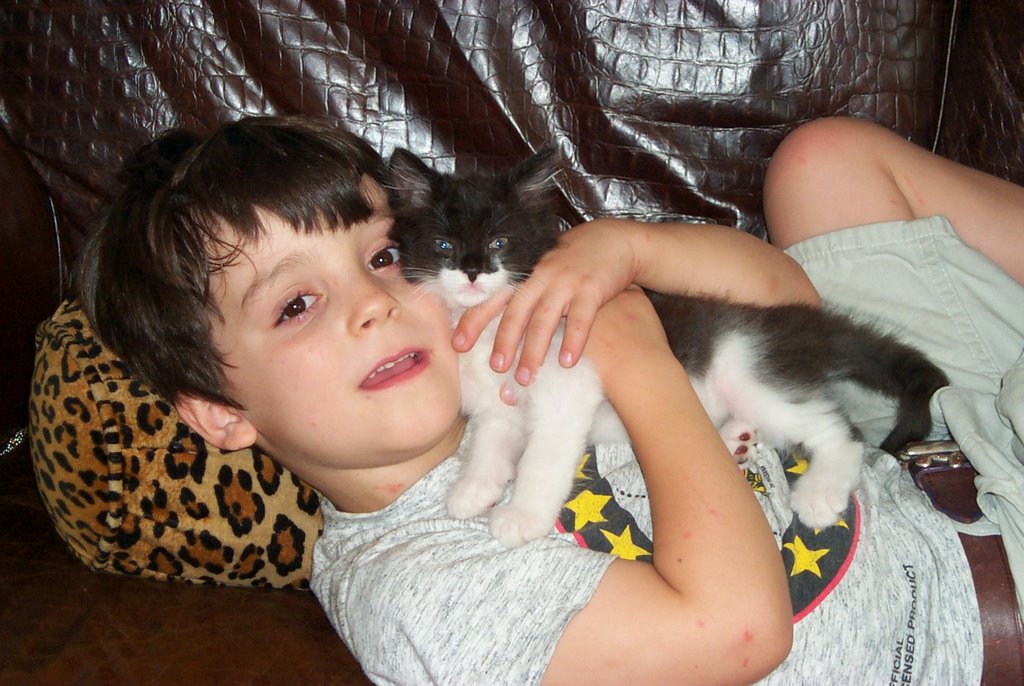
In the end, I think all of our roving was just too much for him. The move from the US first to Germany, and Maria’s parents’ yappy poodle … then to the Italian countryside with its overpopulation of wild cats and world of strange and ominous things … then to our rental house with the 4 dogs across the street … our 5-day absence in the UK in early December … the mystery blight that leveled him and hospitalized him for 2 days … and the 10-hour car trip to Germany.

He knew that something was afoot, with all the packing of suitcases and trips to the car. He knew that we were going away again. And whether he was coming with us or staying on his own, somehow he knew it would be too much for him, still recovering from his undiagnosed brush with death. After retur
 ning from the vet hospital, every time we went out, he sat at the front door, waiting for us to return.
 In his own way he tried to tell us, huddling silently and sadly under the trampoline as we searched for him, our last precious piece of cargo before hitting the road. We didn’t recognize his signal – or
 subliminally chose not to – and he died less than an hour after arriving in Germany. We simply shouldn’t have left. We shouldn’t have left.
In the end, I am left with a picture of him sitting, like a compact ball of woolly silk, in quiet submission to the will of his family, resigned to his fate. He trusted us. We let him down.
We’re so sorry, Mr Young, we’re so sorry.


Friday, December 15, 2006
Fiastra
Beato Ugolini was, in one respect, like any other man – he got jilted. Perhaps the reason behind it was a tad unusual – the target of his affection took her religious vows – but his subsequent withdrawal to ponder his lot was not. In fact, it was a pretty natural thing for a man, devastated by the blight of unrequited love, to go and hide in his cave for a period of reflection. What did constitute a departure from the norm, however, was that, first, he literally went into a cave, and secondly, he stayed there for a little while longer than most would – for 30 years, in fact. Until he died. This clearly was one jilted fellow.
 Granted, his cave was in a pretty amazing location – on a remote hillside on the banks of the Fiume Fiastrone in Le Marche. But 30 years of penance for his amorous failure? Apparently, he wasn’t the first to wallow in his rejection to such an extent, and indeed followed the example of St Francis, who also sold all his property and withdrew to meditate on his lot.
Ugolini was a religious man, as his name implies (Beato = Blessed), and today there’s a little chapel near the site of his rather lengthy rumination. There’s a trail that leads there too, through stands of coniferous trees, and magnificent views of Lake Fiastra. Of course, being man-made, the lake wasn’t there when Ugolini undertook his meditative marathon back in the 1300’s, but I’m sure the view was no less impressive.

The creation of Lake Fiastra in 1950 as a hydroelectric project changed the whole area, as one might imagine. Quite dramatically, in fact. What was a collection of sleepy villages with an interesting history that predates the Romans, is now a tourist haven, particularly in the summer when windsurfers, fishermen, boaters, sunbathers, and promenade-walkers crowd its shores.
Our first visit to the lake’s tourist center, San Lorenzo al Lago, was well after the end of the “official” season in October. It was still busy, and when we went into a restaurant for a late lunch, a group of 30-odd leather-clad bikers was just leaving, having driven all the way from Rome to celebrate a birthday. We enjoyed a delicious meal there, which included cinghiale (wild boar), Julius’ favourite (thanks to Asterix & Obelisk).

Our visit to San Lorenzo followed a rewarding hike down into the depths of Gola de Fiastra, the gorge created by damming the river. The trail winds through what seems to be old-growth forest, teeming with all sorts of plant life, and criss-crosses the crisp waters of the Fiastrone river through its narrow canyon.
Apparently (according to a local friend) water is periodically released from the dam, flooding the gorge. This naturally conjures images of the standard Italian modus operandus of notifying people after they’ve done the deed, and it added a certain … edge, should we say, to the outing. Looking at the plant life down there, however, it didn’t look like there’d been a release for quite some time.
In addition to the chapel dedicated to Ugolini, the area has a number of sanctuaries, as well as few “rustic” hermitages, where religious recluses lived in caves. There are many in Marche, apparently a sort of clandestine infiltration tactic on the part of the various religious orders as a result of the marchigiani’s resistance to organized Christianity. Witchcraft, or stregheria, was once “the way” in these parts, as it was in the ancient Etruscan realms, and elements of it still survive, both separate from and integrated with established Catholic rites.
Beyond its religious history, archeological findings indicate that there have been settlements in the Fiastra area since around 2000 BC. The Romans also used it as a stopover on the way to the colonial capital of Urbs Salvia. Prior to being absorbed into the papal state in 1545, Fiastra fell under the respective domains of the Magalotti family (until 1259), and the Varano family – several castles serve as testament to this period of its history, the most notable (the 9th-Century Castello dei Magalotti) providing a sweeping vista over the lake and its surrounds. During its medieval and subsequent years, the area became known for its wool, flax, and hemp.

The construction of the dam in 1950 submerged many of the villages and hamlets that comprised the community. While the physical changes wrought by the flooding of the valley have been significant, it’s the drowning of the historical culture encapsulated in these Fiastrone communities that perhaps represents the greater change. Some of it survives – in its sanctuaries, its frescoes, its castles, and its ruins – but today “Fiastra” is more likely to conjure responses related to fishing, swimming, and sunning.
So be it. Life moves on. It was probably just as great a change when the Magalotti family started exerting its influence in the area some thousand years ago. But as we ramble along the valley … walk the trails on the valley walls … and visit the deserted hamlets and castles that remain … perhaps we should open our spirits to the voices that still speak of ancient tribal customs, colonial Rome, and medieval industry. It is, after all, what’s buried in the hills and under the lake’s waves … forever.
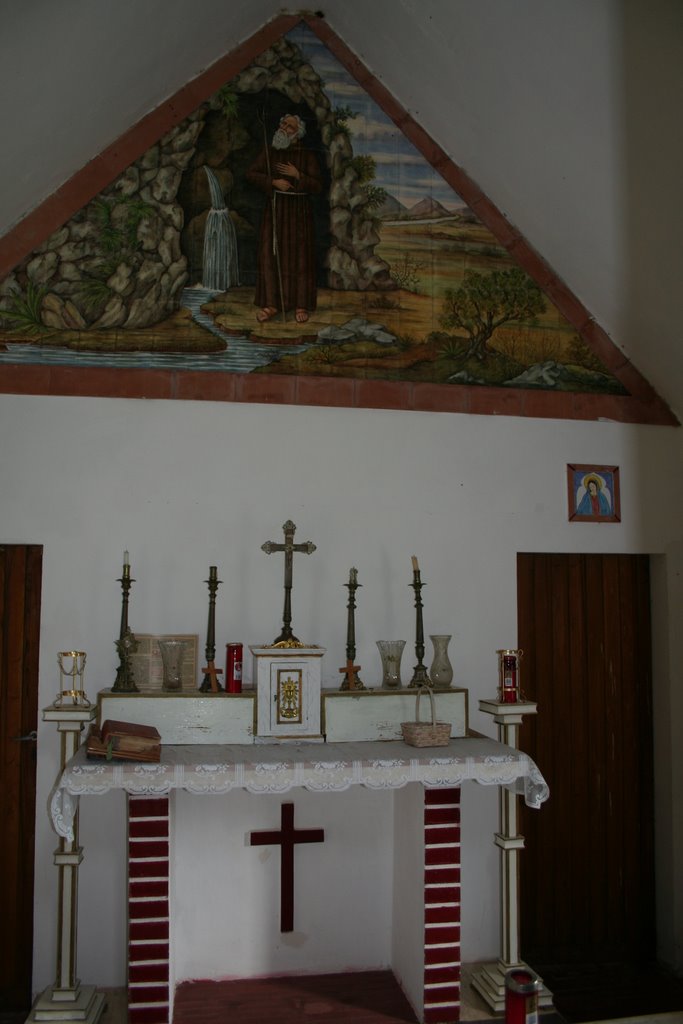
 Granted, his cave was in a pretty amazing location – on a remote hillside on the banks of the Fiume Fiastrone in Le Marche. But 30 years of penance for his amorous failure? Apparently, he wasn’t the first to wallow in his rejection to such an extent, and indeed followed the example of St Francis, who also sold all his property and withdrew to meditate on his lot.
Ugolini was a religious man, as his name implies (Beato = Blessed), and today there’s a little chapel near the site of his rather lengthy rumination. There’s a trail that leads there too, through stands of coniferous trees, and magnificent views of Lake Fiastra. Of course, being man-made, the lake wasn’t there when Ugolini undertook his meditative marathon back in the 1300’s, but I’m sure the view was no less impressive.
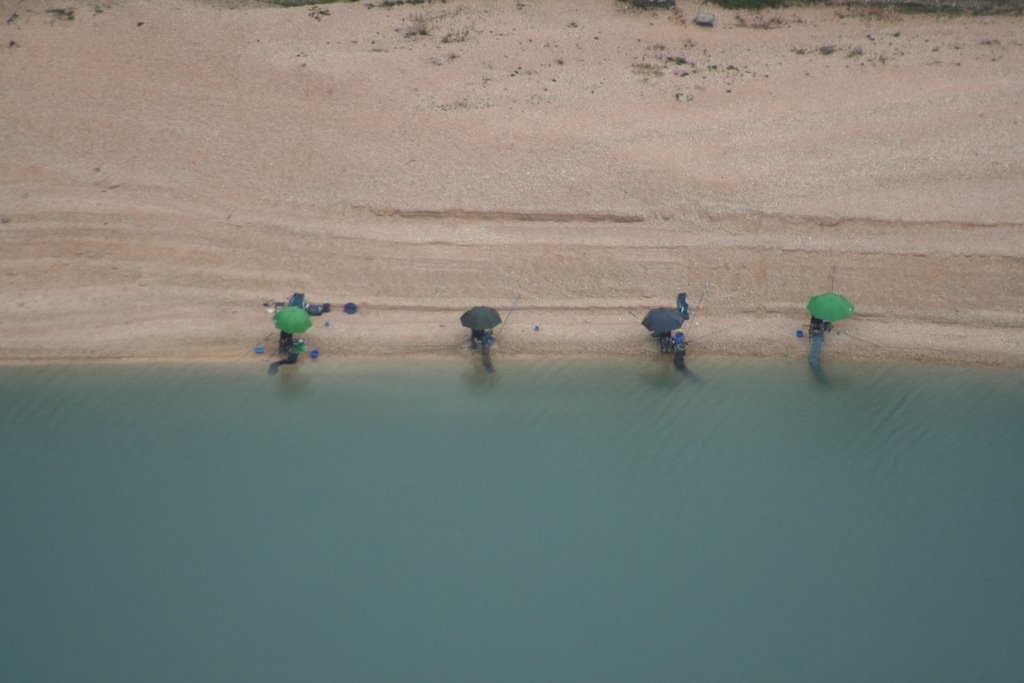
The creation of Lake Fiastra in 1950 as a hydroelectric project changed the whole area, as one might imagine. Quite dramatically, in fact. What was a collection of sleepy villages with an interesting history that predates the Romans, is now a tourist haven, particularly in the summer when windsurfers, fishermen, boaters, sunbathers, and promenade-walkers crowd its shores.
Our first visit to the lake’s tourist center, San Lorenzo al Lago, was well after the end of the “official” season in October. It was still busy, and when we went into a restaurant for a late lunch, a group of 30-odd leather-clad bikers was just leaving, having driven all the way from Rome to celebrate a birthday. We enjoyed a delicious meal there, which included cinghiale (wild boar), Julius’ favourite (thanks to Asterix & Obelisk).
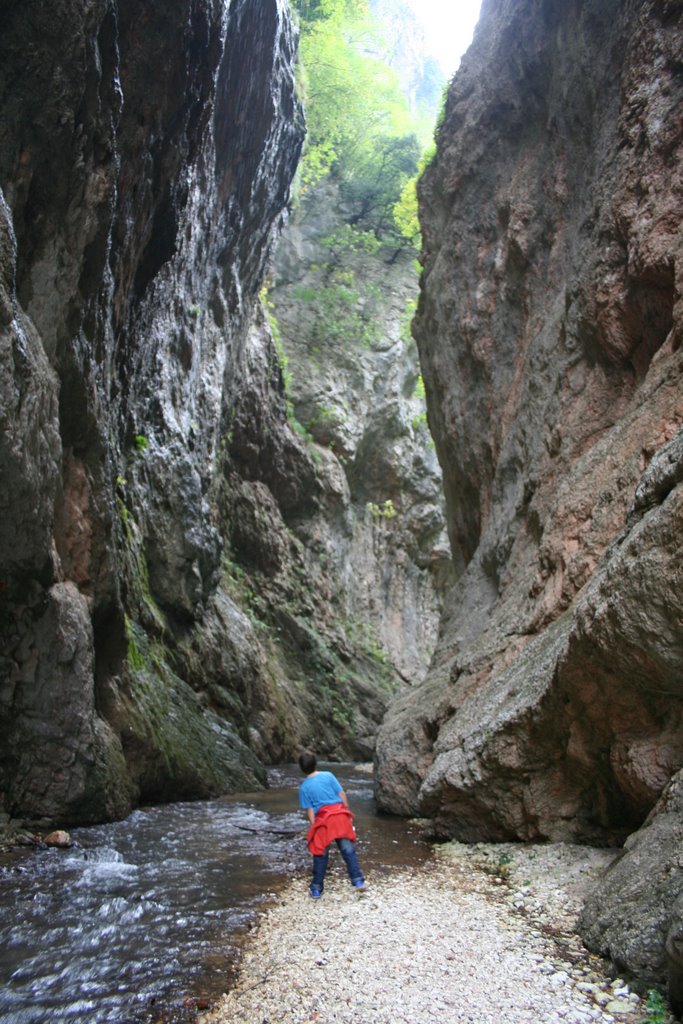
Our visit to San Lorenzo followed a rewarding hike down into the depths of Gola de Fiastra, the gorge created by damming the river. The trail winds through what seems to be old-growth forest, teeming with all sorts of plant life, and criss-crosses the crisp waters of the Fiastrone river through its narrow canyon.
Apparently (according to a local friend) water is periodically released from the dam, flooding the gorge. This naturally conjures images of the standard Italian modus operandus of notifying people after they’ve done the deed, and it added a certain … edge, should we say, to the outing. Looking at the plant life down there, however, it didn’t look like there’d been a release for quite some time.
In addition to the chapel dedicated to Ugolini, the area has a number of sanctuaries, as well as few “rustic” hermitages, where religious recluses lived in caves. There are many in Marche, apparently a sort of clandestine infiltration tactic on the part of the various religious orders as a result of the marchigiani’s resistance to organized Christianity. Witchcraft, or stregheria, was once “the way” in these parts, as it was in the ancient Etruscan realms, and elements of it still survive, both separate from and integrated with established Catholic rites.
Beyond its religious history, archeological findings indicate that there have been settlements in the Fiastra area since around 2000 BC. The Romans also used it as a stopover on the way to the colonial capital of Urbs Salvia. Prior to being absorbed into the papal state in 1545, Fiastra fell under the respective domains of the Magalotti family (until 1259), and the Varano family – several castles serve as testament to this period of its history, the most notable (the 9th-Century Castello dei Magalotti) providing a sweeping vista over the lake and its surrounds. During its medieval and subsequent years, the area became known for its wool, flax, and hemp.

The construction of the dam in 1950 submerged many of the villages and hamlets that comprised the community. While the physical changes wrought by the flooding of the valley have been significant, it’s the drowning of the historical culture encapsulated in these Fiastrone communities that perhaps represents the greater change. Some of it survives – in its sanctuaries, its frescoes, its castles, and its ruins – but today “Fiastra” is more likely to conjure responses related to fishing, swimming, and sunning.
So be it. Life moves on. It was probably just as great a change when the Magalotti family started exerting its influence in the area some thousand years ago. But as we ramble along the valley …
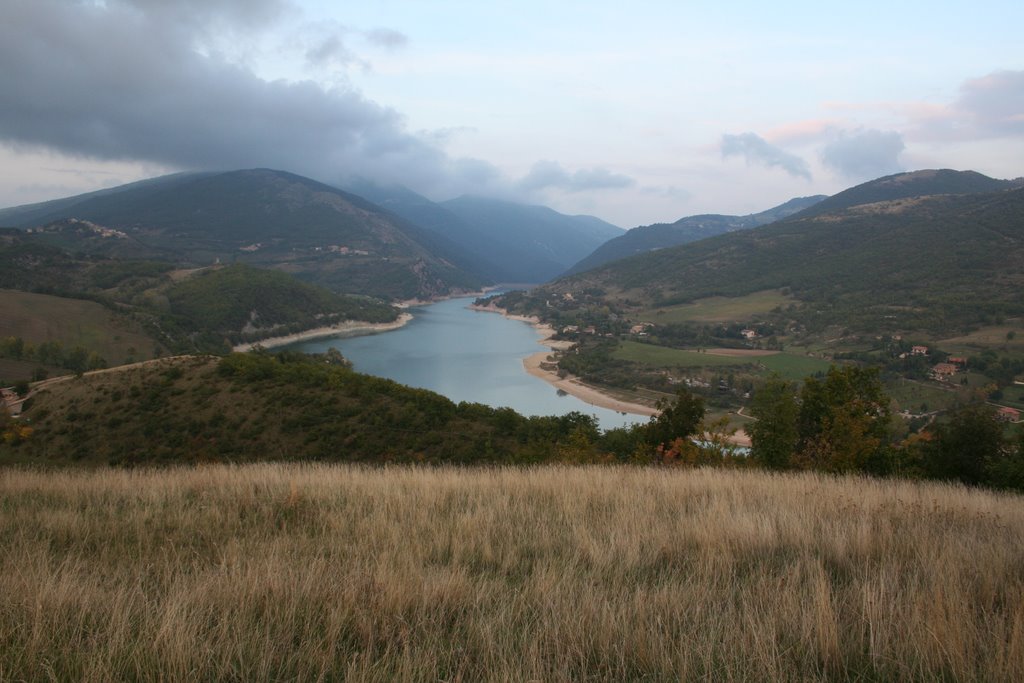 walk the trails on the valley walls … and visit the deserted hamlets and castles that remain … perhaps we should open our spirits to the voices that still speak of ancient tribal customs, colonial Rome, and medieval industry. It is, after all, what’s buried in the hills and under the lake’s waves … forever.
Tuesday, December 12, 2006
A few casual pictures
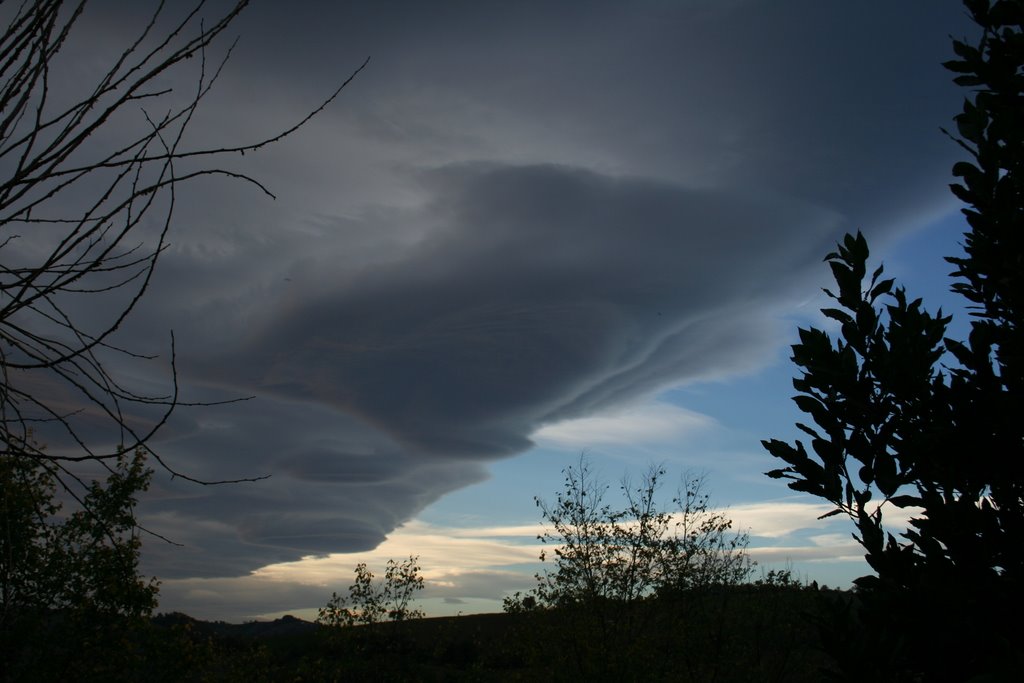
Brooding sky
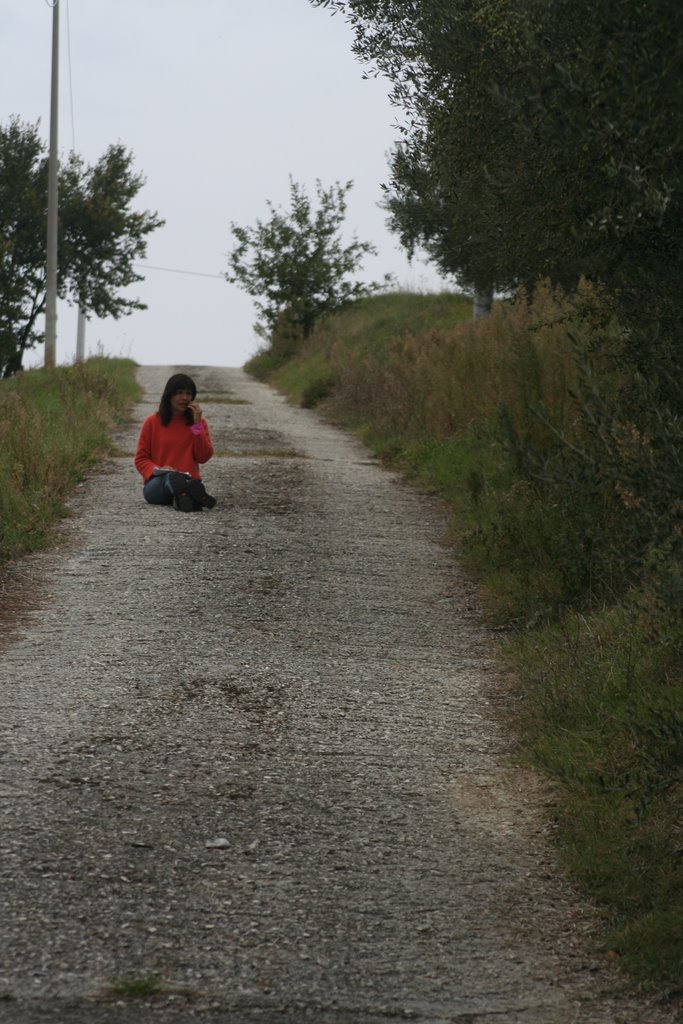
Looking for cell phone reception
Tourist in Jesi - by Julius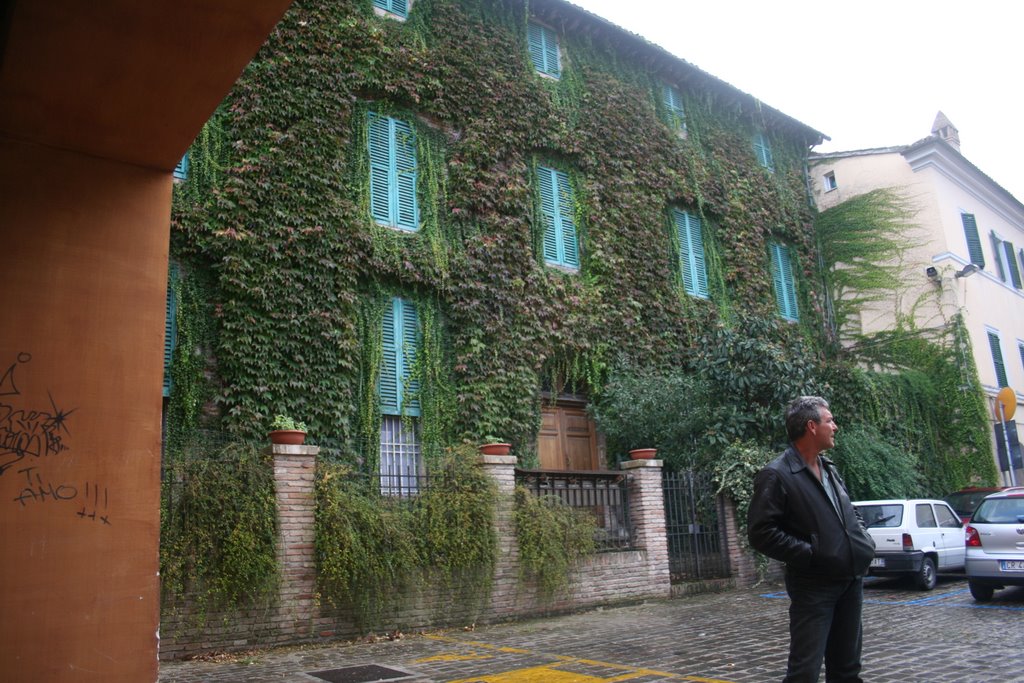
Indoor wildlife%20wildlife%20portrait.jpg)
Morning glory
Morning ritual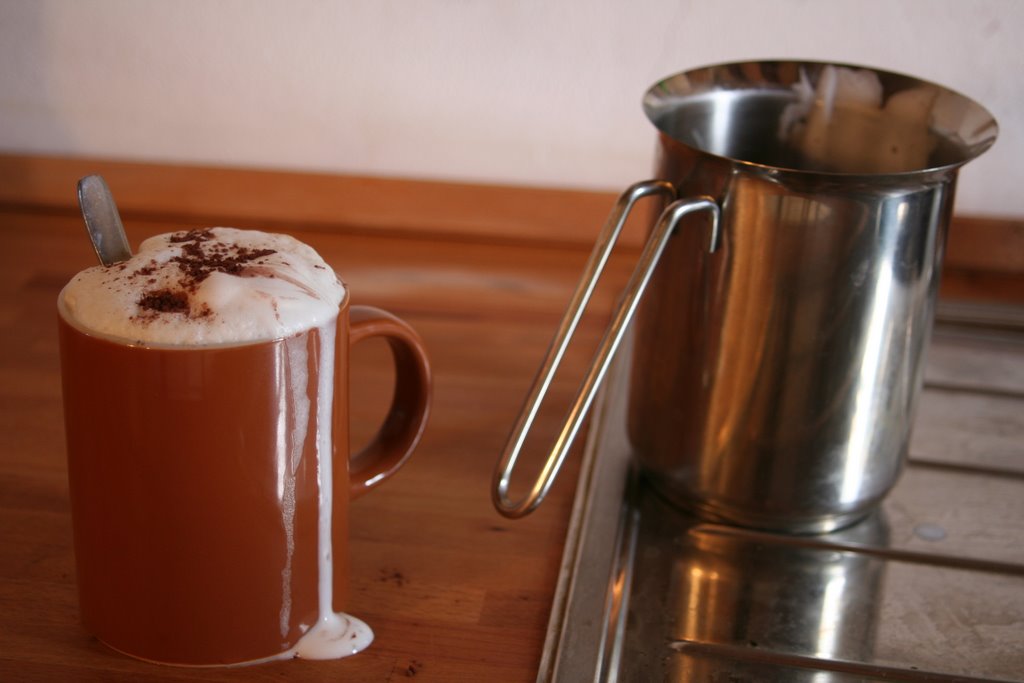
Writer and helper - by Maria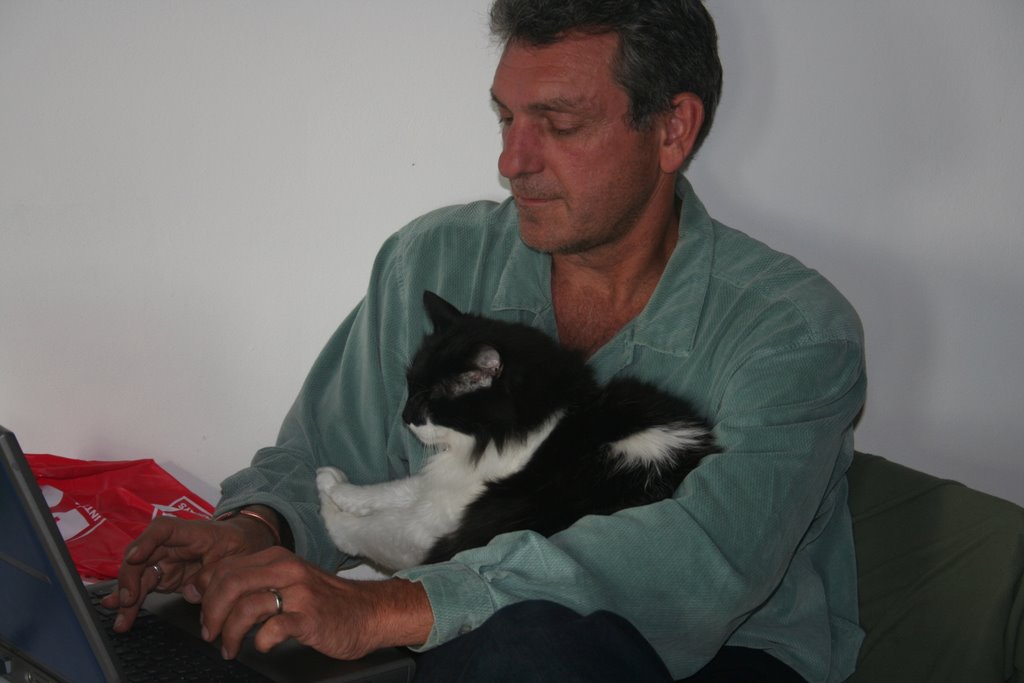
Jesi
Artful sky

Wednesday, November 29, 2006
Tree-climbing
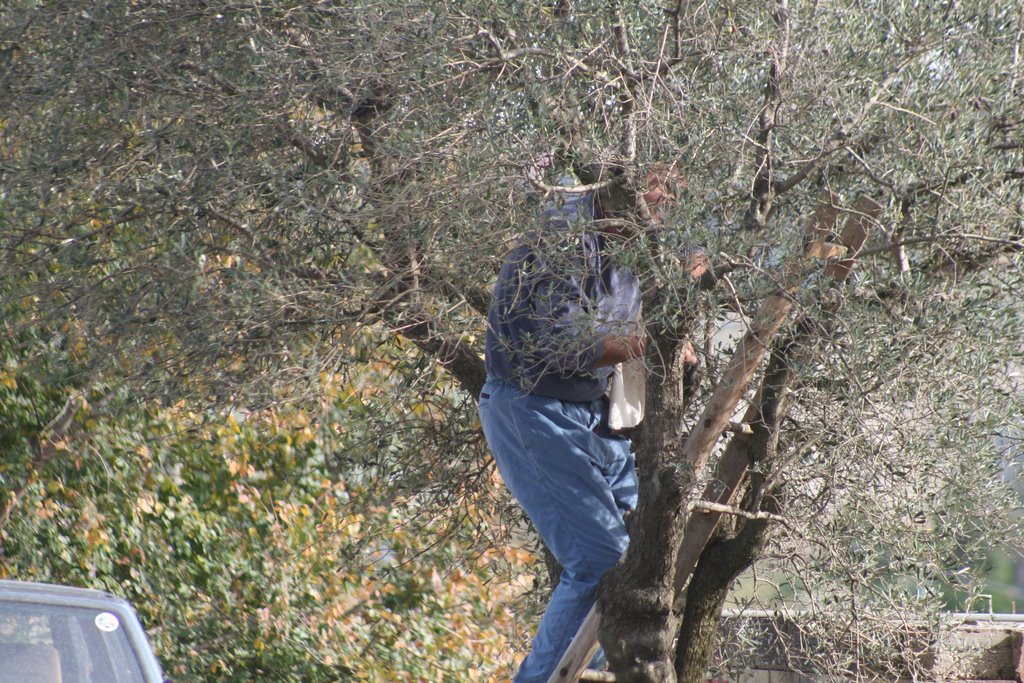 I’ve been climbing trees lately … with our 70-year-old neighbour, Maria. She’s pretty deft at it, and fearless too, peering and reaching over the topmost branches.
But let me explain – while this was at least part-recreation for me, and conjured up memories of my clamberings in the avocado tree in our back garden in Durban, it was pure business for Maria. Not that she sees it as business, though, it’s actually simpler than that – it’s her life.
That’s of course not to say that she’s a professional tree-climber – although I’m sure she would be a contender in the senior categories, along with innumerable other head-scarved marchigiani – but it’s just that those olives need picking.
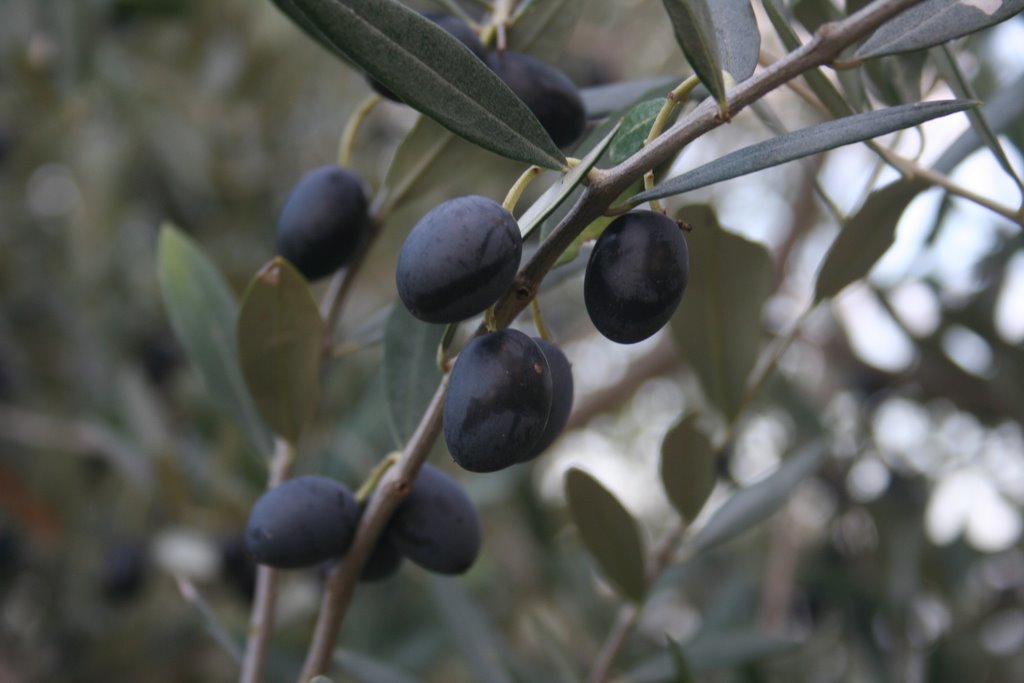
Our mutual picking sessions were the result of an offer we made to help her family at olive-picking time, in return for her son, Giuliano’s, help in tractoring our household belongings down the steep hill – our driveway – that the moving truck couldn’t negotiate. I won’t deny that there was some selfishness in my offer – the opportunity to get to know our farmer neighbours, and participate in one of the most timeless traditions of the Mediterranean countries.
The family’s picking team consists of Maria, a diminutive, energetic, cherub-faced, salt-of-the-earth marchiagiani; Umberto, her equally diminutive 70-something husband with his glass eye (not sure about this, but it does “glaze” over quite a bit) and inane smile (pure deception); and her two sons, Giuliano and Giuseppe.

I ended up helping for 3 full days, and another two half-days; Maria helped for a day-and-a-half, and Julius, one Sunday afternoon. We probably covered 100 trees in the time I helped – they had maybe 150-175 to pick all told.
Let me make one thing clear – I/we have no prior history in olive picking. Consequently, everything we did was a new experience for us (as in “wow, isn’t this cool?”). And so, in spite of the confidence and apparent knowledge with which our experience is related, remind yourself that it’s the voice of a pure novice (a babe in the olive woods, so to speak) …
Now olive picking, in its purest form, is a hand job. That’s right, manual. The day before the older Maria came and summonsed me to the field, Julius and I had stripped the couple of trees on the property of our rental home. Pick, put in bag, pick, put in bag, pick, put in … you get the picture. Took all @#$@#%$ day, it did – two trees.
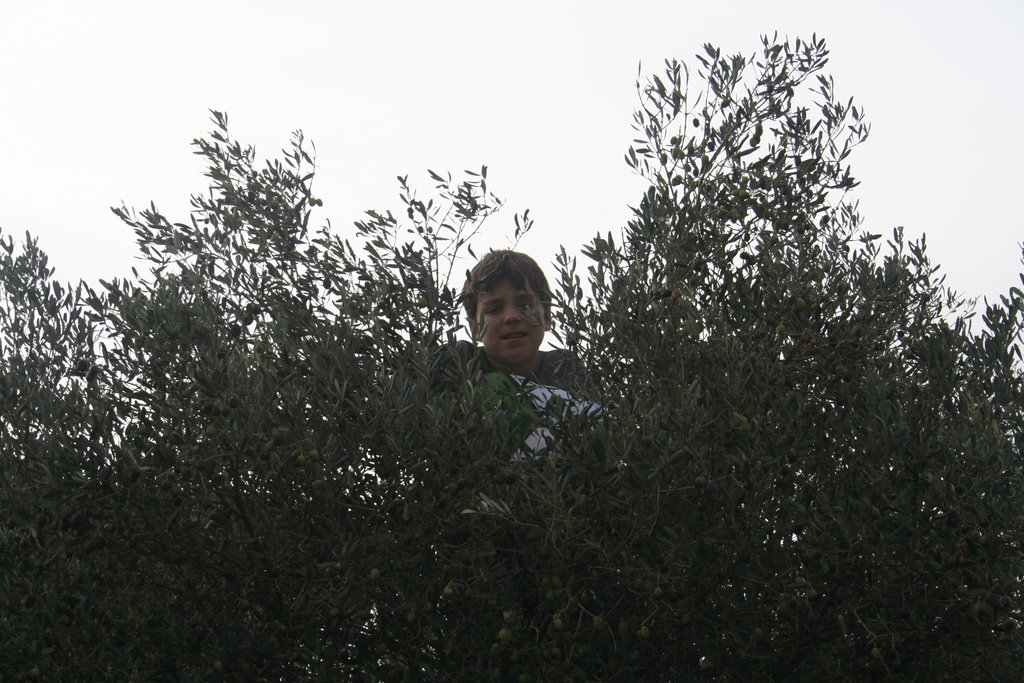 So I was glad to see netting spread below the trees to catch the olives, and olive rakes to expedite the stripping. The rakes are more like big combs, which you pull along the length of a branch, separating the olive from its perch, and sending it plummeting … yes, into the spread-out net below. On picking day #2, Giuliano arrived with a machine, powered by an air compressor attached to the tractor, that is a bigger, mechanical version of the olive rake, snapping open and closed on the end of a long pole, just like Pacman’s open-and-close munching action. This machine made a huge difference in productivity, and, I suspect, has revolutionized the olive-picking industry.
The goal – almost always accomplished – is to get every olive on the tree, whether black, red, multi-coloured, green, or shriveled. The machine can’t get all of them, particularly those on the “inside” of the tree, so we take to the ladders and climb.
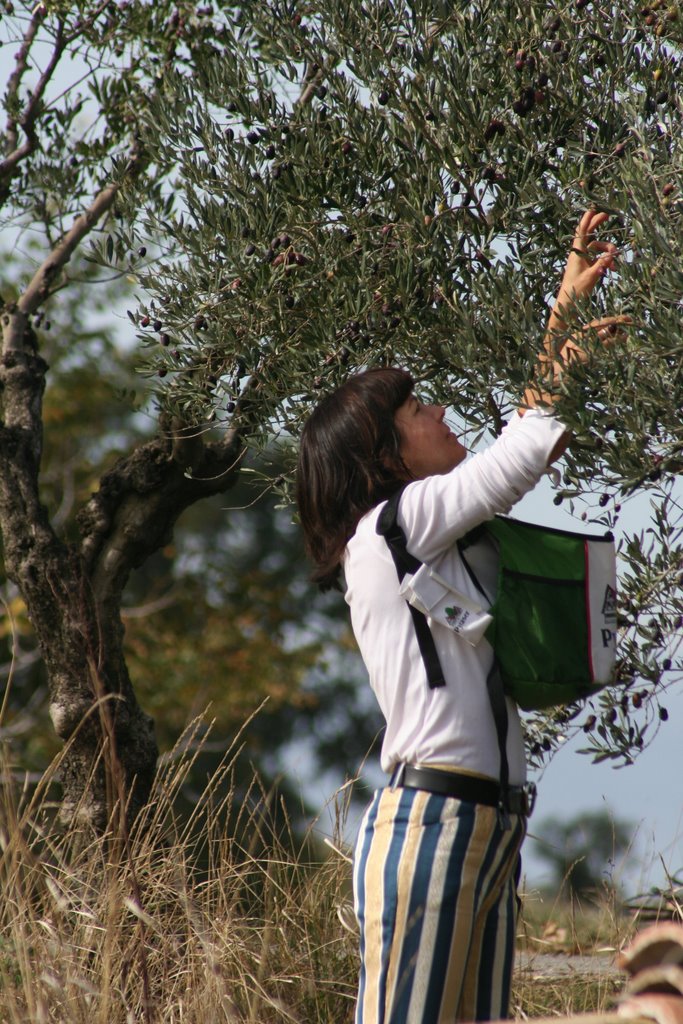
To get to some of them, you have to get up into the topmost branches. Ladders help with this … to start with. But for those out-on-a-limb rascals, you have to s-t-r-e-t-c-h. Precarious? At times, yes. Particularly for those of us that are not regular tree-climbers, which – notwithstanding my aspirations in this field – is a category I fit comfortably into.
But it’s a thrill, nonetheless. The weather was glorious – blue sky, temperatures in the springtime ranges, the kind of day that you’d describe if you had to be outside the whole time. And climbing trees – how can it get better than this? Not earning a penny doing it, but the feel of the olive branch, the olive itself, the teetering ladder below … heaven.
Watching the family at work was a treat too, particularly the elders. Most amazing to me was Maria, climbing trees, carrying ladders, falling over under the weight of what she was carrying and just getting right on back up again, leaving to go and make lunch, returning after cleaning up and carrying on until dark. And Umberto – patriarch in his white coat (!) and black woolly-cotton cap, always out there first, silently pulling the effort forward, expecting and getting.
The big bonus of the experience was the daily pranzo with the family. Lunch being the sacred event that it is in traditional Italy, it was just assumed that we would join them. I felt simultaneously like a guest and a member of the family … special and yet one of the crew. It was wonderful. Pasta every day, of course, with a variety of meats. Wine from last year’s grapes, and a smorgasbord of last year’s olives – green, black, dried. And the focus of everyone’s attention – Leonardo, 18-month-old son/nephew/grandson, blue-eyed imp and pure charmer.
The picking seems to be all over now. It was interrupted by a bout of wet weather – olives can’t be picked when they’re wet, they rot – and then continued in a couple of locations in the vicinity until yesterday. Senior Maria stopped by the other day to ask us for glass containers to give us some olive oil. From last year’s batch, since this year’s is still “più tòrbido” (use your imagination). Our wages.

We gave her two five-liter jugs – she asked if that was all.
It’s enough – we have our reward. Perhaps best captured by a single moment – Maria (wife) and I were both on ladders, stripping the tree using our olive rakes under glorious skies, and I turned to her with a smile and said: “Can you believe this? We’re picking olives in Italy.” “And we don’t have the internet,” she replied.
Amen.
The canine sagas
Vitalliano, our organic neighbour, is now right across the street from us in our rented house. He has 4 dogs. One is small, old, and precious, and yaps when it comes outside. It’s really Orellia’s (his wife’s), and is the only one that’s allowed the privilege of going inside the house.
The other three are a family – father, mother, and son. They live outside, and more or less have to fend for themselves, including for most of their food. I’ve never seen Vitalliano show them any affection, or, for that matter, any kind of recognition at all.
They’re a pretty motley crew, when all’s said and done, but a tight unit, I must say. And in spite of my negative inclinations to the canine population here … resentment at the deft footwork we need when venturing from the house to the car (to avoid the pungent “smear-bombs” that surround the house) … and the invasions on Mr Young’s freedom … I’ve been watching them since we’ve been renting here (a month now), and it’s a fascinating case study.

Dad is a street-smart, half-blind nondescript mongrel, as tough as old nails. I call him Buster. Mom is a shifty-eyed, pitch-black, equally nondescript mongrel. I call her Hyena, for both physical and character similarities. Puppy is non-stop energy, ever curious, fighting, bouncing, biting, chasing, sniffing, eating.
Mom is the model of measured patience and discipline with Puppy – a perfect mother. Dad is the typical father of the animal world – aloof, tolerant, and decisive in his reprimands. Puppy knows his place with dad, and has already developed a wisdom on how far to go.
They’re an archetypal cooperative unit, opportunists and hardy survivors. And a real family, in every sense of the word.
Down the street, there’s a Weimerana (I think that’s what it is), who partners the dumb-as-a-plank German Shepherd that loses its skin in excited barking every time we walk anywhere near. The Weimerana has found a way out of its confines, and has recently taken to the streets and the fields, prancing around (as Weimeranas are wont to do) as if looking for something. It almost seems like it’s lost.
But yet out it comes through a whole in the fence, a hole it seems the German Shepherd is (a) too big to get through, (b) unwilling to breach for fear of leaving its safe haven, or (c) too stupid to figure out. (Personally, I think it’s a combination of (b) and (c).)
In any event, the Weimerana today encroached on Buster’s property, and they “met” each other. Sniff … lift leg … pee … sniff … lift leg … pee … sniff … and so on. Buster walks away nonchalantly, back to his armchair, as if he doesn’t care. Weimerana continues its stiff-legged prance-action, looking confused and unsure. Hyena hangs around on the edge, watching her adversary, and after a while, trots back to join Buster. Puppy stays well back behind the frontlines – instinctively he knows it’s not a playground out there.
Ten minutes later, the ritual is repeated. Sniff … lift leg … retreat. No bared teeth, no snarling ... yet. But who’s to say what might happen as the battle of nerves for territorial supremacy rages. If it comes to arms – or teeth, rather – my money’s on Buster. Julius disagrees, saying that Weimerana’s bigger. But Buster’s smarter … and he’s got Hyena.
Stay tuned.
Meanwhile, in between the routine of sniffing and leg-lifting, it seems the family collared a rooster or a chicken today. Or maybe it was Weimerana. I found Hyena and Puppy hovered over this headless feather-body this morning, tugging and gnawing and grunting. Hyena retreated very slowly when I approached to investigate – normally she runs away, tail between her legs – barking at me as I did, reluctant to give up her prize, and then ran back in to claim it as I walked away again.
Later I saw Buster carting it around, and Vitalliano found him with it. He (Vita) picked it up and walked away muttering, probably to check if it was from his own brood. I’m convinced it was, and so was half-expecting to hear blood-curdling yelps and squeals as he exacted his punishment for their indiscretion.
There was no yelping, no squealing. Clearly I still have a lot to learn about this rural Italian man-animal relationship thing …
The other three are a family – father, mother, and son. They live outside, and more or less have to fend for themselves, including for most of their food. I’ve never seen Vitalliano show them any affection, or, for that matter, any kind of recognition at all.
They’re a pretty motley crew, when all’s said and done, but a tight unit, I must say. And in spite of my negative inclinations to the canine population here … resentment at the deft footwork we need when venturing from the house to the car (to avoid the pungent “smear-bombs” that surround the house) … and the invasions on Mr Young’s freedom … I’ve been watching them since we’ve been renting here (a month now), and it’s a fascinating case study.

Dad is a street-smart, half-blind nondescript mongrel, as tough as old nails. I call him Buster. Mom is a shifty-eyed, pitch-black, equally nondescript mongrel. I call her Hyena, for both physical and character similarities. Puppy is non-stop energy, ever curious, fighting, bouncing, biting, chasing, sniffing, eating.
Mom is the model of measured patience and discipline with Puppy – a perfect mother. Dad is the typical father of the animal world – aloof, tolerant, and decisive in his reprimands. Puppy knows his place with dad, and has already developed a wisdom on how far to go.
They’re an archetypal cooperative unit, opportunists and hardy survivors. And a real family, in every sense of the word.
Down the street, there’s a Weimerana (I think that’s what it is), who partners the dumb-as-a-plank German Shepherd that loses its skin in excited barking every time we walk anywhere near. The Weimerana has found a way out of its confines, and has recently taken to the streets and the fields, prancing around (as Weimeranas are wont to do) as if looking for something. It almost seems like it’s lost.
But yet out it comes through a whole in the fence, a hole it seems the German Shepherd is (a) too big to get through, (b) unwilling to breach for fear of leaving its safe haven, or (c) too stupid to figure out. (Personally, I think it’s a combination of (b) and (c).)
In any event, the Weimerana today encroached on Buster’s property, and they “met” each other. Sniff … lift leg … pee … sniff … lift leg … pee … sniff … and so on. Buster walks away nonchalantly, back to his armchair, as if he doesn’t care. Weimerana continues its stiff-legged prance-action, looking confused and unsure. Hyena hangs around on the edge, watching her adversary, and after a while, trots back to join Buster. Puppy stays well back behind the frontlines – instinctively he knows it’s not a playground out there.
Ten minutes later, the ritual is repeated. Sniff … lift leg … retreat. No bared teeth, no snarling ... yet. But who’s to say what might happen as the battle of nerves for territorial supremacy rages. If it comes to arms – or teeth, rather – my money’s on Buster. Julius disagrees, saying that Weimerana’s bigger. But Buster’s smarter … and he’s got Hyena.
Stay tuned.
Meanwhile, in between the routine of sniffing and leg-lifting, it seems the family collared a rooster or a chicken today. Or maybe it was Weimerana. I found Hyena and Puppy hovered over this headless feather-body this morning, tugging and gnawing and grunting. Hyena retreated very slowly when I approached to investigate – normally she runs away, tail between her legs – barking at me as I did, reluctant to give up her prize, and then ran back in to claim it as I walked away again.
Later I saw Buster carting it around, and Vitalliano found him with it. He (Vita) picked it up and walked away muttering, probably to check if it was from his own brood. I’m convinced it was, and so was half-expecting to hear blood-curdling yelps and squeals as he exacted his punishment for their indiscretion.
There was no yelping, no squealing. Clearly I still have a lot to learn about this rural Italian man-animal relationship thing …
General update - parte tre
Life continues, in comfort in our rental home with its stupendous views. The sky and the light here are unreal. Every day is different, and sometimes I feel like I’m looking at a Lord of the Rings or a Roger Dean picture – surreal cloud formations, shards of light piercing the silver and grey layers and highlighting a hill or a house or a field, blues and yellows and golds, and the ever-changing shades of green on the rolling landscape. It strikes me every time, and I remind myself how fortunate I am.
Some good and some frustrating to report, but mostly good.
First – the renovations to our house are scheduled to start in the next 2 weeks! We inked a contract with the builder last Friday, and he’s committed to be done before June 30th, otherwise a penalty kicks in. Turns out he’s the cousin of one of our neighbours … such is life and its connections here. This is one huge cloud lifted.
The night before this momentous event, I completed my application for residence, and this past Monday I got my residence identity card. This, it seems is the equivalent of having arrived – I am now official! And an amazing thing happened – my residence was granted the same day I made the application! Non-plussed, I was … but ever so grateful.
And to cap an eventful week, we bought a car – a second-hand Honda 4X4 to help us negotiate the winter roads and the mountain passes when we get up there to explore and go camping (next year).
Unfortunately, however, the vagaries with the Italian service industry continue. First, the postal service.
Item # 1 – Maria sent a small package to our part-time neighbours in Bari in the south of Italy. Four days after sending it, I just happened to intercept the postman trying to deliver it … to us! They had ignored the large-as-life bold address on the front, and instead focused on the minute address on the back, added at the last minute at the request of the postal service clerk who took the package. I managed to explain his/their (incomprehensible) error, which, unbelievably, it took him a while to recognize. But he took the parcel away again, and … lo and behold … it arrived in Bari 2 days later, quicker than it took to get 10 km from Tolentino to Regnano!
Item # 2 is a letter I sent to a friend in the US, containing a check, part of which was meant to go towards my SA Passport renewal application. Disappeared. No sign of it. This is now a month ago. Nothing I can do either – like a trusting idiot, having had one envelope make its way safely over there, I did not register it.
On the semi-positive side, unbelievably two of the boxes that were ostensibly sent back to the US showed up. The third is still MIA – it hasn’t been received back in the US, and they have no record of it in the post office here. Of course, it’s also the one with all the books I really need and want, and, frustratingly but by now not surprisingly, there’s just nothing that can be done.
It doesn’t get much better if you use UPS either. We had to have a cheque reissued (a refund from our movers) because it got lost in posteitaliano. So they sent it UPS. 3 weeks later, no sign of it. Contact moving company. UPS says our address doesn’t exist. Call them (UPS in Marche) – they need a phone number. Give it to them, but unfortunately incorrectly. Call them back to correct – no, don’t need it, they’re going to deliver tomorrow. 3 days later, call back – can’t deliver, the phone number’s wrong. Give them the right one, they’ll deliver tomorrow. Call from Tolentino – we don’t know where Regnano is (and are too lazy to find out). OK, we’ve had enough of this, leave it at the bar just outside the bridge into the city. Finally pick it up yesterday.
Don’t know what we’re going to do about this postal thing. Maybe get a PO Box in Tolentino.
On the phone and internet side, still no call from telecomm Italia since they put the phone down in the middle of one of Maria’s complaint calls. Turns out there’s a web site dedicated to complaints about telecomm Italia from English-speaking people in Italy. Now that makes me feel better…
Some good and some frustrating to report, but mostly good.
First – the renovations to our house are scheduled to start in the next 2 weeks! We inked a contract with the builder last Friday, and he’s committed to be done before June 30th, otherwise a penalty kicks in. Turns out he’s the cousin of one of our neighbours … such is life and its connections here. This is one huge cloud lifted.
The night before this momentous event, I completed my application for residence, and this past Monday I got my residence identity card. This, it seems is the equivalent of having arrived – I am now official! And an amazing thing happened – my residence was granted the same day I made the application! Non-plussed, I was … but ever so grateful.
And to cap an eventful week, we bought a car – a second-hand Honda 4X4 to help us negotiate the winter roads and the mountain passes when we get up there to explore and go camping (next year).
Unfortunately, however, the vagaries with the Italian service industry continue. First, the postal service.
Item # 1 – Maria sent a small package to our part-time neighbours in Bari in the south of Italy. Four days after sending it, I just happened to intercept the postman trying to deliver it … to us! They had ignored the large-as-life bold address on the front, and instead focused on the minute address on the back, added at the last minute at the request of the postal service clerk who took the package. I managed to explain his/their (incomprehensible) error, which, unbelievably, it took him a while to recognize. But he took the parcel away again, and … lo and behold … it arrived in Bari 2 days later, quicker than it took to get 10 km from Tolentino to Regnano!
Item # 2 is a letter I sent to a friend in the US, containing a check, part of which was meant to go towards my SA Passport renewal application. Disappeared. No sign of it. This is now a month ago. Nothing I can do either – like a trusting idiot, having had one envelope make its way safely over there, I did not register it.
On the semi-positive side, unbelievably two of the boxes that were ostensibly sent back to the US showed up. The third is still MIA – it hasn’t been received back in the US, and they have no record of it in the post office here. Of course, it’s also the one with all the books I really need and want, and, frustratingly but by now not surprisingly, there’s just nothing that can be done.
It doesn’t get much better if you use UPS either. We had to have a cheque reissued (a refund from our movers) because it got lost in posteitaliano. So they sent it UPS. 3 weeks later, no sign of it. Contact moving company. UPS says our address doesn’t exist. Call them (UPS in Marche) – they need a phone number. Give it to them, but unfortunately incorrectly. Call them back to correct – no, don’t need it, they’re going to deliver tomorrow. 3 days later, call back – can’t deliver, the phone number’s wrong. Give them the right one, they’ll deliver tomorrow. Call from Tolentino – we don’t know where Regnano is (and are too lazy to find out). OK, we’ve had enough of this, leave it at the bar just outside the bridge into the city. Finally pick it up yesterday.
Don’t know what we’re going to do about this postal thing. Maybe get a PO Box in Tolentino.
On the phone and internet side, still no call from telecomm Italia since they put the phone down in the middle of one of Maria’s complaint calls. Turns out there’s a web site dedicated to complaints about telecomm Italia from English-speaking people in Italy. Now that makes me feel better…
Friday, November 10, 2006
General update - parte due
Last week we had the first frost of the winter, and snow on the mountains. Julius was ecstatic. We weren’t. We have an uninsulated house, and no central heating. It’s the beginning of November. Our spirits were dented and daunted by what lay ahead.
So we caved … and ran running for the neighbour’s house. By the end of last weekend, we were firmly ensconced – an insulated house that holds its heat at a pretty constant 10-15° C, and central heating if we need it. Three working bathrooms. A clean kitchen and living room. In other words – bliss.
Even Mr. Young has adjusted, roaming around the house as if it’s his own, and venturing outside in plain sight of – but respectable distance from – our organic neighbour’s four dogs.
Seems our move was timed just right. I collapsed with a streaming cold, Maria with a stiff neck, both probably taking hold as we exhaled and released the tenuous tension of living “down there”.
Quite a bit of walking and exploring lately – Bolognola and Sasso Tetto up in the mountains, Gola dell’Infernaccio (Hell’s Gorge), Lake Fiastra, and Jesi, center of arts, music, a Juventus coaching clinic for youngsters, and the verdicchio wine-producing area of Italy. Maybe a separate post or two on these subjects in the future. And we’ve just scratched the surface. It’s wonderful.
At the end of the month we’re going to England for a long weekend. Holmfirth in Yorkshire, to be precise, home of the neighbour whose house we’re living in. Somehow we couldn’t pass up the opportunity of his invitation at €2 a ticket from Ancona (Marche) to Liverpool, €103 for all 3 of us with taxes. Thought of trying to catch one of the Springbok rugby games, but at £150 we’re taking a pass. Now we’re focusing on getting a ticket for an Anfield (Liverpool) game, maybe even get to sit at the Kop. But at £50 a ticket, we’re not holding out too much hope for that either.
Renovations to the house still haven’t started. There’s always a (legitimate?) reason from the builder, but his frequent promises to “set up a meeting to sign a contract” turn out to be somewhat hollow, and do not instill confidence. Worse still, our architect and project manager, who we ran into one evening this past week, assumed not only that the building had started, but that it had stopped for the winter. Is this Italian for "being on top of things"? As for my overall confidence, if it manifests itself as a sort of hole in the stomach, then I guess I’m brimming with it …
So we caved … and ran running for the neighbour’s house. By the end of last weekend, we were firmly ensconced – an insulated house that holds its heat at a pretty constant 10-15° C, and central heating if we need it. Three working bathrooms. A clean kitchen and living room. In other words – bliss.
Even Mr. Young has adjusted, roaming around the house as if it’s his own, and venturing outside in plain sight of – but respectable distance from – our organic neighbour’s four dogs.
Seems our move was timed just right. I collapsed with a streaming cold, Maria with a stiff neck, both probably taking hold as we exhaled and released the tenuous tension of living “down there”.
Quite a bit of walking and exploring lately – Bolognola and Sasso Tetto up in the mountains, Gola dell’Infernaccio (Hell’s Gorge), Lake Fiastra, and Jesi, center of arts, music, a Juventus coaching clinic for youngsters, and the verdicchio wine-producing area of Italy. Maybe a separate post or two on these subjects in the future. And we’ve just scratched the surface. It’s wonderful.
At the end of the month we’re going to England for a long weekend. Holmfirth in Yorkshire, to be precise, home of the neighbour whose house we’re living in. Somehow we couldn’t pass up the opportunity of his invitation at €2 a ticket from Ancona (Marche) to Liverpool, €103 for all 3 of us with taxes. Thought of trying to catch one of the Springbok rugby games, but at £150 we’re taking a pass. Now we’re focusing on getting a ticket for an Anfield (Liverpool) game, maybe even get to sit at the Kop. But at £50 a ticket, we’re not holding out too much hope for that either.
Renovations to the house still haven’t started. There’s always a (legitimate?) reason from the builder, but his frequent promises to “set up a meeting to sign a contract” turn out to be somewhat hollow, and do not instill confidence. Worse still, our architect and project manager, who we ran into one evening this past week, assumed not only that the building had started, but that it had stopped for the winter. Is this Italian for "being on top of things"? As for my overall confidence, if it manifests itself as a sort of hole in the stomach, then I guess I’m brimming with it …
The canine challenge
Dogs … bark. It’s what they do, an indisputable reality, in much the same way as sugar is sweet, sky is blue, and husbands are wrong.
In the case of dogs in Regnano – and rural Marche, actually – this reality is doubly true. Perhaps even triply. They bark … a lot.
They also, through their vocal proclivities, can have an impact on the performance of ritual and tradition. Take the passegiata, for instance, one of the noblest and enjoyable of Italian traditions. This is the evening stroll down the promenade with family and friends, a leisurely end-of-the-day ritual in towns and cities across the country, intended – or so it appears to me – to slow down, catch up, and clutch out. We’ve indulged in the pastime – with relish – whenever we’ve had the opportunity. I tried to do so in our little one-road borgo, while Julius rode his bicycle – it was a once-in-a-lifetime event, thanks to the dogs. Apart from barking incessantly, some of them were quite menacing as they approached me, and, being in no hurry to test the theory of barks being worse than bites, ended up siding with discretion rather than valour (i.e. I scuttled off … with my tail in a place I’d rather have seen my antagonists’ in).
One of these dogs – a German shepherd, or Alsatian – is positively scary. He gets so excited that I can actually picture him opting to jump out of his skin (if given the option) just to get a chance to go at us. Being an immediate neighbour, one might have hoped that he’d develop some familiarity over time, given the frequency that we pass him, both by car and on foot. No such luck. Not even a hint of recognition. Thank heavens he’s confined to a fenced-in garden. His frantic, beside-himself behaviour makes me wonder if his owner is hiding something behind such a vicious visage.
A week or so ago in Bolognola we saw a woman trying to calm her own dog as her son and grandson arrived for a visit. His (the dog’s) reaction to her slapping his jaw was downright frightening – his bark turned to a snarl-growl, and he bared his teeth as if he was about to de-hand her. The 3 of us (Maria, Julius and I) watched – horrified and transfixed – waiting for him to perform the severing act. To our morbid disappointment (or possibly relief), he didn’t, perhaps deciding at the last minute to postpone the dastardly deed. If I’d been her son carrying in my own child, I’d have turned tail and fled for the hills rather than take the risk of having my boy in the company of such a beast.
Out in the country, these dogs roam free. Our organic neighbour has four such dogs. They’re always out in the streets or galavanting across the fields, sometimes sniffing around our house. They shit everywhere, of course. And bark. A month or so ago, he told Maria proudly how they’d caught and killed a rabbit. Back in June when the bitch had four puppies, he killed 3 of them – a sort of post-partum method of birth control. Such is life out here – basic, practical, unemotional.
On the way to school in the morning, we often see another roamer – a large German shepherd running along the road with an apparently definite destination. I’m not sure where he’s bound, but he always looks earnest and serious, as if he’s on a mission, and not one of altruism or charity either. Sometimes he has buddies with him, each displaying the same ominous purpose. They seem like a canine sort of Gestapo – sly, ill-meaning, and not to be trusted. Every time I see them I think the same thing: Me here (in the car). You there. Good arrangement.
Across the valley from our house, I’ve counted up to 13 dogs at one of the farms. It’s possible there are more. They hold the valley’s title for most barks per square meter. Many of these accolades are earned at night. As you might imagine, across the silence of a rural Italian valley at night, sound carries, right into one’s bedroom and one’s ear and directly through to one’s attempting-to-sleep conscience. The impact is flash-like, turning a pacifist animal-lover into an irrational vengeance-seeker with disturbing thoughts of deeply satisfying mass murder. (Naturally, this is only on the bad days – the normal ones only render us savage-like.)
Having said all that, I think I sort-of understand why this canine culture exists. I’ve seen it before, in South America, where a sturdy stick (or canine repellent) is an essential tool when walking out in the country. The dogs provide protection and an alarm system – it’s cheap, efficient, and the only option available, in most cases. Interestingly enough, they also seem to know their boundaries and their role. Our neighbour, for instance, also keeps chickens, pigeons, and cats, and the dogs leave them well alone, not even reacting as they stroll past within biting distance at mealtimes.
Naturally, understanding of the reasoning behind it all doesn’t necessarily diminish the frustration it breeds. And it hasn’t stopped us scheming how to do some clandestine culling of our own. Of course, we won’t go through with it, not only because it would be criminal and cruel, but because it wouldn’t make a difference at the end of the day – within weeks, perhaps months at the most, there’ll be a new litter, and this time around they’ll let the whole lot of them keep breathing and barking on instead of just one or two.
So, like a parent that develops a tolerance of an infant’s wailing, we’ll just have to build up our immunities. Who knows, maybe we’ll have a Spot of our own sometime in the future … although I somehow doubt it. And besides, it’s a virtual certainty that HRH (Mr Young) would veto such a suggestion with pleasure and a feline flourish.
In the case of dogs in Regnano – and rural Marche, actually – this reality is doubly true. Perhaps even triply. They bark … a lot.
They also, through their vocal proclivities, can have an impact on the performance of ritual and tradition. Take the passegiata, for instance, one of the noblest and enjoyable of Italian traditions. This is the evening stroll down the promenade with family and friends, a leisurely end-of-the-day ritual in towns and cities across the country, intended – or so it appears to me – to slow down, catch up, and clutch out. We’ve indulged in the pastime – with relish – whenever we’ve had the opportunity. I tried to do so in our little one-road borgo, while Julius rode his bicycle – it was a once-in-a-lifetime event, thanks to the dogs. Apart from barking incessantly, some of them were quite menacing as they approached me, and, being in no hurry to test the theory of barks being worse than bites, ended up siding with discretion rather than valour (i.e. I scuttled off … with my tail in a place I’d rather have seen my antagonists’ in).
One of these dogs – a German shepherd, or Alsatian – is positively scary. He gets so excited that I can actually picture him opting to jump out of his skin (if given the option) just to get a chance to go at us. Being an immediate neighbour, one might have hoped that he’d develop some familiarity over time, given the frequency that we pass him, both by car and on foot. No such luck. Not even a hint of recognition. Thank heavens he’s confined to a fenced-in garden. His frantic, beside-himself behaviour makes me wonder if his owner is hiding something behind such a vicious visage.
A week or so ago in Bolognola we saw a woman trying to calm her own dog as her son and grandson arrived for a visit. His (the dog’s) reaction to her slapping his jaw was downright frightening – his bark turned to a snarl-growl, and he bared his teeth as if he was about to de-hand her. The 3 of us (Maria, Julius and I) watched – horrified and transfixed – waiting for him to perform the severing act. To our morbid disappointment (or possibly relief), he didn’t, perhaps deciding at the last minute to postpone the dastardly deed. If I’d been her son carrying in my own child, I’d have turned tail and fled for the hills rather than take the risk of having my boy in the company of such a beast.
Out in the country, these dogs roam free. Our organic neighbour has four such dogs. They’re always out in the streets or galavanting across the fields, sometimes sniffing around our house. They shit everywhere, of course. And bark. A month or so ago, he told Maria proudly how they’d caught and killed a rabbit. Back in June when the bitch had four puppies, he killed 3 of them – a sort of post-partum method of birth control. Such is life out here – basic, practical, unemotional.
On the way to school in the morning, we often see another roamer – a large German shepherd running along the road with an apparently definite destination. I’m not sure where he’s bound, but he always looks earnest and serious, as if he’s on a mission, and not one of altruism or charity either. Sometimes he has buddies with him, each displaying the same ominous purpose. They seem like a canine sort of Gestapo – sly, ill-meaning, and not to be trusted. Every time I see them I think the same thing: Me here (in the car). You there. Good arrangement.
Across the valley from our house, I’ve counted up to 13 dogs at one of the farms. It’s possible there are more. They hold the valley’s title for most barks per square meter. Many of these accolades are earned at night. As you might imagine, across the silence of a rural Italian valley at night, sound carries, right into one’s bedroom and one’s ear and directly through to one’s attempting-to-sleep conscience. The impact is flash-like, turning a pacifist animal-lover into an irrational vengeance-seeker with disturbing thoughts of deeply satisfying mass murder. (Naturally, this is only on the bad days – the normal ones only render us savage-like.)
Having said all that, I think I sort-of understand why this canine culture exists. I’ve seen it before, in South America, where a sturdy stick (or canine repellent) is an essential tool when walking out in the country. The dogs provide protection and an alarm system – it’s cheap, efficient, and the only option available, in most cases. Interestingly enough, they also seem to know their boundaries and their role. Our neighbour, for instance, also keeps chickens, pigeons, and cats, and the dogs leave them well alone, not even reacting as they stroll past within biting distance at mealtimes.
Naturally, understanding of the reasoning behind it all doesn’t necessarily diminish the frustration it breeds. And it hasn’t stopped us scheming how to do some clandestine culling of our own. Of course, we won’t go through with it, not only because it would be criminal and cruel, but because it wouldn’t make a difference at the end of the day – within weeks, perhaps months at the most, there’ll be a new litter, and this time around they’ll let the whole lot of them keep breathing and barking on instead of just one or two.
So, like a parent that develops a tolerance of an infant’s wailing, we’ll just have to build up our immunities. Who knows, maybe we’ll have a Spot of our own sometime in the future … although I somehow doubt it. And besides, it’s a virtual certainty that HRH (Mr Young) would veto such a suggestion with pleasure and a feline flourish.
Wednesday, October 25, 2006
Learning Italian - parte due
From 10-18-06 (see post entitled "Learning Italian - parte uno" for context)
Learning Italian means learning that …
… you don’t order cappuccino after 11am
… you can’t shop when it’s convenient for you, only when it’s not
… or, its corollary – pranzo is sacred, and is never, ever to be disturbed
… if there’s a patently obvious way to do something, it will not be done that way
… the only nutrients necessary to sustain life are pasta and pommodoro sauce
… the only goal of driving is to see how close you can get to the car in front of you
… ‘going the extra yard’ does not translate for the Italian service industry
… ‘going the distance’ does not translate for the Italian service industry
… in order to request phone service, you first have to have a phone number
… street signs are for decorative purposes only
… language is not just a verbal thing
… language is about communication, not just a combination of words
Learning Italian means learning that …
… you don’t order cappuccino after 11am
… you can’t shop when it’s convenient for you, only when it’s not
… or, its corollary – pranzo is sacred, and is never, ever to be disturbed
… if there’s a patently obvious way to do something, it will not be done that way
… the only nutrients necessary to sustain life are pasta and pommodoro sauce
… the only goal of driving is to see how close you can get to the car in front of you
… ‘going the extra yard’ does not translate for the Italian service industry
… ‘going the distance’ does not translate for the Italian service industry
… in order to request phone service, you first have to have a phone number
… street signs are for decorative purposes only
… language is not just a verbal thing
… language is about communication, not just a combination of words
Fed up
It’s a clear blue sky, a slight breeze blowing, there’s just the slightest hint of crispness in the air but I’m nonetheless in my shorts – it’s a beautiful day in the Italian countryside.
And I’m fed up. Frustrated. Pissed off.
It’s the insects. The $%@#?&@ insects, that is. I’ve now officially declared an all-out war against all kinds.
I’ve written previously about the bees and wasps and hornets. They’ve become so annoying that I now wield a fly-swatter on a regular basis. Yesterday I swatted my first two. Those that know me and my creature-loving side – I help spiders across the road – will appreciate the gravity of this action. Worse still, I watched with some relish as they squirmed around after I’d smashed them to the ground. If my aim was just slightly better, there’d be more notches on the swatter. It’s simply gone too far, and pushed me beyond the pale.
As if abluting in a third-grade bathroom and cooking and eating in a damp-ridden kitchen were not bad enough, last night as I read in bed, the gnats were so thick that they were not only walking on my lenses of my reading glasses, they were examining my eyelids and checking out the inside of my ears. I felt like I was in an Edgar Allan Poe story. It got so bad I had to flee to a place with more space between the light and me, just to preserve my sanity and to be able to continue reading.
There’s a permanent fruit-fly presence in the kitchen, an ample supply of your common garden fly, the ubiquitous stink bug, and a healthy enough selection of other creeping and flying crawlies to make your average tropical forest proud. I managed to ignore it for a while, and then tolerate it, but finally even grinning and bearing it became too much, hence the call to arms.
They’d better watch out, these insects, they’ve awoken a giant. Numbers? (Ouch!) Who cares how many of them there are! (Get off my leg, you ^$@#*&!) I’m not cowed. (Damn bite won’t stop itching!) If they’re not careful, I’ll move up to our neighbour’s …
And I’m fed up. Frustrated. Pissed off.
It’s the insects. The $%@#?&@ insects, that is. I’ve now officially declared an all-out war against all kinds.
I’ve written previously about the bees and wasps and hornets. They’ve become so annoying that I now wield a fly-swatter on a regular basis. Yesterday I swatted my first two. Those that know me and my creature-loving side – I help spiders across the road – will appreciate the gravity of this action. Worse still, I watched with some relish as they squirmed around after I’d smashed them to the ground. If my aim was just slightly better, there’d be more notches on the swatter. It’s simply gone too far, and pushed me beyond the pale.
As if abluting in a third-grade bathroom and cooking and eating in a damp-ridden kitchen were not bad enough, last night as I read in bed, the gnats were so thick that they were not only walking on my lenses of my reading glasses, they were examining my eyelids and checking out the inside of my ears. I felt like I was in an Edgar Allan Poe story. It got so bad I had to flee to a place with more space between the light and me, just to preserve my sanity and to be able to continue reading.
There’s a permanent fruit-fly presence in the kitchen, an ample supply of your common garden fly, the ubiquitous stink bug, and a healthy enough selection of other creeping and flying crawlies to make your average tropical forest proud. I managed to ignore it for a while, and then tolerate it, but finally even grinning and bearing it became too much, hence the call to arms.
They’d better watch out, these insects, they’ve awoken a giant. Numbers? (Ouch!) Who cares how many of them there are! (Get off my leg, you ^$@#*&!) I’m not cowed. (Damn bite won’t stop itching!) If they’re not careful, I’ll move up to our neighbour’s …
Autumn chill
Above just about anything else, I remember the wind when we were in Patagonia. First, on the shores of Lago Pingo in Chile’s Torres del Paine National Park, and then in Argentina’s Glacier National Park at Lago Electrica. It came across this massive ice field, second largest in the world, if I recall correctly, and whistled across the glacial waters to the shores where we met it. I remember imagining the path it had travelled, and tried in my own mind to do the same – envisioning the route across the dark and bitter southern ocean, and then barrelling across the bleak, frozen expanses, all well beyond the pale of human endurance. I was enraptured by it – somehow it struck at the core of my human survival sensitivities, wanting to know how it would be out there, out of this comfort zone.
And so when I feel this chill autumn wind here in Marche, and there’s an undercurrent to it as if it is coming from far away, my romantic memories resurface, and I am invigorated by the elemental nature of it. Clearly, Regnano is a long way from Patagonia, there’s no ice field within a thousand miles, and I can step into my house instead of my tent, but who gives a damn. It adds an edge to autumn and lends just a hint of the pioneering spirit to our endeavours here. (The half-camping nature of our existence here might have something to do with it.)
The skies are also brooding, as a few of the pictures in a recent blog post attest, and there’s the scent of a portent in the air. Or perhaps it’s just in my mind. I’ve heard so many warnings about the severity of the winter that I’m waiting with trepidation for it to hit us in our uninsulated, unheated house. And if it comes when the roof’s being worked on … hell, I don’t even know where we’ll be sleeping then, probably in the uninsulated, unheated caravan, and waking up with stiff backs in craggy moods. Boy, I can’t wait.
In the meantime, I’ll just let my mind wander over those Patagonian ice fields, and the legendary peaks of the Sibillini mountains …
And so when I feel this chill autumn wind here in Marche, and there’s an undercurrent to it as if it is coming from far away, my romantic memories resurface, and I am invigorated by the elemental nature of it. Clearly, Regnano is a long way from Patagonia, there’s no ice field within a thousand miles, and I can step into my house instead of my tent, but who gives a damn. It adds an edge to autumn and lends just a hint of the pioneering spirit to our endeavours here. (The half-camping nature of our existence here might have something to do with it.)
The skies are also brooding, as a few of the pictures in a recent blog post attest, and there’s the scent of a portent in the air. Or perhaps it’s just in my mind. I’ve heard so many warnings about the severity of the winter that I’m waiting with trepidation for it to hit us in our uninsulated, unheated house. And if it comes when the roof’s being worked on … hell, I don’t even know where we’ll be sleeping then, probably in the uninsulated, unheated caravan, and waking up with stiff backs in craggy moods. Boy, I can’t wait.
In the meantime, I’ll just let my mind wander over those Patagonian ice fields, and the legendary peaks of the Sibillini mountains …
A macabre departure from the purely Marchigiani
Death is a strange subject. Some shy away from it, ignoring its ever-present threat, perhaps being able to live more in the moment as a result. Others are aware of it, fear it, and take extreme precautions to minimize its likelihood. Then there are some that immerse themselves in it, study it, write about it – like Gabriela Garcia Marquez, for example, who penned a number of death-obsessed short stories around 1950, which I’m now reading in his “Collected Stories.”
I fall into the category of those with a curiosity verging on morbid fascination, sort of like a moth drawn to a flame. However, Garcia’s stories go a bit far for my comfort level. That’s because he makes it so personal – my curiosity is perhaps a little more removed, in more of a Monty-Pythonesque “What’s it like?” sort of way.
I recently found myself fixated by a hunt of Mr Young’s. In spite of our inherent animal-loving natures, we’re reluctantly encouraging him to cull the local mouse population, given their penchant for eating through and defecating on our possessions. They’re extremely quick, the blighters, and so I was amazed at Mr Young’s dexterity in chasing it down, given his own prodigious propensity for lethargy. I guess those natural tendencies kick in when such quintessential feline opportunities come along.
In any event, having caught it and deposited it in the long grass where its escape was more difficult, he proceeded with the age-old cat-and-mouse game, pretending he wasn’t interested and then pouncing as the mouse tried to make a dash for it. After 20 minutes of this, which took him under the caravan and back out again, I came to investigate, and found the mouse on the ground in front of him. It was literally kicking its last, its hind legs kicking as if to try and get away, but – with its back broken – producing no momentum beyond a futile desperate jerk. A thousand thoughts ran through my head, from “Ag, shame, it’s so cute”, to “Just half-an-hour ago this mouse was on its way somewhere, oblivious of its pending fate.”
It’s this latter thought that preoccupies me. Not that the mouse had dinner plans and his friends are now wondering why he hasn’t turned up at the restaurant yet, or even that the mouse necessarily has thoughts of the future. But we do. And when death strikes, tomorrow doesn’t matter any more. That new car you were going to buy, the struggle to pay the rent, the fight you were having with your mom, next year’s Rugby World Cup … none of them are even remotely interesting anymore. Sudden and final. A complete and utter change of plans. Sort of colours our preoccupation with our current plans, doesn’t it?
Of course there are a myriad other subjects that spring from such thoughts, most of them spiritual, but this is not the place for those things. What the mouse did not see, having passed into the afterlife, was how Mr Young then danced, twisted, contorted, and leapt as he threw the corpse in the air, attempting to catch it as it flew lifelessly in its morbid arc. It was a ceremony, a rite, a celebration. I’d never seen Mr Young do that. Nobody has ever taught him to do that. It’s entirely innate. I guess he has his own fascination with death.
After he was done with his ritual, he proceeded to eat it, but only half … the top half. All that was left of the little rodent that was scurrying along the wall less than an hour before was a tail, two hind legs, and the lower part of its torso. I left it where it was, to see what other death-related custom might emerge in Mr Young’s behaviour.
But it was not to be. The next morning it was gone, devoured by another carnivorous creature passing in the night. Mr Young didn’t even look for it. Was that the mouse’s destiny in being put on this earth – to hone the skills of a domestic cat that didn’t need the nutrition, and to provide a free meal for one that did? Hmmm, wonder what mine is …
I fall into the category of those with a curiosity verging on morbid fascination, sort of like a moth drawn to a flame. However, Garcia’s stories go a bit far for my comfort level. That’s because he makes it so personal – my curiosity is perhaps a little more removed, in more of a Monty-Pythonesque “What’s it like?” sort of way.
I recently found myself fixated by a hunt of Mr Young’s. In spite of our inherent animal-loving natures, we’re reluctantly encouraging him to cull the local mouse population, given their penchant for eating through and defecating on our possessions. They’re extremely quick, the blighters, and so I was amazed at Mr Young’s dexterity in chasing it down, given his own prodigious propensity for lethargy. I guess those natural tendencies kick in when such quintessential feline opportunities come along.
In any event, having caught it and deposited it in the long grass where its escape was more difficult, he proceeded with the age-old cat-and-mouse game, pretending he wasn’t interested and then pouncing as the mouse tried to make a dash for it. After 20 minutes of this, which took him under the caravan and back out again, I came to investigate, and found the mouse on the ground in front of him. It was literally kicking its last, its hind legs kicking as if to try and get away, but – with its back broken – producing no momentum beyond a futile desperate jerk. A thousand thoughts ran through my head, from “Ag, shame, it’s so cute”, to “Just half-an-hour ago this mouse was on its way somewhere, oblivious of its pending fate.”
It’s this latter thought that preoccupies me. Not that the mouse had dinner plans and his friends are now wondering why he hasn’t turned up at the restaurant yet, or even that the mouse necessarily has thoughts of the future. But we do. And when death strikes, tomorrow doesn’t matter any more. That new car you were going to buy, the struggle to pay the rent, the fight you were having with your mom, next year’s Rugby World Cup … none of them are even remotely interesting anymore. Sudden and final. A complete and utter change of plans. Sort of colours our preoccupation with our current plans, doesn’t it?
Of course there are a myriad other subjects that spring from such thoughts, most of them spiritual, but this is not the place for those things. What the mouse did not see, having passed into the afterlife, was how Mr Young then danced, twisted, contorted, and leapt as he threw the corpse in the air, attempting to catch it as it flew lifelessly in its morbid arc. It was a ceremony, a rite, a celebration. I’d never seen Mr Young do that. Nobody has ever taught him to do that. It’s entirely innate. I guess he has his own fascination with death.
After he was done with his ritual, he proceeded to eat it, but only half … the top half. All that was left of the little rodent that was scurrying along the wall less than an hour before was a tail, two hind legs, and the lower part of its torso. I left it where it was, to see what other death-related custom might emerge in Mr Young’s behaviour.
But it was not to be. The next morning it was gone, devoured by another carnivorous creature passing in the night. Mr Young didn’t even look for it. Was that the mouse’s destiny in being put on this earth – to hone the skills of a domestic cat that didn’t need the nutrition, and to provide a free meal for one that did? Hmmm, wonder what mine is …
Around the house
If you saw me walking through my house these days, you’d be excused for thinking that I’d gone religious. Now that’s not to say that I’m aspiritual, but the reason my head is bowed is not one of reverence – it’s purely for self-protection, perhaps even self-preservation.
For some reason, the marchigiani build their doorways low. The permanent bump on my head bears testament to that. With my bowed head approach, I’ve got most of them beaten now, but there are two that catch me like snipers waiting for me to drop my guard, and I do this regularly enough to keep the bump permanently tender. Both of the danger zones involve steps, and they carry out their assaults when I’m going down. The doorway from the bathroom wing to the dressing room is one, while the first step down from the outdoor stairway is the other. In spite of my “going down, head down” mantra, they both enjoy healthy success rates.
“Thud!”, when all’s said and done, is probably the best sound approximation of head meeting doorway. It has a real depth to it, without any hollowness, but with substance, transcending layers. Of course “Thud!” is merely the opener. It’s followed by a barrage of audible reactions, which tend to have something of an “edge” to them, and a skull-penetrating, flashing pain that tends to render everything else that was going on utterly irrelevant.
After the umpteenth head-crunch, recovery – which takes some 5 minutes – is typically followed by an angry and wholly unsavoury reference to the doorways, and an oath to ensure the builder raises them all.
While the doorways have a tendency to impact my sense of touch, there are 3 particular rooms in the house which invoke distinct reactions of another sense – the olfactory one.
First, the kitchen. While it’s very functional, and we’re making do, the encroaching chill has necessitated that we close the windows in there. This has brought out a “character” that we’d rather not have been introduced to. The lingering moisture in the walls has left a musty, dank aroma, prompting the thought: “This can’t be healthy.”
The room next door – the ex-wine pressing and storage room, which shares a wall with the kitchen but no door or other opening – has a similar smell, only thicker and with a hard-to-place “twist” that leaves you wondering: “What did they do in this room?” This is where Julius’ bicycle and the Bowflex get stored, both removed for use.
The third room is the bathroom. Now us first-worlders spend a fair amount of time on scents and aromas and perfumes to make our bathrooms smell distinctly unbathroom-like. This is not the case with us. Walk into ours blindfolded, and you go: "This is a bathroom." No question. Think “public toilet,” and you’ve got it. Now if you know Maria and her hygiene obsession, you’ll appreciate that this is not only demeaning, it’s mood-altering. The uncomfortable whiff is attributable to the manual-flush toilet with its rusted mechanism. We’re planning to replace it soon, not only to eliminate the need for bucket-filling and self-flushing, but also to alleviate the need for breath-holding when we’re in there.
Other than this, however, the periodic ceiling paint deposits, the hayfever-inducing dust, and the incessant buzz and interference of insects, everything’s just fine.
For some reason, the marchigiani build their doorways low. The permanent bump on my head bears testament to that. With my bowed head approach, I’ve got most of them beaten now, but there are two that catch me like snipers waiting for me to drop my guard, and I do this regularly enough to keep the bump permanently tender. Both of the danger zones involve steps, and they carry out their assaults when I’m going down. The doorway from the bathroom wing to the dressing room is one, while the first step down from the outdoor stairway is the other. In spite of my “going down, head down” mantra, they both enjoy healthy success rates.
“Thud!”, when all’s said and done, is probably the best sound approximation of head meeting doorway. It has a real depth to it, without any hollowness, but with substance, transcending layers. Of course “Thud!” is merely the opener. It’s followed by a barrage of audible reactions, which tend to have something of an “edge” to them, and a skull-penetrating, flashing pain that tends to render everything else that was going on utterly irrelevant.
After the umpteenth head-crunch, recovery – which takes some 5 minutes – is typically followed by an angry and wholly unsavoury reference to the doorways, and an oath to ensure the builder raises them all.
While the doorways have a tendency to impact my sense of touch, there are 3 particular rooms in the house which invoke distinct reactions of another sense – the olfactory one.
First, the kitchen. While it’s very functional, and we’re making do, the encroaching chill has necessitated that we close the windows in there. This has brought out a “character” that we’d rather not have been introduced to. The lingering moisture in the walls has left a musty, dank aroma, prompting the thought: “This can’t be healthy.”
The room next door – the ex-wine pressing and storage room, which shares a wall with the kitchen but no door or other opening – has a similar smell, only thicker and with a hard-to-place “twist” that leaves you wondering: “What did they do in this room?” This is where Julius’ bicycle and the Bowflex get stored, both removed for use.
The third room is the bathroom. Now us first-worlders spend a fair amount of time on scents and aromas and perfumes to make our bathrooms smell distinctly unbathroom-like. This is not the case with us. Walk into ours blindfolded, and you go: "This is a bathroom." No question. Think “public toilet,” and you’ve got it. Now if you know Maria and her hygiene obsession, you’ll appreciate that this is not only demeaning, it’s mood-altering. The uncomfortable whiff is attributable to the manual-flush toilet with its rusted mechanism. We’re planning to replace it soon, not only to eliminate the need for bucket-filling and self-flushing, but also to alleviate the need for breath-holding when we’re in there.
Other than this, however, the periodic ceiling paint deposits, the hayfever-inducing dust, and the incessant buzz and interference of insects, everything’s just fine.
Friday, October 20, 2006
Learning Italian - parte uno
There's a wonderful book on writing - it actually extends into one's life, actually - by Gail Sher called "One Continuous Mistake: Four Noble Truths for Writers". Her first order of business is to require the writing student (me) to write about the same subject each day for 14 days straight. I chose "Learning Italian" as my subject. Here's the first of several posts, excerpts from this series.
10-11-06
If I keep at it, day after day, reading and understanding in the moment what I am reading, then the knowledge will come. This is what my heart yearns to be true – that simple mechanics can convert me, transform me. And so I do it.
Then I go out. It generally starts well – my Italian conversational counterpart, usually a store clerk or similar, recognizes my handicap and talks a little slower. I lean forward, getting my ear closer to the words so that with greater clarity in hearing them I will enjoy greater clarity in understanding. I nod in acknowledgement of the general concepts being expressed. This encourages the speaker, and soon they are talking at their normal speed – rapid-fire – and using words that they’d use with their family and friends. They step out of their “speak simply for the straniero” role and they get into their normal persona.
Little do they know what a roller-coaster ride this causes the listener – me. I run after their words, zig-zagging as if following random clues, my nodding continues mechanically, without thought, and I cling, fingers on the cliff-edge, holding on with the last ounce of my strength.
And then it gives – my grasp slips, and I’m gone, plunging into the deep abyss, hopelessly dazed, knotted in confusion, and soon the speaker sees the blank, faraway look in my eyes, and they know they lost me a while ago. Then comes the smile, sympathetic and with just the slightest, friendliest touch of frustration, and they once again switch personas. Back we go and start again.
In this moment, I know that mechanics have failed me. With it comes a tinge of despair – how will I ever master it, when, in the heat of battle, I forget that “I am” is simply “sono”.
“You have to live it,” says Claudia, and she’s right. Countless times I’ve noticed errors in her vocabulary, her verb forms, but she presses on, and for her, the conversational counterpart doesn’t have to switch roles. They engage, they flow, and the conversation goes with them.
This is what speaking Italian is about. It’s not mechanical. Aside from the hand-speak, there’s an energy that’s established at the outset as part of the conversational contract, and the participants both follow it and lead it. “Going with the flow” might be the cliché way of expressing it, and it’s true. It comes only from getting out there and doing it. The mechanics have their place, but the real knowing comes from immersion in the conversational currents.
10-11-06
If I keep at it, day after day, reading and understanding in the moment what I am reading, then the knowledge will come. This is what my heart yearns to be true – that simple mechanics can convert me, transform me. And so I do it.
Then I go out. It generally starts well – my Italian conversational counterpart, usually a store clerk or similar, recognizes my handicap and talks a little slower. I lean forward, getting my ear closer to the words so that with greater clarity in hearing them I will enjoy greater clarity in understanding. I nod in acknowledgement of the general concepts being expressed. This encourages the speaker, and soon they are talking at their normal speed – rapid-fire – and using words that they’d use with their family and friends. They step out of their “speak simply for the straniero” role and they get into their normal persona.
Little do they know what a roller-coaster ride this causes the listener – me. I run after their words, zig-zagging as if following random clues, my nodding continues mechanically, without thought, and I cling, fingers on the cliff-edge, holding on with the last ounce of my strength.
And then it gives – my grasp slips, and I’m gone, plunging into the deep abyss, hopelessly dazed, knotted in confusion, and soon the speaker sees the blank, faraway look in my eyes, and they know they lost me a while ago. Then comes the smile, sympathetic and with just the slightest, friendliest touch of frustration, and they once again switch personas. Back we go and start again.
In this moment, I know that mechanics have failed me. With it comes a tinge of despair – how will I ever master it, when, in the heat of battle, I forget that “I am” is simply “sono”.
“You have to live it,” says Claudia, and she’s right. Countless times I’ve noticed errors in her vocabulary, her verb forms, but she presses on, and for her, the conversational counterpart doesn’t have to switch roles. They engage, they flow, and the conversation goes with them.
This is what speaking Italian is about. It’s not mechanical. Aside from the hand-speak, there’s an energy that’s established at the outset as part of the conversational contract, and the participants both follow it and lead it. “Going with the flow” might be the cliché way of expressing it, and it’s true. It comes only from getting out there and doing it. The mechanics have their place, but the real knowing comes from immersion in the conversational currents.
Musings of a future murderer...
It started out as seething anger, and I considered a “boiling cauldron” sort of post, with lava spitting and fire searing everything. But that lasted for a day, and then the despondency set in. Now I simply feel defeated. Not just by a whisker or a hair, but comprehensively.
I’ve written about Italian bureaucracy in the past, but this surpasses it, by far – laziness, incompetence, thievery, and couldn’t-care-less attitude. It has to do with mail, on 4 counts – yes, that’s right, not just one count, but four.
Case #1 – the 3 boxes. These were mailed on the day of my departure from the US, containing clothes, personal papers and accounts, home study course material, and a load of books that I bought for my business consumption and research here (i.e. important material for my money-earning intentions). I’ve been eagerly awaiting them. They never came. Finally, 6 weeks after they were mailed, we went to the post office in Tolentino, USPS tracking slips in hand.
“No,” we were told, “we don’t handle packages. You’ll have to call this number in Civitanova Marche.”
We did. They told us that since they in Civitanova (one of Marche’s larger towns and a coastal holiday destination some 50km from us) were not familiar with Regnano, they sent the boxes back. To the US, that is, where they were mailed from. Excuse me????
“No!” we said, “we live here, we have a house here, why didn’t someone come and drop the boxes at our house? PosteItaliano seems to know where we are – they deliver (some) of our mail.”
“Sorry,” they said, “but we don’t know where Regnano is.”
Is this a first world country I’m in? If your job is to deliver things to places, and you got a delivery to a place you hadn’t heard of before, wouldn’t you look it up? Apparently not. Incredulous doesn’t begin to describe my reaction.
Follow-up calls – which involve a minimum 15-minute wait before getting a live person – yielded this: “Complaints? You’ll have to do that in the US, where the packages originated.” There’s just nowhere to go from there, is there?
However, if I were to step away momentarily from my morass of anger, frustration, and evil desire to do someone some real, serious harm, and look at this whole scenario from a distance, I’d have to confess that this is, after all is said and done, brilliant. Teflon. No flies. They’re untouchable. Which makes me want to hurt them even more ... as the boxes make their way back to the US.
Case #2 – the other package. When we were enquiring about the 3 boxes, we learned that there was another package scheduled to be delivered. This is likely a package of special coffee Maria ordered. We gave them our phone number. “Call us,” we said, “and we’ll direct you to our house. It’s easy.”
They called this morning. “Can I drop the parcel at a bar outside the gates of Tolentino?”
I'm sorry, what was that? Tolentino is some 12 km away, and it’s not Regnano!!! Just after Maria said “Unacceptable,” they simply hung up the phone. I kid you not. Just like that – problem, go away. Smoke coming out of ears by now (ours, that is).
Call back – music, recorded message, no answer, and this from the number that just, just, hung up on us. Half an hour later, get someone on the phone.
“We were just talking to someone about our package, and they said they wouldn’t deliver it to Regnano.”
“Thank you for the information,” they say, and promptly hang up. Yes, that’s right – Click. We’re now beside ourselves. So we go and commiserate with Michael and Lili. In spite of their own personal experience with such things, lots of it too, they’re amazed at this flagrant display. Scruples? Conscience? Desire to do a good job? Absent. Actually, even that’s inaccurate – it was never there to begin with.
Later, we checked at the bar they mentioned – no parcel. Maria called again, and spoke with someone who said they’d make sure the parcel gets delivered tomorrow. Uh-huh.
Case #3 – the forwarded mail. While Cases #1&2 are in progress, I’m also anxiously awaiting a package containing all my mail from my US-based postal address. Amongst regular bank statements and such, I’m expecting several checks (one rather substantial), and another business-related book I ordered. I send an email to mailing service – where’s the package? Package on its way – sent October 2nd.
Two weeks later, and still no package. First-world country to first-world country, right? Uh-uh.
Finally, a card in the mailbox on 18th – pick-up registered package in Tolentino. I thought PosteItaliano didn’t handle packages? Scratch head. Don’t ask, just go. Off we go.
“€8.66 please, and then we’ll give you your package.”
“€8.66? What for?”
“Customs, postal expenses, and taxes.”
What? It’s a $%#%@^$$ package of personal letters!
“OK, would you like us to send it back?”
Pay the €8.66, more smoke barreling out of our now-prolific personal smoke-producing machines. And that’s on top of the $23 postage that’ll be hitting my credit card any day now.
Open the package. Checks are there – good. But the book’s not. Instead, there’s the “You have a package that wouldn’t fit in your mailbox” card that everyone who physically picks up their mail (in the US) gets. She forgot to include the book. I can’t believe it.
All of this, bear in mind, has happened in the last 3 days. This is when my head starts to droop. I turn off the smoke-making machine – it’s no use anyway. It’s a conspiracy.
But wait, there’s more…
Case #4 – the vanished check. Remember the container story? The US-based moving company promised to reimburse us several hundred dollars for our moving pains. Check the mailbox every day – not there. Send email – did you send the check? Yes, on 20th September. It’s a month later. No check. No hope. Defeated.
Maria philosophizes thus: “If we didn’t have all these attachments to things, this wouldn’t be happening. We’re trying to move from a complicated life to a simple one, and they just can’t (or don’t) handle things the same way.” All very true and rational, but this afternoon I could see the picture in her own mind of getting her hands around someone’s neck. And I know what her response will be if her special coffee doesn’t arrive.
However, she’s right. We can’t lose sight of the mountain top. And even though I might be reminded of my very first blog post “Who would think of moving here?”, I haven’t once thought: “I wish we hadn’t done this. I wish we were back in the US.” Not even for a nano-second. At the end of the day, I may get indicted for first-degree murder, but I’m staying in Italy.
I’ve written about Italian bureaucracy in the past, but this surpasses it, by far – laziness, incompetence, thievery, and couldn’t-care-less attitude. It has to do with mail, on 4 counts – yes, that’s right, not just one count, but four.
Case #1 – the 3 boxes. These were mailed on the day of my departure from the US, containing clothes, personal papers and accounts, home study course material, and a load of books that I bought for my business consumption and research here (i.e. important material for my money-earning intentions). I’ve been eagerly awaiting them. They never came. Finally, 6 weeks after they were mailed, we went to the post office in Tolentino, USPS tracking slips in hand.
“No,” we were told, “we don’t handle packages. You’ll have to call this number in Civitanova Marche.”
We did. They told us that since they in Civitanova (one of Marche’s larger towns and a coastal holiday destination some 50km from us) were not familiar with Regnano, they sent the boxes back. To the US, that is, where they were mailed from. Excuse me????
“No!” we said, “we live here, we have a house here, why didn’t someone come and drop the boxes at our house? PosteItaliano seems to know where we are – they deliver (some) of our mail.”
“Sorry,” they said, “but we don’t know where Regnano is.”
Is this a first world country I’m in? If your job is to deliver things to places, and you got a delivery to a place you hadn’t heard of before, wouldn’t you look it up? Apparently not. Incredulous doesn’t begin to describe my reaction.
Follow-up calls – which involve a minimum 15-minute wait before getting a live person – yielded this: “Complaints? You’ll have to do that in the US, where the packages originated.” There’s just nowhere to go from there, is there?
However, if I were to step away momentarily from my morass of anger, frustration, and evil desire to do someone some real, serious harm, and look at this whole scenario from a distance, I’d have to confess that this is, after all is said and done, brilliant. Teflon. No flies. They’re untouchable. Which makes me want to hurt them even more ... as the boxes make their way back to the US.
Case #2 – the other package. When we were enquiring about the 3 boxes, we learned that there was another package scheduled to be delivered. This is likely a package of special coffee Maria ordered. We gave them our phone number. “Call us,” we said, “and we’ll direct you to our house. It’s easy.”
They called this morning. “Can I drop the parcel at a bar outside the gates of Tolentino?”
I'm sorry, what was that? Tolentino is some 12 km away, and it’s not Regnano!!! Just after Maria said “Unacceptable,” they simply hung up the phone. I kid you not. Just like that – problem, go away. Smoke coming out of ears by now (ours, that is).
Call back – music, recorded message, no answer, and this from the number that just, just, hung up on us. Half an hour later, get someone on the phone.
“We were just talking to someone about our package, and they said they wouldn’t deliver it to Regnano.”
“Thank you for the information,” they say, and promptly hang up. Yes, that’s right – Click. We’re now beside ourselves. So we go and commiserate with Michael and Lili. In spite of their own personal experience with such things, lots of it too, they’re amazed at this flagrant display. Scruples? Conscience? Desire to do a good job? Absent. Actually, even that’s inaccurate – it was never there to begin with.
Later, we checked at the bar they mentioned – no parcel. Maria called again, and spoke with someone who said they’d make sure the parcel gets delivered tomorrow. Uh-huh.
Case #3 – the forwarded mail. While Cases #1&2 are in progress, I’m also anxiously awaiting a package containing all my mail from my US-based postal address. Amongst regular bank statements and such, I’m expecting several checks (one rather substantial), and another business-related book I ordered. I send an email to mailing service – where’s the package? Package on its way – sent October 2nd.
Two weeks later, and still no package. First-world country to first-world country, right? Uh-uh.
Finally, a card in the mailbox on 18th – pick-up registered package in Tolentino. I thought PosteItaliano didn’t handle packages? Scratch head. Don’t ask, just go. Off we go.
“€8.66 please, and then we’ll give you your package.”
“€8.66? What for?”
“Customs, postal expenses, and taxes.”
What? It’s a $%#%@^$$ package of personal letters!
“OK, would you like us to send it back?”
Pay the €8.66, more smoke barreling out of our now-prolific personal smoke-producing machines. And that’s on top of the $23 postage that’ll be hitting my credit card any day now.
Open the package. Checks are there – good. But the book’s not. Instead, there’s the “You have a package that wouldn’t fit in your mailbox” card that everyone who physically picks up their mail (in the US) gets. She forgot to include the book. I can’t believe it.
All of this, bear in mind, has happened in the last 3 days. This is when my head starts to droop. I turn off the smoke-making machine – it’s no use anyway. It’s a conspiracy.
But wait, there’s more…
Case #4 – the vanished check. Remember the container story? The US-based moving company promised to reimburse us several hundred dollars for our moving pains. Check the mailbox every day – not there. Send email – did you send the check? Yes, on 20th September. It’s a month later. No check. No hope. Defeated.
Maria philosophizes thus: “If we didn’t have all these attachments to things, this wouldn’t be happening. We’re trying to move from a complicated life to a simple one, and they just can’t (or don’t) handle things the same way.” All very true and rational, but this afternoon I could see the picture in her own mind of getting her hands around someone’s neck. And I know what her response will be if her special coffee doesn’t arrive.
However, she’s right. We can’t lose sight of the mountain top. And even though I might be reminded of my very first blog post “Who would think of moving here?”, I haven’t once thought: “I wish we hadn’t done this. I wish we were back in the US.” Not even for a nano-second. At the end of the day, I may get indicted for first-degree murder, but I’m staying in Italy.
Thursday, October 19, 2006
Recent pictures
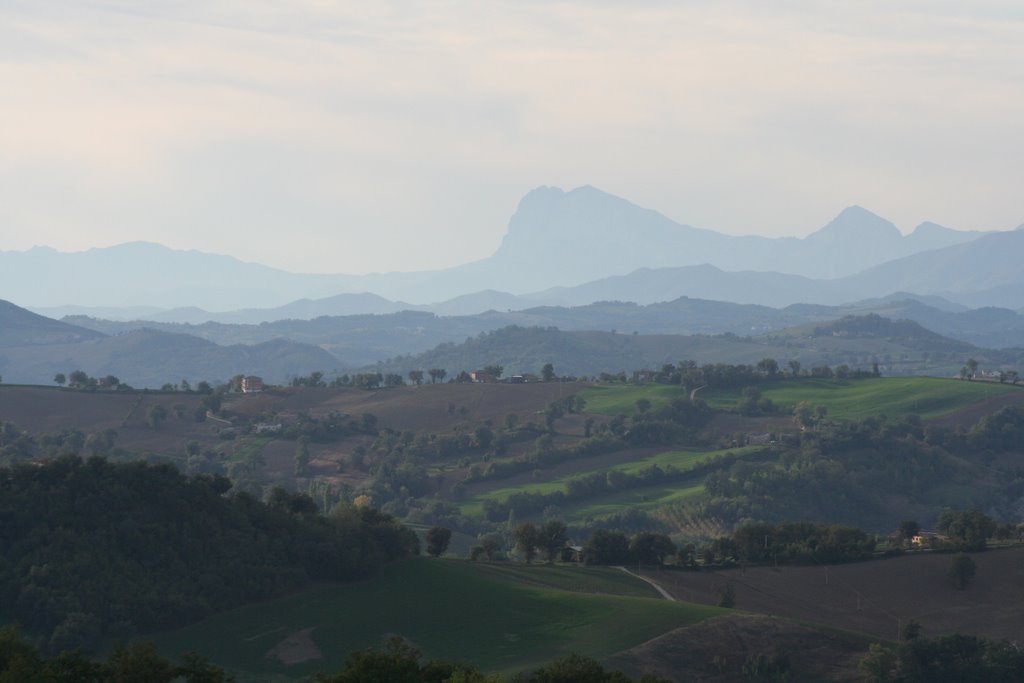 Hills near San Ginesio
 Interesting statue railing at the church - Corridonia
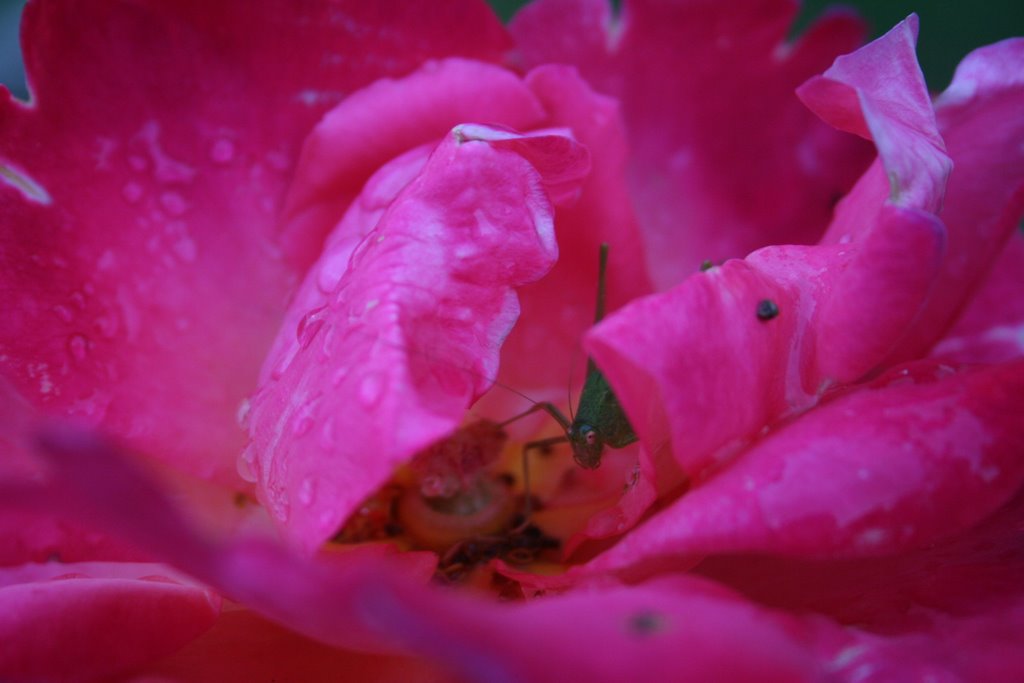 Maria's picture - grasshopper in rose
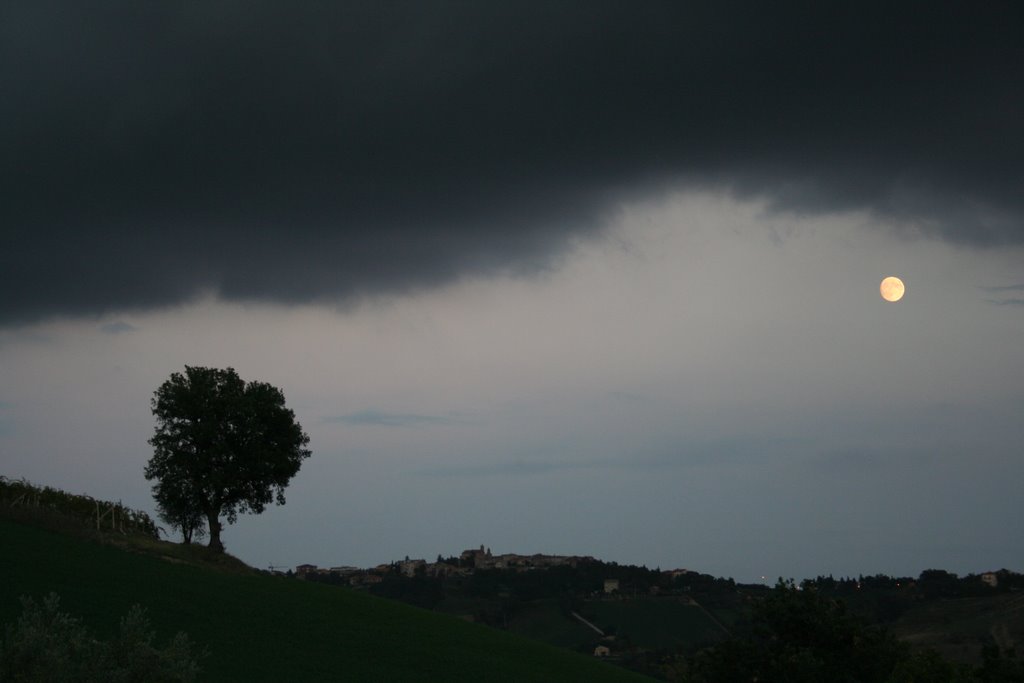 Brooding full moon rising over Colmurano
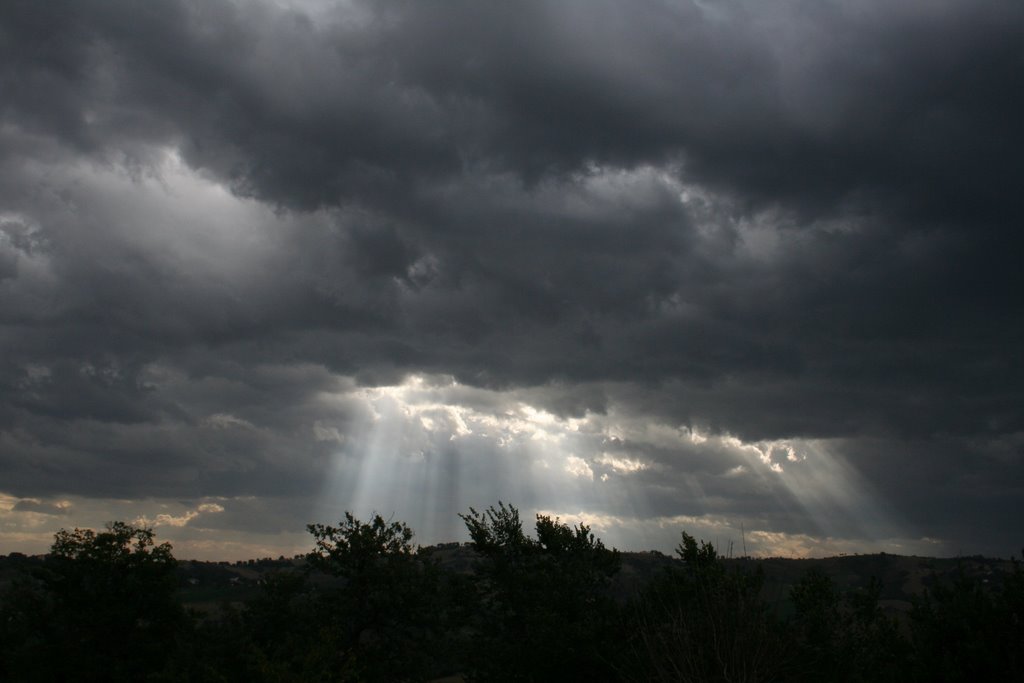 Threatening sky over Colmurano, but it didn't rain
 Sunset from home
 Abbadia di Fiastra, a wonderful, peaceful refuge (during the week) a few km from home
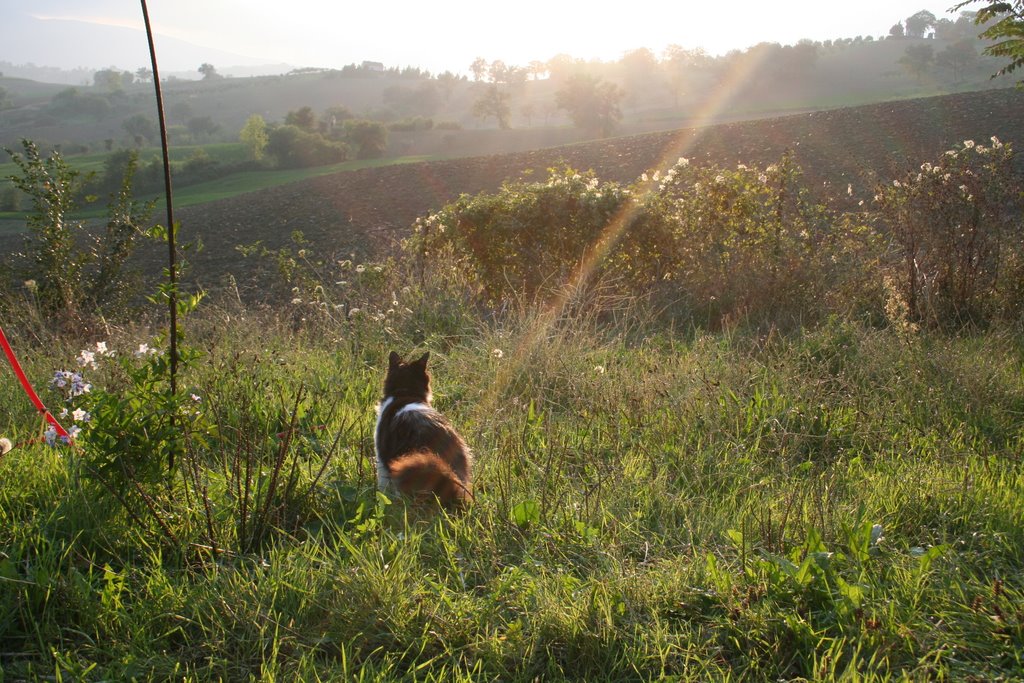 Mr Young drawn by the sunset
 A wizened face in the streets of Macerata
 Numana beach, about 45 mins from our house - that's us on the sand below
 Sunrise from home
Subscribe to:
Posts (Atom)