Friday, March 16, 2007

Driving in Italy

You look in your rearview mirror, and there he is … he’s so close he could inhale exhaust fumes direct from your tailpipe, and he’s trying to mount your boot/trunk and drive into your back seat through the back window. Who is he? Who is this obsessed maniac that suddenly appears where there was no-one just a split-second before?

He’s the Italian driver, deadpan-faced and on a mission – to get as close as possible to the car in front.

Our friend Michael says it’s baked into their persona. After nodding in obedient agreement at an explanation of the benefits of a good trailing distance, he will promptly jump in his car and try to use his front bumper to scrape the dirt off the registration plate of the car in front of him. In short, he can’t help himself.

He? Most of the time, yes. But I must say that women have graced my rearview mirror more intimately than I would have liked on more than one occasion.

Women are more like men in the following respect – overtaking in hair-raising situations. Without losing their deadpan expressions. This is a curious phenomenon for a passionate and expressive people – an appearance so calm that one might be tempted to wave one’s hand in front of their faces to see if they’re conscious. It doesn’t matter what the scenario is either – they could just have had a layer of paint scraped off their driver’s door by a 10-ton truck going 120 km/h – pokerface.

But back to the overtaking. Lines – dotted, solid, or spotted – on the road mean nothing. Signs? Don’t know why they bother to put them up. Width of road? Immaterial. If they want to overtake – I think there’s a hormone that kicks in and "takes over" (sorry) – out they pull, and forward they go. It’s a rare occasion – imminent death (for themselves) being the only remote possibility – that they would pull back in at the same place in the traffic. And regardless of the closeness of the shave or the havoc they may leave in their trail ... deadpan.

It happens so frequently that, if I see a truck heading towards me on a single-lane-each-way road, I instinctively look for an escape route, and start considering how I might negotiate the ditch or rocky slope or river or whatever should someone’s bio-rhythms take them out into the oncoming traffic (i.e. me).

Sometimes they overtake even when there’s no-one to pass. This is a favourite practice on winding roads with blind curves. Our friend Al has a general overtaking maxim – the blinder the curve, the greater the irresistible urge of the Italian driver to overtake.

Al also has another maxim – if you’re a pedestrian and an Italian driver makes eye contact with you, you’re a-goner. It’s all over. This implies some degree of intent, and therefore assumes that said Italian is paying some degree of attention to what he is doing. This is far from being a given. Quite the contrary, in fact. It seems that Italians use their driving time to catch up on a few things, most notably talking on the phone (which they do all the time anyway and simply can’t help it), and day-dreaming (which they don’t have enough opportunity to do and therefore grasp the chance with both reckless hands).

Parking? This perhaps more than any other aspect of life here gives a visual insight into the Italian mentality. One could think of it as an avant garde design exercise. Parking bays? A waste of paint. Orderliness and organization? Huh? Blocking another parked car in when there’s oodles of space just 10 metres away is standard practice – it’s your own fault if you park yourself into such a vulnerable position. Protrusion into a traffic lane? Blocking the view of oncoming traffic? Pardon? It’s part of the design.

Take a look at Bruno Bonzetti’s classic portrayal of his native culture (http://www.infonegocio.com/xeron/bruno/italy.html), and pay special attention to the parking skit. (They are, by the way, all agonizingly accurate.)

Having said all this, I must say that driving on the freeways (which we do probably less than 30% of our driving time) is a refreshing experience when compared with the US – the people actually use each lane for its intended purpose. In other words, after they’ve overtaken a truck, they move back into the right lane (left lane for British, South African, Australian, Kiwi, and Indian readers). Granted, some of them drive like bats out of hell, and they’ll suddenly appear out of nowhere, trying to climb into your back seat, all the while flicking their lights. But they do the same in Germany. And Austria. And so you move over.

What all of this ultimately adds up to is a precarious and pericoloso driving environment that doesn’t exactly rank amongst the best in the world – International Living ranks it amongst the 20 worst. This has a direct affect on the rates of insurance, which are I believe the highest in Europe. Try renting a car in Italy – insurance is mandatory, and it’s not cheap. We paid €554 for 6 months of bare-bones (and I mean bare-bones) coverage of my 1998 Honda CRV with 103,000 km on it. (We’re hoping for a reduction for the next 6 months after Geico, following about 10 attempts, finally gave me a proof of coverage letter for the 7 years I was with them.)

It also has a sinister side – death. Here they cover wrecked cars with white sheets if there was a fatality. A few weeks ago, 4 young guys in a BMW were killed in the wee hours on a freeway somewhere up near Pesaro. White sheet. The next day I saw another picture in the paper. I didn’t have to read the caption – white sheet. The images stuck with me for days.

With all our technical know-how and innovation and capacity for creativity, how utterly foolish we can be at times ...

Wednesday, March 14, 2007

Bologna photo essay

About a month ago, we took a brief one-day sortie to Bologna to do a restaurant review (my first - links will be forthcoming when it's published). I had the opportunity to wander around and take a few pictures. Here's a sampling of the fun I had.


Monday, March 05, 2007

An unasked-for learning experience

Every now and then life rears a head that we don’t pay attention to very often. And it reminds us not to take anything for granted.

Take the finger, for example. The index finger of your dominant hand, in particular. How often do you stop to think about all it has to do, and all that goes on inside it, when you straighten it, extend it, and stretch for something? I’ll bet you haven’t done this kind of thinking for a while (if ever).

But I have. Quite a bit too, for long seconds at a time, thanks to the deep slice that runs along a sizable part of my pointing digit.

It happened when Julius and I were on our way to a mountain ramble, and we stopped, as is our custom, to fill our water bottles from the mountain spring gushing out of the hillside next to the Fiastra road. Julius pointed out the icy patch to me, but my aging memory discarded the info when I turned to cross the road with a full bottle. The result was predictable – no traction on the shoe, out it flew from under me, down I went, unfortunately on the bottle side, and its glass shattered as I hit the tar.

It sounds cliché perhaps, but as I went down, it was almost in slow motion, and I thought ”Shit! I can’t stop this. I’m going to cut myself.” This was true.

It was a nice clean cut, deep, and it hurt like hell. So did the butt of my hand, which had a chunk of skin hanging from it, having taken the tail-end of the fall-and-break. But enough of the graphics. The finger needed 11 stitches, the base of the hand 5.

As a result, my left hand was called into immediate action to perform all sorts of tasks that it used to witness indolently as the right hand toiled. Like eating pasta, for instance, a vital life-sustaining task in Italy. Necessity being the mother of invention that it is, the left hand learned quickly, but I think it realized that it would never achieve the dexterity and proficiency of the right, backed as it is by long-established and powerful synapses in high places. Its respect for the right hand’s efforts has been further bolstered at tooth-brushing time, the morning’s dressing ritual, and during various other sundry (and basic) functions.

But it’s the stretching that’s the killer. I’ve learned to try and use my left hand when I can remember, or to keep my index finger bent when I have to use my right. But I forget, several times a time. And I pay. A sort of burning, buzzing, searing pain of a thing surges through my finger, and I’m compelled to stop what I’m doing – instantly. It happens when I’m doing something as simple as tossing a shirt over the chair, or putting a glass down on the floor next to the couch. These are not strenuous activities requiring great intellectual exercise. At least they didn’t use to be. Now unfortunately they are, and my life has become cluttered, with all sorts of considerations that were hitherto automaton tasks.

Ah well, everything’s a learning experience, right? There’s much to be thankful for. Like the fact that I didn’t fall face first on the road. Or that a car wasn’t coming along at the moment I fell.

And after the initial shock and resentment, my left hand has rather relished its new role, having its capabilities flexed and extended. I almost sense its disappointment as the finger begins its slow healing process.

Friday, March 02, 2007

Daily update - parte cinque

It's amazing what a voice raised in anger can accomplish. After numerous unfulfilled promises (the details are unimportant), and our house standing patiently waiting for its facelift, I lost it. I called Paolo (the builder), and in my fractured Italian, berated him for his absence and empty words, even questioning why I made a special effort to get him his first (sizable) payment.

Since then, he has been on site every day before 8am, works into the deepening gloom (at times dark) of the evening, and has gone so far as to curtail pranzo to but a single hour, a positively counter-cultural, even anti-patriotic, behaviour. Still more astounding, they're working in the rain, just as their colleagues run for cover and indolence for fear of melting (I assume).

Progress has been dramatic. The lower floor has taken on a rather more livable look than its previous rather obvious agricultural flavour. We're both holding our breaths, hoping the trend continues, and showed our friendlier side by inviting Paolo and his two assistants from Kosovo (with whom we've struck up a friendship) for a slap-up lunch, ostensibly to cement (sorry!) the relationship.

On the language front, for the past 5 weeks or so we've been attending Italian classes put on (for free!) by the Commune of Tolentino. The class is an eclectic mix of Albanians, Ukrainians, Senegalese, Indians, Peruvians, and French. The teacher and head of the academy, Franca, is a fascinating woman who speaks 5 languages fluently and runs an international store with products from the developing world. Like the renovation of our house, our linguistic progress has been notable and noticeable, although perhaps not quite as dramatic as the house's.

It's interesting how learning another language reveals our lack of knowledge of our own language. I'm now being forced to re-learn (learn for the first time?) imperfect tenses, past participles, pluperfects, and the like. I'm left thinking - who cares what it's called? Our natural proclivities are far more able to intuit it from simple examples (e.g. eat, ate, was eating, have eaten, will have been going to eat, wanted-to-but-couldn't-get-away-to-go-and-eat, etc.).

Oh well. As the apparently oldest person in the class, I do seem to get shown a little respect, and a small allowance for my clearly waning learning aptitude.

Curiously, I'm the only English-speaking person in the class. This is interesting given the profusion of expats in the area. Outside of our own immediate circle (which includes four English-speaking families), we recently met an Australian couple who live across the valley, and an English couple who are just a few km beyond. Then there are the English owners of a house near Colmurano, and the several families in the village I've heard tell of but never met. In the coffee shop I frequent each morning there's invariably an English accent in the buzz, and in the Internet store I go to each day, English-speaking customers come in almost every day.

It's really quite astounding, and the sheer numbers simply have to change the profile of this place in some way. So far the flow of English arrivals has already pushed house prices up by 15-20% and more for each of the past few years. Who knows how else it will manifest itself - it will be interesting (and hopefully not unfortunate) to be a witness to it.

Talking of the internet, I was recently referred to a new outfit that is erecting towers in the area for hi-speed wireless access. There's not one planned for Colmurano (right now 5km is the standard reach of the tower, ruling out Tolentino), so I'm trying to drum up the 10-15 names they would need to consider it. In the meantime, they've given me daily access (at a very reasonable cost) to their training room, where I plug in my laptop for 3-4hours a day. It feels just like going to work, which, in my so far low-income existence, makes me feel a bit better. Now I just need to make it work for me.


Sex and death in the Italian countryside

It’s a bloodbath on the roads around Regnano these days. Utter carnage. Like a bizarre canvas of splattered over-ripe fruit, the splayed figures of countless frogs are paying the ultimate price of their unflinching response to the call of nature.

They’re generally out and about after the rain – and it has been raining recently – but the recent numbers are unprecedented, certainly for us. On one trip home from Italian lessons in Tolentino on the curling, undulating backroads, there were probably 20-30 in one 10-15m stretch. Given our beastly sympathies, we stopped, and I got out to try and get them off the road and out of the “splatter and splay” zone. But they would have none of it, completely ignoring my nudging foot.

On closer inspection, however, I understood why. Several of them were indulging in an activity of a particularly sexual nature, while the remainder were simply waiting their turn. I can only assume that they had some sort of inside knowledge that their indulgences would produce a sort of "positive net procreative balance" when weighed against the death and destruction they risked.

Another curious observation was that the females – a safe assumption, I think – were inordinately larger, by several factors, than the males. Veritable Big Berthas they were, squatting passively and staring into the night with a look of utter boredom. I guess procreation can be a drag, particularly when you’re just being used, as female frogs clearly are. If there were such things as frog cigarettes, I would have expected to see one dangling precariously from her ample lips.

So this, in the end, was the answer – the road, and in particular certain obviously erogenous sections of it, is a “hussy highway”, a sort of “madam’s mile”, as it were. But why the road? Why not the slushy, squelchy mire of the sodden fields? This would be, I’d hazard a guess, a more appropriate environmental accompaniment, somewhat more akin to the reptilian form of the activity they’re engaging in. Perhaps they are out there in the damp darkness in far greater numbers than on the road, and I just can’t see them. But I’m not convinced. Must be some form of aphrodisiac in the aggregate used to lay the roads.

The bestial carnal frenzy seems to be over now. There are many who gave their lives for the cause, now anonymous stains on the road, soon to fade into reptilian obscurity. However, there are still a few of them out there. I saw one the other night, sitting – hopefully, it seemed – on the side of the road, looking for Big Bertha. Maybe he was a blooming teenager, hoping to learn from the pros, or try a few moves of his own.

“Where is everybody?” he asks.

I don’t know what to tell him.

Tuesday, February 27, 2007

Just another Saturday night

The toddler was crying. He had been for a while, a niggly, grisly, grating protest at his fatigue. The bespectacled woman, nondescript except for her piercing, nails-on-the-blackboard voice, was articulating a point with some passion. This involved projecting her strongest weapon at full volume, which for her was some decibels above anyone else. No mean feat.

Not to be outdone, the bespectacled man – anything but nondescript with his impish smile and artistic bent – was articulating a counterpoint. Simultaneously. They were talking to each other. Others were listening, although I’m not sure to whom, perhaps exercising an innate Italian skill, listening with one ear to each of two vocal combatants, much in the manner that a chameleon moves its eyes independently.

I couldn’t understand a thing.

The toddler cried, despite the attention of its mother. Others expressed concern (or at least appeared to, given my reliance on facial expression and body language for translation and interpretation). I thought I must be missing something – surely he would be taken to another (quieter) room, away from the cacophony of deafening competing opinions? Apparently not. It was like the frustrating experience of watching a poor spider falling continuously each time he tried to scale a (for him) precipitous slope, when a gradual slope invited his ascent just an inch or two away.

It was midnight on Saturday, and just another friendly get-together in a regular Italian home in Colmurano.

Julius and I had arrived at what I thought was fashionably late, 15 minutes beyond the appointed hour – 9:15 pm – only to find that we were the first to get there. By half an hour. I should be used to this now, I suppose – arriving within half an hour after the agreed time is considered early. Perhaps I’m just confused by the one clear anomaly to this rule – school pick-up time, when a tardiness of just 5 minutes will greet you with a ghostly, deserted school, and possibly even a mild reprimand.

Back to the night out – 5 families, including the host and us, with 7 kids in total. Games for the kids, and discussion for the adults. And food, of course, a table-full of snacks (this being an after-dinner gathering), which kept getting refreshed with roasted chestnuts, along with a wide selection of sugar and starch. Perfect late-night fodder to sink like a lead weight into fitful sleep.

The mother of the toddler eventually left to take him home to sleep – perhaps a rather extreme and overdue solution – leaving his bespectacled father to continue his verbal bout with the bespectacled woman. At around 12:30, we rounded up the kids, who were zinging through the passageways riding on their sugar- and starch-horses, and dispersed.

I feel lucky that we were invited to such a gathering. Stranieri (foreigners) in a local scene. And frustrated that I could barely understand a thing. It prompted me to look more earnestly into Italian lessons. After all, why shouldn't I be able to don my spectacles, express my opinion, and make my contribution to a toddler's sleeping habits ...
Appennini aria

The smoke wafted tantalizingly within osmic distance. I savoured it, savoured the memory of those deep draws of pure satisfaction from my days a social misfit (i.e. as a smoker). It may be a year and a month and counting since I last had a cigarette, but there’s not a day goes by when I don’t crave for one. Starting up again would be a breeze … and a catastrophe.

Which is why I grasp those occasional second-hand smoke opportunities when they drift my way. However, I must say I was surprised to encounter this one – on a trail winding through the woods on a steep hillside on the way to a religious cave in the Valle di Fiastrone forests. The smoker was the father of Ornella, deputy mayor, 4th grade teacher in Colmurano, mother of Julius’ classmate Marguerita, and friend of Claudia’s. For 22 years her father (the smoker) was a protector of animals from illegal hunting and the like, working in the service of the forestry service. Today he’s retired from his official job, and has settled comfortably into his role as contadino. Amongst other things he distils his own firewater, a well-established and respected contadino activity, and a few of his particular concoctions have numbed my mouth on several occasions.

Aside from his smoking and distilling habits, he’s a character, but that’s not the only reason I didn’t complain about his smoking on the trail – after all, a toke is a toke … but on the trail? Only in Italy.

Just another example of how this country is nothing if not a smorgasbord for the senses. While the auricular is perhaps the sense most impacted by the Italian experience, the olfactory is not far behind. And right up there is the intense, impossible-to-dislike, unmistakable aroma of coffee. It’s everywhere – in the piazza, walking on the beachfront promenade, idling past ancient monuments … and taking a break on a mountain trail in the Apennines!!!

Yes indeed, there we were at the hand-built hermitage – church, really – of San Leonardo in the Gola dell’Infernaccio (Hell’s Gorge), when the whiff coming from the Ancona man’s coffee pot atop his portable gas stove turned every head of the 30+ hikers in the vicinity. It was the trigger for a bout of good-natured verbal sparring between his party of a dozen or so and ours of similar size. As part of the repartee, we were treated to coffee laced with Sambuca, no less – no need to scrimp and deprive yourself just because you’re in the mountains.

At the risk of stating the obvious, Italians are a social people. To extend the risk somewhat further, they’re also sensual, as in “I want some of whatever it is that’s generating sensory overload.” Perhaps we would have interacted with the Ancona group anyway, but it’s interesting that it was an aroma that provided the catalyst. Followed, of course, by a treat for the taste buds. And all the while surrounded by a veritable feast for the eyes, the gorge stretching up and around dramatically (apologies for the cliché, but it just fitted).

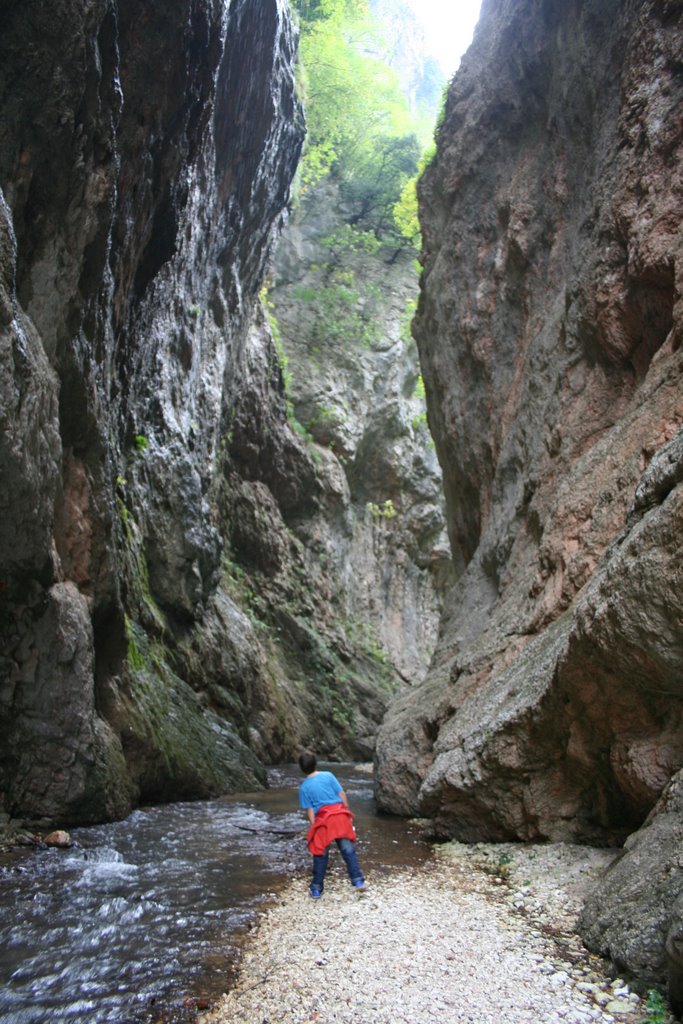
The Gola dell’Infernaccio is a dramatic, twisting passage through curved, jagged cliffs that turn back on each other as the Tenna River finds its way down from its source on the mountain slopes. The path through the gorge ends up in Rome, so I believe, at one time providing the only route between the capital and this area. Its spectacular aspect prompted Fra’ Pietro, a Capuchin monk, to build his church on the remains of an ancient Benedictine hermitage, with his own hands. He’s been living there for over 30 years. Every Sunday he dons his ornate vestments and conducts a service. The church is always full.

Vitaliano

“Ciao!” he says, arm and fingers raised in crooked salutation. They create an apt frame for his round head, bent forward and sideways in focused gesture. From eyes that lodge deep in the hollow sockets of a face shaped by eons of trial and toil, Vitaliano looks out at the world.

What does he make of these stranieri, these inglesi, who have begun to invade his land, surrounding him with their blustery exuberance and stone houses renovated to a condition that he’s been trying to leave behind all his life? Why are they here?

Life is hard for him – 70 years old with a frame that’s starting to creak, and still he has to work the land on his own. And yet here he was today, early February, mid-winter, offering us lettuce with the fresh earth still dripping from its leaves. We are neighbours. And as strange as we may be to each other, we look out for each other.

Vitaliano is the quintessential contadino. That means peasant, and in spite of it seeming to rankle of derogation (at least to me), it’s widely used to describe any class of people who are freeholders and who work the land. Their roots go deep into this earth, going back who knows how many generations, and they simply cannot be anywhere else – this is where they belong. It’s as simple as that.

Vitaliano’s house is an unfinished project, beyond his means but not his dreams. Stepping inside it for the first time – which we did to give he and Orellia (his wife) their Christmas gifts (mainly clothing) – it appeared from the state of the kitchen/dining room/lounge as if the plot of the dream has yet to take coherent shape. He was clearly uncomfortable to have us surprise them unannounced, and in retrospect I wish we hadn’t – despite their humble lives, they have a pride which hurts when dented.

When we first met Vitaliano during our September 2005 visit to see how our house was doing, he asked if our offering of chocolate was because we wanted to be his friend. We said yes. I might be misinterpreting his attitude at the time, but I remember it as edged with aggression, given that the previous owner was like a brother to him. But there’s nothing like that now, and I’d say there’s a solid respect between us, each with our own reason and different perspective.

He is nothing if not generous in sharing what his land produces and supports. Last week we ate the pigeons he gave us – plucked and frozen, thank heavens – with a few sprigs of rosemary from the veritable bush that he gifted us along with the birds. (All contadini around here keep pigeons, it seems, as a food source, fiddly and finicky as it is to eat them – for all we know, they’re a delicacy.) We still haven’t made it through his bunch of garlic, and we remember the fall and his earth-caked tomatoes, hand-picked from his vegetable garden. These are the things we came to Italy for.

And then we have our points of departure. Treatment of animals, for instance. Apparently, last spring his dog (Hyena, from a previous post) had four puppies. Vitaliano decided that his environment could only support one. He killed the other three. (I’m not sure how, but perhaps that’s irrelevant.) This is his crude form of birth control. He must have wondered at our obvious grief at Mr Young’s death – he was just an animal, after all.

The most obvious emblem of the contadino is the Piaggio, or cocolore as Maria has named them – 3-wheeled scooter bugs made by Ape (pronounced “ah-peh”) with one seat in the semi-open “cab” in the front, and a small open pickup-type bed on the back. Seeing them buzzing – “buzz” being used here to convey sound rather than speed – with a laboured whine on the curving roads is confirmation that you’ve arrived in rural Italy. Like their brethren Vespa, buzz-thing of the Italian urbanite, cocolore are veritable institutions for the contadini who putt-putt around in them from farm to market to church to neighbour.

Vitaliano, of course, has one. It’s his only form of transport, frequently getting him and his wife Orellia all the way to Tolentino and back. Seeing the two of them spilling out of its open sides triggers thoughts of scenes from some sort of weird, creepy movie (The Twilight Zone springs to mind). Massimo, their bus-driver son, has a car, but I’ve only ever seen Orellia in it once, and never Vitaliano.

Massimo, a miniature version of Vitaliano, bald spread and all, spends a few nights a week here. He recently sold his Mercedes to an Albanian – it had 600,000 km on the clock. I wonder what he got for it. Sometimes he brings the bus over to get an early start in the morning for one of his longer trips to Paris, Stuttgart, or other distant destination. It adds to the surreal picture seeing the luxury Pullman standing next to an unfinished contadino house with its requisite cocolore standing outside.

Regnano’s little microcosm has taught me never to be surprised at what you might find here. Naturally, I still am. I wonder how we contribute to its flavour – I sincerely hope it’s in some tasty way. It is certainly changing – with an English couple, an Australian couple, and a South African-German-American family all within eyeshot of each other, how can it not? But here’s a hope – that we don’t change Vitaliano and his values, and if we affect his life at all, that it’s in a positive way.

Tuesday, February 06, 2007

A visit to an Italian hospital

I have an aversion to hospitals. It’s not because they’re associated with illness and injury, or because they have that memory-triggering, clinical smell, or even necessarily because of the practices (and malpractices) perpetuated in them. Instead, it’s first and foremost because of the mounds of red tape and hours of waiting involved every time you step near one. At least that’s the way it is in the US.

So when I sliced my finger nice and deep after slipping with a glass bottle in my hand, I was more inclined to take the path of natural healing than the path to the hospital – clean the wounds, pull them closed, cover them up, and then bandage them securely. However, six hours after having done this, when the pain and bleeding hadn’t stopped, it seemed as if it might be prudent to get another opinion.

Not having a family doctor to call on, we headed for the hospital in Tolentino, where we expected Italian bureaucracy to stand tall, proud, and in the way. I took 3 books in anticipation of the wait, to accommodate the several mood swings that I anticipated during the hours we would be waiting see a doctor.

We arrived, and, to my surprise, found a parking within walking distance of the emergency room – a novelty when compared with the States. At the front desk (where nobody asked us to fill out a form), we were duly directed to the right place, which, instead of involving a maze-like path following a yellow line, simply required going down one flight of stairs.

When we stepped through the doors in front of us, we were in it – the emergency room, that is. No counter with a diversionary clerical squad asking for cards and IDs and mother’s maiden name … just a nurse and a doctor. Within the first minute, my bandages were off and the nurse was cleaning my wounds (vigourously) while the doctor got my details from Maria – all he asked for was my ID card and where I was born. Then he came over and stitched me up. We were in and out of there in just over an hour, of which perhaps 3 minutes was spent on administrative stuff.

Of course our experience was helped by the fact that there was no-one else requiring attention, and the only flurry of activity involved a changing of shift. But still – this experience beats anything I’ve ever encountered. It’s no wonder the World Health Organization consistently ranks Italy’s medical care the best in the world (although I’m sure they use a few more exacting measures than “time-to-operating-table”).

After the shock of the accident wore off, the shock of the ultra-efficient hospital experience still had me in a daze. I almost didn’t notice, as I got into bed, that the anesthesia had worn off and they hadn’t given me any pain killers …

Thursday, February 01, 2007

Why we moved to Marche - the good stuff

As I’m discovering, it’s very easy to write about the challenges of our new life here. Perhaps that should be a bit of a concern, given how it reveals a certain tendency in my character to focus on the negative. But it is cathartic, and thus helpful in its own way.

However, it does present a somewhat distorted view, which needs – through periodic posts like this one – to be put right. Here’s an example of the upside …

A few weekends ago, in order to try and atone for his rather gloomy and gift-less birthday following the death of Mr Young, we promised Julius a trip to Monte Vettore, Marche’s highest peak at 2,476m. He’s been hankering after a frolic in the snow for some time now, and has developed a burning desire to live in some remote place high up in the mountains, cut off from cities and crowds and, of course, school. He’s developed this romantic notion of living self-sufficiently – hunting (wild boar, like Asterix & Obelisk), growing vegetables, and experiencing the elements in all their depth and power. He’s even asked to go camping in the mountains, now, in winter, in the snow. His persistence has required me to take the request seriously, and my own alarm at the prospect has brought forth sources of reasoning that I didn’t realize I had.

Anyway, back to the frolic in the snow – since there hasn’t been any, at least prior to Christmas, it’s been a little tricky to oblige him in his request. However, a sprinkling in the mountains during the week after his birthday gave Julius some hope.

Saturday broke clear and glorious. When we got in the car, we actually stopped to consider our options – beach, or mountains. I dare say we could have swum in the sea – although perhaps only briefly – but we eventually decided to head for Monte Vettore. Such is the glory of Marche – that very same day, friends of ours went fishing at the ocean, and came back with sunburn.

As for us, after an hour of hiking, we reached Vettore’s base, and, given the icy state of the path, I made the executive decision not to go any further. Julius, after complaining that I was wimping out, enjoyed himself by sliding down some of the snow banks that dotted the mountainside. We even picked up some creamy gelato in Amandola on the way home.

Two weeks later, after a few more flurries, we headed to Sasso Tetto, the local ski resort just less than an hour away. The slopes were closed to skiing, there not being enough snow, but they were open for sledding, and we joined the rosy-cheeked Italians in careening down on all manner of snowcraft. Despite – or perhaps because of – the biting wind and stinging snow, it was an invigorating escape from the daily worries and challenges, and the time flew by as if in fast-forward. It gave us a good nudge on how to direct our energies most positively and productively.

A final note – one of the best aspects of this type of experience is the appetite it builds … and the way it is satisfied. Which is, of course, one of the other reasons we moved here …

Oh how I yearn...
I want a hot shower. I want to lose myself in the dreamy stupour induced by water crashing on to my crown and weaving its warmth over my closed eyelids, down my face and onto my shoulders. I want to feel its permeating glow running down my flanks, smothering my legs, and thawing my toes. I want to stand there, motionless, euphoric, transported, and not care about anything except the warmth I am experiencing – just simple, friendly warmth.

I haven’t had a hot shower for months now. At least not in Italy. The few showers we had in our own house were “challenges”, to put it mildly – a hand-held snake that spouted water from both ends, at a temperature that was both fragile and, when more than lukewarm, short-lived. Over Christmas in Germany, the showers in Maria’s parent’s house were more ordeals than anything, given the set-up of the bathroom and the protocols involved. The net result was a minimalist approach to staying clean.

In our rented house here in Regnano, the shower temperature has never risen above warm – “quite warm” would be as generous as I could offer. “Hot”? Nope. Not once. Maria claims to have had a hot one, but she can’t remember when. We’ve tried at various times of the day, freeing the water heater from any load for some time before taking the plunge – to no avail.

In a house that’s cold and draughty, it’s become another colourful, character-building aspect of life here. We always knew that we’d have to give things up to gain the benefits of Italian living – good beer? Yes. Shopping at lunchtime? Uh-huh. Easy communication? Yup. Hot showers? Uh-uh.

As always, though, we must look for the silver lining. It’s temporary. At least I hope it is. If anything, it has given me some serious motivation to make sure the plumbing set-up in our own house is tip-top.

Rita

Rita is Julius’ history and geography teacher. She has deep-set, staring eyes, bony, square features, and hair that’s a sort of mauve-red (an interesting colour choice for someone in their fifties). When everything’s put together, it gives her a certain gypsy look. This should make her interesting.

But she never smiles, at least not that I’ve ever seen or heard about, and, by many, many accounts from both children and adults (including other teachers), she has a proclivity for yelling … at children. In some cases this yelling doesn’t always appear to have a clear cause, a rational grounding, or a logical pattern. It’s unclear whether this “unjustified yelling” is in the majority or minority (when compared with the (debatably) “justified” yelling), but the fact that it’s even a contest is concerning, not only to a parent, but also to protectors of the principles of good, all-round education.

It’s so bad that Julius asks to stay home on days when he has Rita for anything more than 2 hours. Thursdays in particular he faces with dread, given the four hours of Rita torture that await. It’s highly unfortunate, given his love of geography and history.

It got so bad that he asked Maria to talk to Rita. She did, asking for a more gentle hand given Julius’ struggles with the language, friends (or lack thereof), and the loss of Mr Young (a continuing aching hole in his life). She (Rita) was very receptive, and even horrified that she might be the cause of Julius’ disinclination toward the scholarly dimensions of his life.

She thanked Maria for approaching her, and told Julius to let her know when she was overdoing things. Well, my dear son, contrary to my expectations of his reaction to such an invitation – his shyness manifests itself in a reluctance to join groups that do things he loves (e.g. play soccer, music, etc) for fear of being “shown up” as inadequate – called her on it the first opportunity he had. He told me this in a straight matter-of-fact tone as if it was the most natural thing to do (how our children, like our parents, never cease to surprise).

Unfortunately, Rita’s reaction wasn’t quite as welcoming as her initial invitation. She turned on two of the other boys in the class and told them to “calm down” (this is what Julius had suggested she do). Julius felt the whole point was lost, and therefore that her invitation was insincere. Since then, she has been markedly cold to Julius, even more critical than usual of the other kids, and – of even greater concern – seems to have similarly influenced the demeanour of her normally warm and approachable husband, who is both the headmaster and Julius’ math teacher. Perhaps needless to say, Julius hasn’t told her to calm down since.

We have toyed with the idea of keeping Julius back a year to repeat the fifth grade and allow him to develop a better grasp of Italian before making the big leap to middle school. Methinks that if we do, we’ll be driving a little further than we do now, to a different school …

Respite

Phew! The wind has stopped. It’s a whole different world out there. It seems like it’s been blowing for so long, I’d almost forgotten what it was like to have no wind. Don’t get me wrong – I’m all for experiencing the elements, and will even travel to find them, but after days of constant, battering gales and gusts, where you can’t venture outside for fear of being bowled over (like our barbecue) or have the chill blown all the way into your bones, it was time for a break. Besides, it rendered us incommunicado at home, with our cell-phone struggling for reception and our bodies resistant to the necessary outdoor requirements of our telephone communication.

This wind is not the kind of thing one would naturally associate with central Italy, nor is it something I expected or came looking for when I moved here. I’m not sure that it’s a common occurrence either, but this January it was definitely a phenomenon.

The very antithesis of the warm and sultry Mediterranean scirocco, this wind has a somewhat ominous dimension to it, an unspoken statement that there’s something big behind it, which if fully unleashed, could split the world. Most noticeable is its voice – a constant, heaving wail, like a chorus of dead souls baying for atonement (or perhaps revenge). It’s almost as if it has a character, a rather devious, multiple-personality one, with a wit to match its malice – a sort of Falstaff, Rasputin and Attila the Hun all wrapped into one. And it’ll find your flaw and slap it until it flares, snapping your composure just when you most need it. Simply stated, it is beastly.

If I could have taken a photo of it, I would have. But such is the nature of wind – it’s invisible. And therein lies its ultimate power – we can’t see it coming.

But I ramble. The weather’s gorgeous now, and I’m going to head outside to enjoy it.

What’s that? I see the trees starting to stir. Looks like a breeze is picking up ….

Friday, January 12, 2007

Working in Italy - Maria's experience

A couple of weeks before Christmas, Maria got a call from an employment agency that she’d registered with, for a German-speaking job in Civitanova Marche, a half-hour from here. After the interview, she was hired on a probationary basis, and so our lives changed.

The job entailed talking on the phone to German car sellers for an Italian who buys them and resells them to his clients here. The cars are identified on an online German website, and then drivers are sent up to bring the cars back. The proprietor is a 30-something-year-old choleric who walks about the office yelling and screaming, and has yet to direct a word Maria’s way. Apparently he’s been inside the clink.

Also in the office are an Italian (a qualified schoolteacher), and a Croatian. They are the first responders to phone calls coming in from the Italian clients. Leticia, the Italian, is friendly and an ally. Maurizia, the Croatian, is sullen and prone to outbreaks of tears and frustration, and, as it turns out, not to be trusted.

The atmosphere is barely short of a penitentiary – cameras monitor every move, phone calls are recorded, and all work on the computers is tracked. Talk about Big Brother! Here’s a man who clearly doesn’t trust himself.

When Maria returned from Germany, she discovered that she didn’t have a contract for January, and so decided to stay home until they resolved it (given that she wouldn’t be paid without a contract). The boss wanted to make it the Croatian’s decision so that she could be blamed if something went wrong either way. The Croatian didn’t want the decision because she’d be blamed if something went wrong. Wonderful situation.

It’s now been 3 days, and they haven’t even bothered to call. Chances are they’ve decided not to continue with Maria, but they simply don’t have the guts or the courtesy to pick up the phone and let her know.

Not that she’s sweating it. Having someone peer over your shoulder at your every move for €7 an hour isn’t exactly what I’d call motivating…

Daily update - parte quattro

A lot has happened – or not happened, as the case may be – in the month-plus since last posting a general update. The events relating to Mr Young have dominated, but these are documented in other postings, so I won’t spend any words on them here.

On the building side, the official absolutely last day (according to our contract) that renovations would start – December 11th – came and went neither hide nor hair of Paolo (the builder). Finally, the day before we left for Germany (December 22nd), a platform was built for the crane. When we came back two weeks later, the crane had been delivered and installed, but nothing more. Another week later, and we’re still waiting for some real activity, although there have been a few symbolic hammerings coming from down there.

The story on the Internet, telecommunications, and postal fronts are no better, but then who would have expected these services to change their attitudes in the space of two weeks. I’ve railed enough in the past about their ability to take incompetence, indifference, and laziness to a whole new, mind-boggling level. So I won’t spend too much time on it, except for one thing that I must confess I simply marvel at – the Italian’s propensity and unscrupulous tendency to simply put the phone down when things aren’t going their way. This doesn’t apply just to government agencies like the telecommItalia or posteItaliano, but to private companies as well. I am astounded by this. But I also realize that if I am to be happy living in this country, I will simply have to accept it, and live with it.

On the car front, we finally found an insurance company that gave us some credit for our period of coverage in the US – and a break on the premium – on the Honda that we bought. It’s a German-based company, perhaps not surprisingly.

Julius returned to school on Monday (8th), to a brand new building, renovated after earthquake damage in 1993. Apparently it took this long to complete because some of the relief money was only released in 2006. It’s beautiful, with high ceilings, arched windows, and a fully-functioning, commercial-level kitchen and canteen. On the Sunday before school started, the whole village turned out for speeches, food, and wine to celebrate its opening.

Monday was also Julius’ 11th birthday, an uneventful and somewhat sad one this year. Given the events of the past few weeks, the only presents we were able to muster were some brightly-coloured flowers for Julius to tend and plant in the spring in remembrance of Mr Young. It’s been a tough week for him, but our borrowing of The Two Towers (Lord of the Rings) has helped to distract him.

Today he called to be picked up early because of a headache. This was really a euphemism for claustrophobia, and a ruse to get out and about on a gorgeous, 15°C (60°F) day. Given their freewheeling approach to life, the Italian attitude to the outdoors is a little surprising – at the slightest hint of cold weather, they recoil and run scurrying for cover. And the fact that it’s January (winter) seems to taint every consideration of the weather, regardless of what’s actually happening outside. As a result, Julius was severely scolded for opening the window “to get some fresh air”.

It’s a cause for concern – boys of his age need a channel to expend energy, but the schools here don’t even let them go outside, regardless of what it’s like or how they are dressed. And they keep them there until 4:30pm, often sending them home with homework, leaving precious little time for activity when they get home. In Columbus, Ohio, as a 4 and 5-year-old, Julius went outside for several hours a day, whether rain, sleet, or snow. Not sure what we’re going to do about this one…

Christmas in Germany

Aside from the cheap airfares, another advantage of living in Europe is that you can get in your car in the morning and be in another country in the afternoon. Of course, being in relative proximity to Maria’s parents, Christmas in Germany was a given.

It took 10 hours to get there, driving through northern Italy, western Austria, and Bavaria in southern Germany, a relatively pain-free passage. Traffic going the other way was stopped dead, in some places, for 10km, without any apparent reason. Driving on European expressways is a pleasure, too, since, unlike the US, people know what lanes are for, and “the fast lane” has true meaning.

The two-week visit was tainted by Mr Young’s death within an hour of arriving, but in some ways it was the best place it could have happened, with loving and caring family and friends around to provide solace to Julius and Maria.

The Advent calendar is very big in Germany, and many towns – Forcheim near Maria’s parents being a great example – have larger-than-life calendars in the central plaza, accompanied by the ubiquitous Christkindlmarkt. Niklaus (Santa Claus) himself comes on December 6th, and the tree is decorated and gifts are exchanged on the 24th. We enjoyed venison and goose with Maria’s sister on the 24th, attended a (long and laborious) Christmas service at 10pm, and the next day stuffed ourselves again with duck at Maria’s parents.

New Year’s eve was spent with friends of Maria, culminating in fireworks all over the village at midnight. Fireworks are freely available to the public, and Germans spend some €60M on the stuff at New Year. Amazingly, there are very few incidents of injury. Imagine the same in the US – it would be pandemonium, if not life-threatening, providing ample reason enough to stay at home on New Year’s eve.

Aside from the obvious value time with family, we enjoyed good beer, schnapps, and food, with fish – carp (a local specialty), mackerel, and “waller” – on a few occasions providing welcome relief from the ever-present carnivorous diet. Also played some great tennis (for the first time in years) with some 40- and 50-something-year-olds. Strolls in the woods and exploring on bicycles with Julius were amazingly (in comparison with rural Italy) free of barking and attacking dogs – on one occasion as we approached a particularly large yet obedient and unexcited German shepherd, I said to Julius: “If we were in Italy, I’d turn around and flee.”

Julius didn’t want to leave, wanting to make sure that the candle on Mr Young’s grave was kept alight, and the fact that it would just “be easier” to stay in Germany. Maria’s parents were of the same opinion, and I heard from her mother about the folly of our Italian escapade on a few occasions.

Parting is always hard, and it was no easier on this occasion – I have this picture in my mind of Maria’s aging and frail parents standing tearfully and forlornly in their doorway as we drove away. The 1,057km drive took 11 hours coming back, with one long 25km stop-start stretch around Munich costing us the extra hour. Getting back to the house without Mr Young was, of course, wrenching, and it felt totally empty.

But being back in Italy helped also to highlight the stark differences between these two countries separated by a mountain range and a cultural chasm. Here are just a few:

  • In Italy, strangers – men or women – greet you with kisses, while Germans stand their distance and extend only their hands.
  • After clean streets for two weeks I’m now back to dodging excretory mines on the sidewalk.
  • After the cold, grey, German weather, the sunny skies and blustery winds are welcome indeed, even if there’s no snow to please Julius.

Walking through the streets in Germany I was struck by how, well, Germanic everyone looks – square jaws, thin lips, deep-set eyes, strong bones. Duh? I guess somehow I don't subscribe to generalizations. In this sense, though, the Germans seem to conform to their caricature.

However, in another sense – efficiency, reliability – they did not, although I’m not sure if it was the Internet curse I brought with me that was the cause. The network of the only wireless hotspot I found was not working on the day I dedicated to catching up …

Trip to England

One of the advantages of living in Europe is the cheap air fares that facilitate shuttles between countless countries and cultures. At the end of November, we took advantage of one, from Ancona (our closest airport, an hour or so away) to Liverpool. €1 per person each way, plus tax, making it a total of €118 for all 3 of us. (That, however, is where the economic side of things ends – England, with its super-strong pound, is very expensive in euros, never mind dollars!)

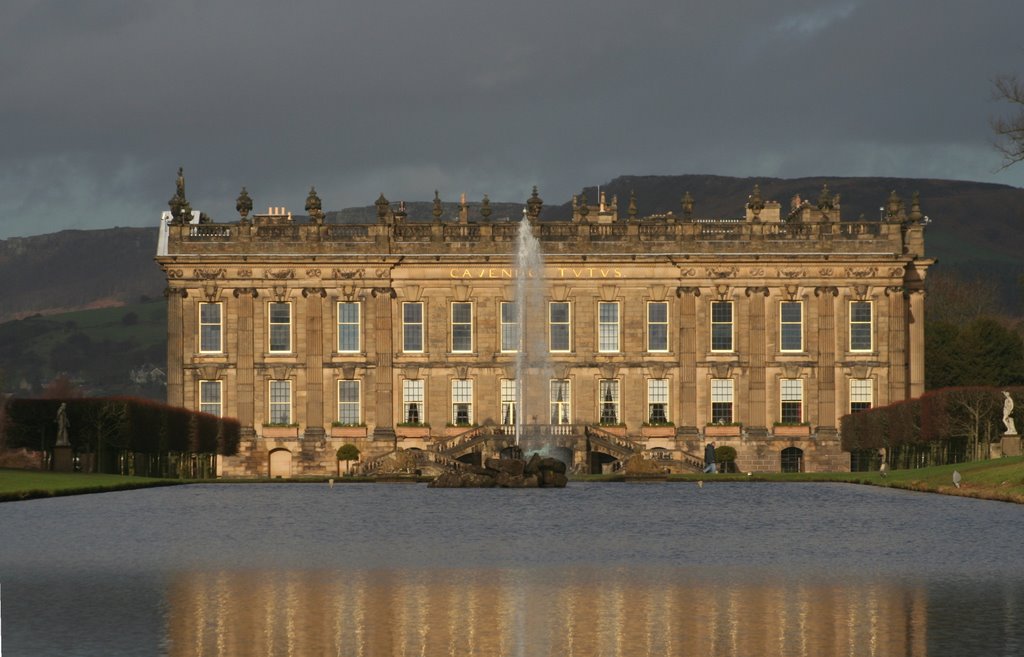
We flew in and out of Liverpool, and were treated to the warm and welcoming hospitality of our friends and landlords, Al and Vron, in West Yorkshire in the High Peaks area. Aside from being just a bloody good time being together, we got to see York and its Minster, Whitby with its moody abbey ruins on the blustery coast, and the stately Chatsworth, home of the Duke of Northumberland. Had fish ‘n chips in Whitby, Yorkshire pudding at home (along with several other superb meals), drank some good bitter in a few warm pubs, and watched the SA vs World XV rugby game live on TV (going to the game was the original impetus for the trip, but it just didn’t work out).

Leaving Liverpool airport introduced us to the new UK, uncompromisingly and unflinchingly unmovable on the “no liquids” rule. We tried to travel light and not check baggage, taking everything on board the plane. Big mistake.

Granted, I can see how my Gillette Sensor razor blades could slice off the plane’s wing in mid-flight, so I gave them up willingly. But marmalade and a tape measure? Into the bin they went, along with the peanut butters, lip glosses, and other weapons of the terrorist’s arsenal. The shaved-headed twenty-somethings that conducted the pillage even took one tiny bottle away (a very expensive essential oil) because “I don’t know what it is, luv.”

Perhaps it’s our own fault in the end – we should have known – but we really didn’t think that the English could match, let alone surpass, the security zealots in the US. But then again, who’s to say that the marmalade made by the Housewives League of Holmfirth isn’t packed choc-a-bloc with explosive ingredients, or that they are secretly funding Al Qaeda operations? The England of olde – friendly bobbies without weapons – is clearly a thing of the past. Apparently, there is more surveillance in the UK than anywhere else in the world. Perhaps this is all necessary. I don’t know. All I know is that it’s a shame.

The eventful nature of our return didn’t stop there. Ancona was fogged in, so we were diverted to Pescara in Abruzzo. Thankfully buses were laid on by Ryanair, and we were on the road in short order, finally getting home around midnight instead of 9:30pm.

We were then greeted with another stark reality – Mr Young was nowhere to be found. We had left him with enough food and water for the 5 days, and left the upstairs bedroom window open so he could at least get outside on to the roof of the patio. But it was too long for him – he had fled. We searched all around, calling and pleading, but no response. So we went to bed, anxious and concerned.

Maria found him the next day, perched high in a neighbour’s tree. He probably got down from the roof after a few days, and then, when he found he couldn’t get back into the house, sought out the safest place to him in a hostile environment of roving dogs and wild cats. For a highly-strung creature like a cat, it must have been terrifying. Apparently severe stress like this can cause a thrombosis, and this could well have been the cause of his mysterious affliction a week later, and ultimately, his death on December 23rd.

Now that he’s gone, I’m constantly brought back to this incident. What were we thinking, for 5 days leaving a totally dependent creature that identifies so strongly with its family that it relies on them for not only food, but also for comfort, security, and general wellbeing? And what goes through an animal’s mind at times like this? Was he going to look for us? Did he think we had abandoned him?

There are no answers, only haunting questions …

Our beloved Mr Young

There’s a spirit burning brightly in the winter air beneath Julius’ tree in his grandparents’ garden in Röttenbach, Bavaria. Our beloved Mr Young lies there, a premature victim of the stress that our roving lives created for him. Julius has lost his brother and best friend, and we a loving member of our family.

The days are different now, there’s something missing, and that empty part in each of us still cracks wide open as we struggle to adjust to life without our loyal and trusting companion. At least once a day I still hear his bell, and just half-an-hour ago I heard his “hello” chirrup from some shadowy corner of the house. And as with each and every instance of these audible reminders, I turn in hope, only to realize that it’s my heart making echoes of our wishes.

As time goes on, all this will happen less frequently I suppose, until we remember and talk of him – both happily and sadly – with steadier voices and drier eyes.

In the end, I think all of our roving was just too much for him. The move from the US first to Germany, and Maria’s parents’ yappy poodle … then to the Italian countryside with its overpopulation of wild cats and world of strange and ominous things … then to our rental house with the 4 dogs across the street … our 5-day absence in the UK in early December … the mystery blight that leveled him and hospitalized him for 2 days … and the 10-hour car trip to Germany.

He knew that something was afoot, with all the packing of suitcases and trips to the car. He knew that we were going away again. And whether he was coming with us or staying on his own, somehow he knew it would be too much for him, still recovering from his undiagnosed brush with death. After returning from the vet hospital, every time we went out, he sat at the front door, waiting for us to return.


In his own way he tried to tell us, huddling silently and sadly under the trampoline as we searched for him, our last precious piece of cargo before hitting the road. We didn’t recognize his signal – or subliminally chose not to – and he died less than an hour after arriving in Germany. We simply shouldn’t have left. We shouldn’t have left.

In the end, I am left with a picture of him sitting, like a compact ball of woolly silk, in quiet submission to the will of his family, resigned to his fate. He trusted us. We let him down.

We’re so sorry, Mr Young, we’re so sorry.

Friday, December 15, 2006

Fiastra

Beato Ugolini was, in one respect, like any other man – he got jilted. Perhaps the reason behind it was a tad unusual – the target of his affection took her religious vows – but his subsequent withdrawal to ponder his lot was not. In fact, it was a pretty natural thing for a man, devastated by the blight of unrequited love, to go and hide in his cave for a period of reflection. What did constitute a departure from the norm, however, was that, first, he literally went into a cave, and secondly, he stayed there for a little while longer than most would – for 30 years, in fact. Until he died. This clearly was one jilted fellow.

Granted, his cave was in a pretty amazing location – on a remote hillside on the banks of the Fiume Fiastrone in Le Marche. But 30 years of penance for his amorous failure? Apparently, he wasn’t the first to wallow in his rejection to such an extent, and indeed followed the example of St Francis, who also sold all his property and withdrew to meditate on his lot.

Ugolini was a religious man, as his name implies (Beato = Blessed), and today there’s a little chapel near the site of his rather lengthy rumination. There’s a trail that leads there too, through stands of coniferous trees, and magnificent views of Lake Fiastra. Of course, being man-made, the lake wasn’t there when Ugolini undertook his meditative marathon back in the 1300’s, but I’m sure the view was no less impressive.

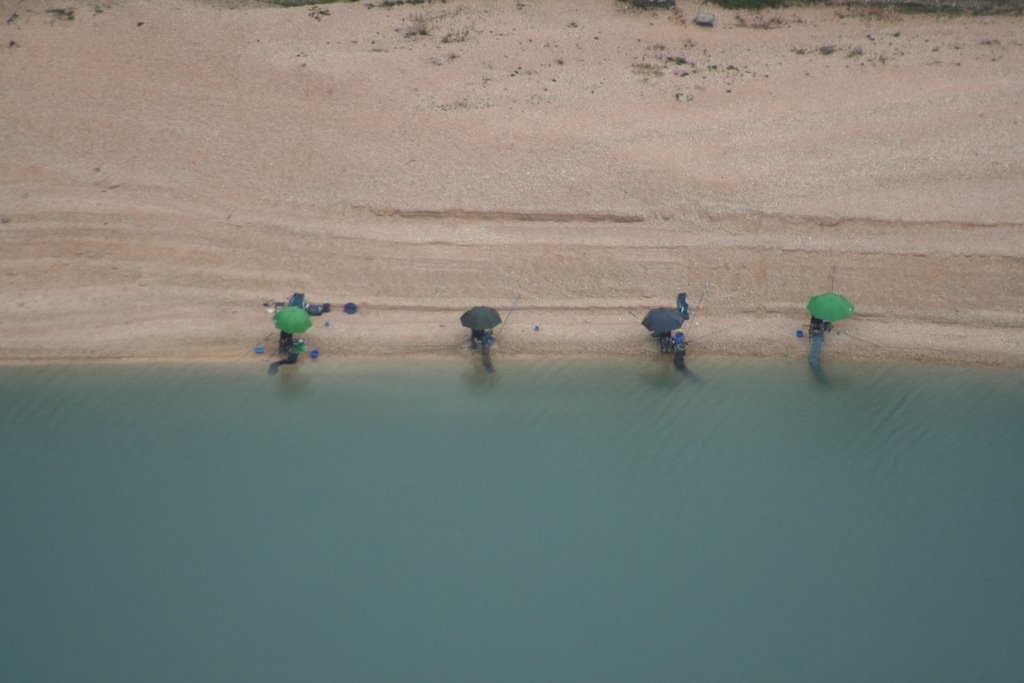
The creation of Lake Fiastra in 1950 as a hydroelectric project changed the whole area, as one might imagine. Quite dramatically, in fact. What was a collection of sleepy villages with an interesting history that predates the Romans, is now a tourist haven, particularly in the summer when windsurfers, fishermen, boaters, sunbathers, and promenade-walkers crowd its shores.

Our first visit to the lake’s tourist center, San Lorenzo al Lago, was well after the end of the “official” season in October. It was still busy, and when we went into a restaurant for a late lunch, a group of 30-odd leather-clad bikers was just leaving, having driven all the way from Rome to celebrate a birthday. We enjoyed a delicious meal there, which included cinghiale (wild boar), Julius’ favourite (thanks to Asterix & Obelisk).

Our visit to San Lorenzo followed a rewarding hike down into the depths of Gola de Fiastra, the gorge created by damming the river. The trail winds through what seems to be old-growth forest, teeming with all sorts of plant life, and criss-crosses the crisp waters of the Fiastrone river through its narrow canyon.

Apparently (according to a local friend) water is periodically released from the dam, flooding the gorge. This naturally conjures images of the standard Italian modus operandus of notifying people after they’ve done the deed, and it added a certain … edge, should we say, to the outing. Looking at the plant life down there, however, it didn’t look like there’d been a release for quite some time.

In addition to the chapel dedicated to Ugolini, the area has a number of sanctuaries, as well as few “rustic” hermitages, where religious recluses lived in caves. There are many in Marche, apparently a sort of clandestine infiltration tactic on the part of the various religious orders as a result of the marchigiani’s resistance to organized Christianity. Witchcraft, or stregheria, was once “the way” in these parts, as it was in the ancient Etruscan realms, and elements of it still survive, both separate from and integrated with established Catholic rites.

Beyond its religious history, archeological findings indicate that there have been settlements in the Fiastra area since around 2000 BC. The Romans also used it as a stopover on the way to the colonial capital of Urbs Salvia. Prior to being absorbed into the papal state in 1545, Fiastra fell under the respective domains of the Magalotti family (until 1259), and the Varano family – several castles serve as testament to this period of its history, the most notable (the 9th-Century Castello dei Magalotti) providing a sweeping vista over the lake and its surrounds. During its medieval and subsequent years, the area became known for its wool, flax, and hemp.

The construction of the dam in 1950 submerged many of the villages and hamlets that comprised the community. While the physical changes wrought by the flooding of the valley have been significant, it’s the drowning of the historical culture encapsulated in these Fiastrone communities that perhaps represents the greater change. Some of it survives – in its sanctuaries, its frescoes, its castles, and its ruins – but today “Fiastra” is more likely to conjure responses related to fishing, swimming, and sunning.

So be it. Life moves on. It was probably just as great a change when the Magalotti family started exerting its influence in the area some thousand years ago. But as we ramble along the valley … walk the trails on the valley walls … and visit the deserted hamlets and castles that remain … perhaps we should open our spirits to the voices that still speak of ancient tribal customs, colonial Rome, and medieval industry. It is, after all, what’s buried in the hills and under the lake’s waves … forever.

Tuesday, December 12, 2006

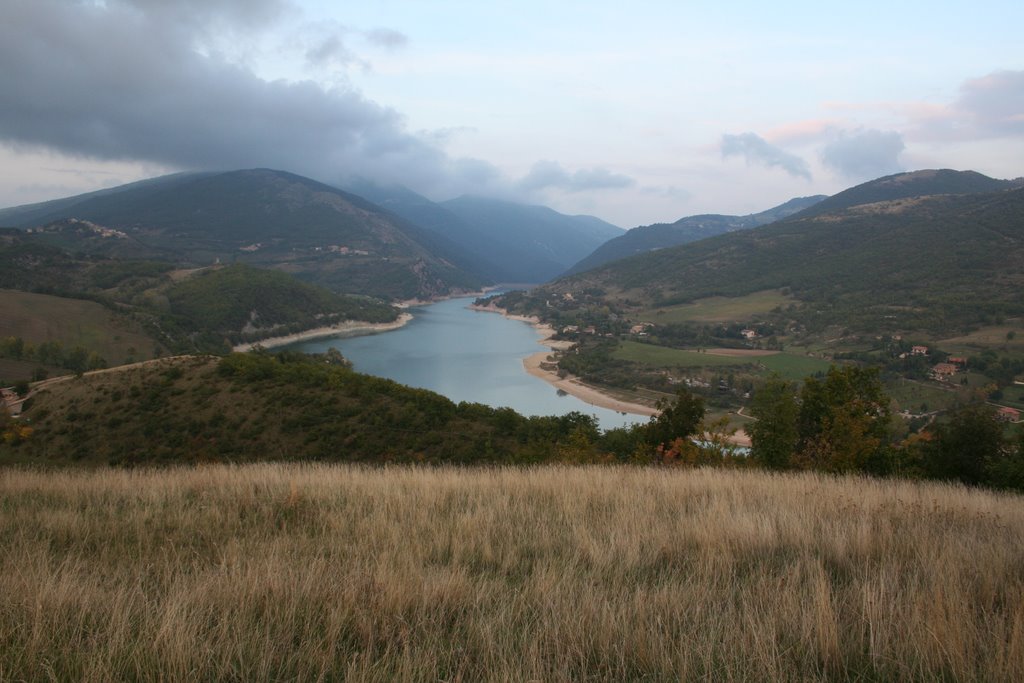
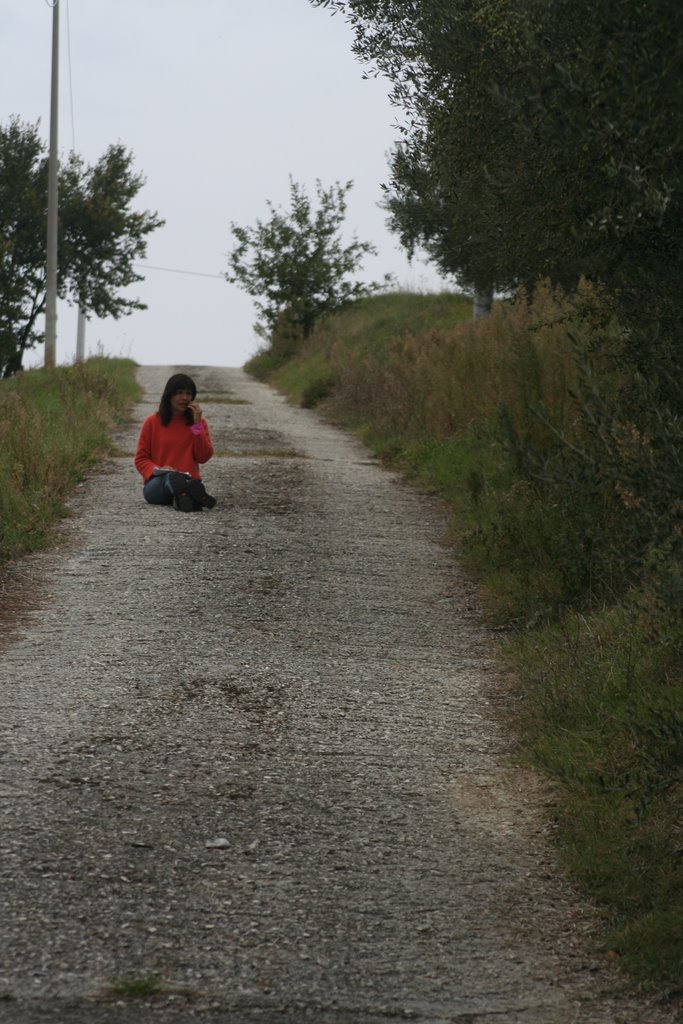
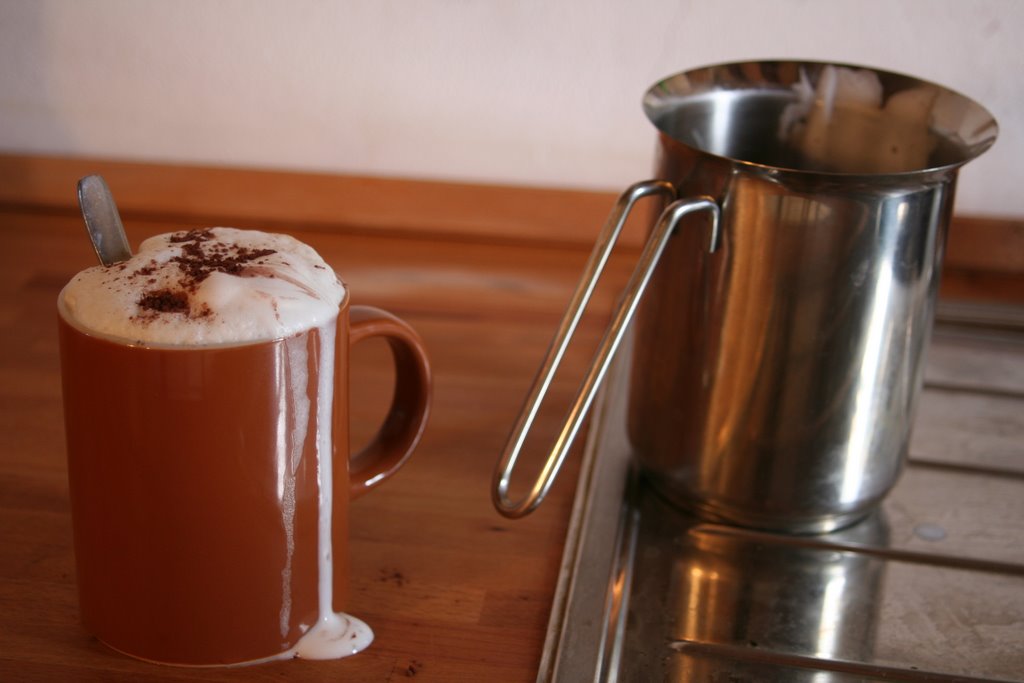
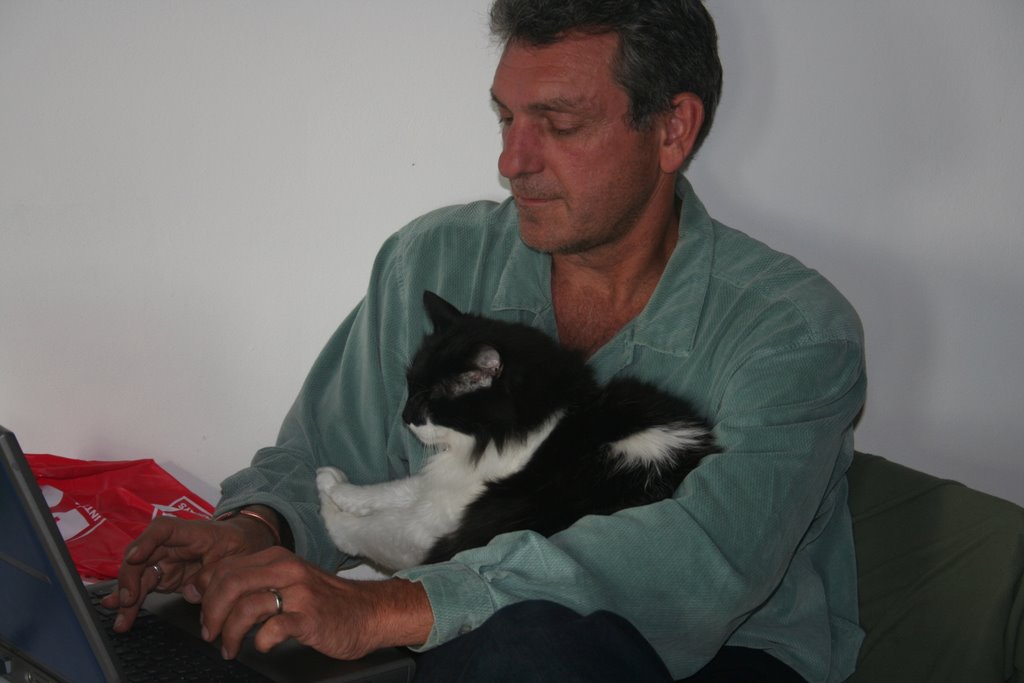
A few casual pictures

Brooding sky

Looking for cell phone reception

Tourist in Jesi - by Julius

Indoor wildlife
Morning glory
Morning ritual
Writer and helper - by Maria

Jesi

Artful sky

Wednesday, November 29, 2006

Tree-climbing

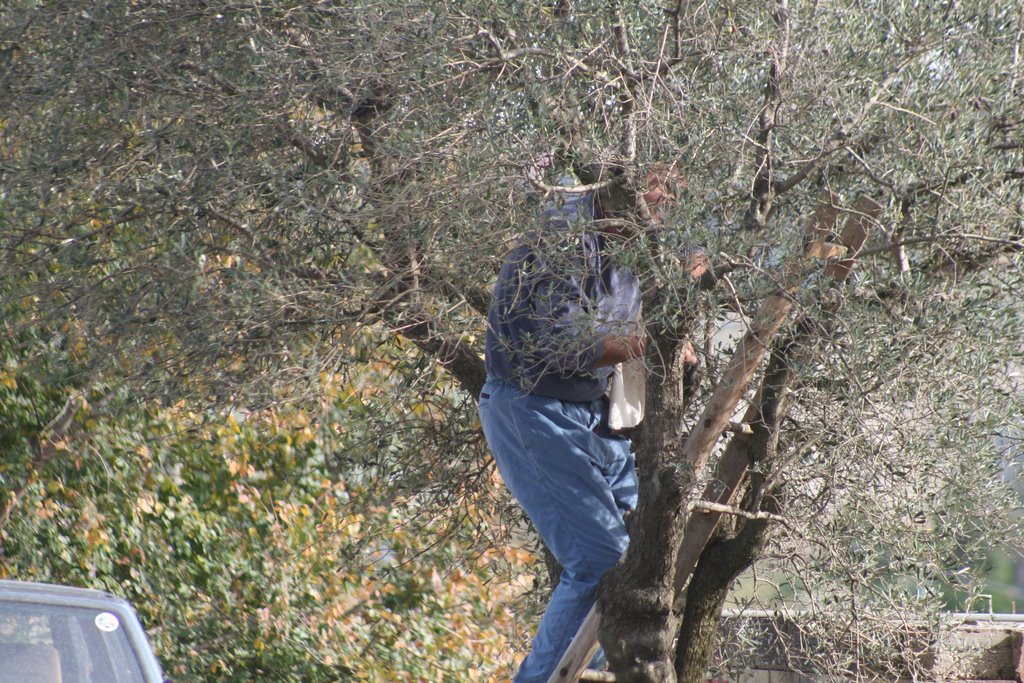
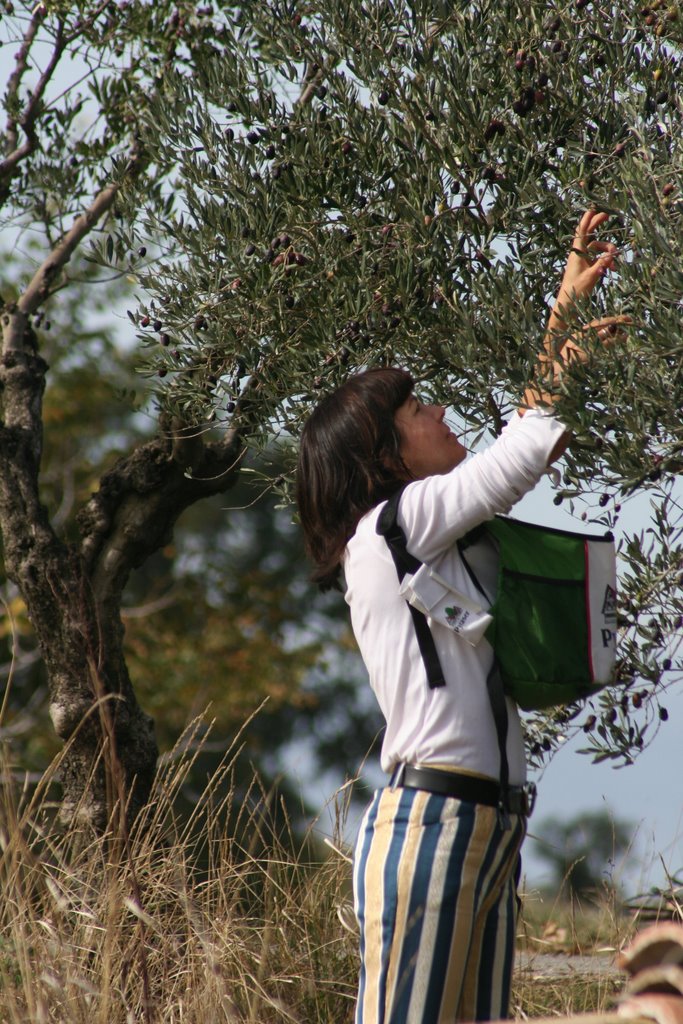
I’ve been climbing trees lately … with our 70-year-old neighbour, Maria. She’s pretty deft at it, and fearless too, peering and reaching over the topmost branches.

But let me explain – while this was at least part-recreation for me, and conjured up memories of my clamberings in the avocado tree in our back garden in Durban, it was pure business for Maria. Not that she sees it as business, though, it’s actually simpler than that – it’s her life.

That’s of course not to say that she’s a professional tree-climber – although I’m sure she would be a contender in the senior categories, along with innumerable other head-scarved marchigiani – but it’s just that those olives need picking.

Our mutual picking sessions were the result of an offer we made to help her family at olive-picking time, in return for her son, Giuliano’s, help in tractoring our household belongings down the steep hill – our driveway – that the moving truck couldn’t negotiate. I won’t deny that there was some selfishness in my offer – the opportunity to get to know our farmer neighbours, and participate in one of the most timeless traditions of the Mediterranean countries.

The family’s picking team consists of Maria, a diminutive, energetic, cherub-faced, salt-of-the-earth marchiagiani; Umb
erto, her equally diminutive 70-something husband with his glass eye (not sure about this, but it does “glaze” over quite a bit) and inane smile (pure deception); and her two sons, Giuliano and Giuseppe.

I ended up helping for 3 full days, and another two half-days; Maria helped for a day-and-a-half, and Julius, one Sunday afternoon. We probably covered 100 trees in the time I helped – they had maybe 150-175 to pick all told.

Let me make one thing clear – I/we
have no prior history in olive picking. Consequently, everything we did was a new experience for us (as in “wow, isn’t this cool?”). And so, in spite of the confidence and apparent knowledge with which our experience is related, remind yourself that it’s the voice of a pure novice (a babe in the olive woods, so to speak) …

Now olive picking, in its purest form, is a hand job. That’s right, manual. The day before the older Maria came and summonsed me to the field, Julius and I had stripped the couple of trees on the property of our rental home. Pick, put in bag, pick, put in bag, pick, put in … you get the picture. Took all @#$@#%$ day, it did – two trees.

So I was glad to see netting spread below the trees to catch the olives, and olive rakes to expedite the stripping. The rakes are more like big combs, which you pull along the length of a branch, separating the olive from its perch, and sending it plummeting … yes, into the spread-out net below. On picking day #2, Giuliano arrived with a machine, powered by an air compressor attached to the tractor, that is a bigger, mechanical version of the olive rake, snapping open and closed on the end of a long pole, just like Pacman’s open-and-close munching action. This machine made a huge difference in productivity, and, I suspect, has revolutionized the olive-picking industry.

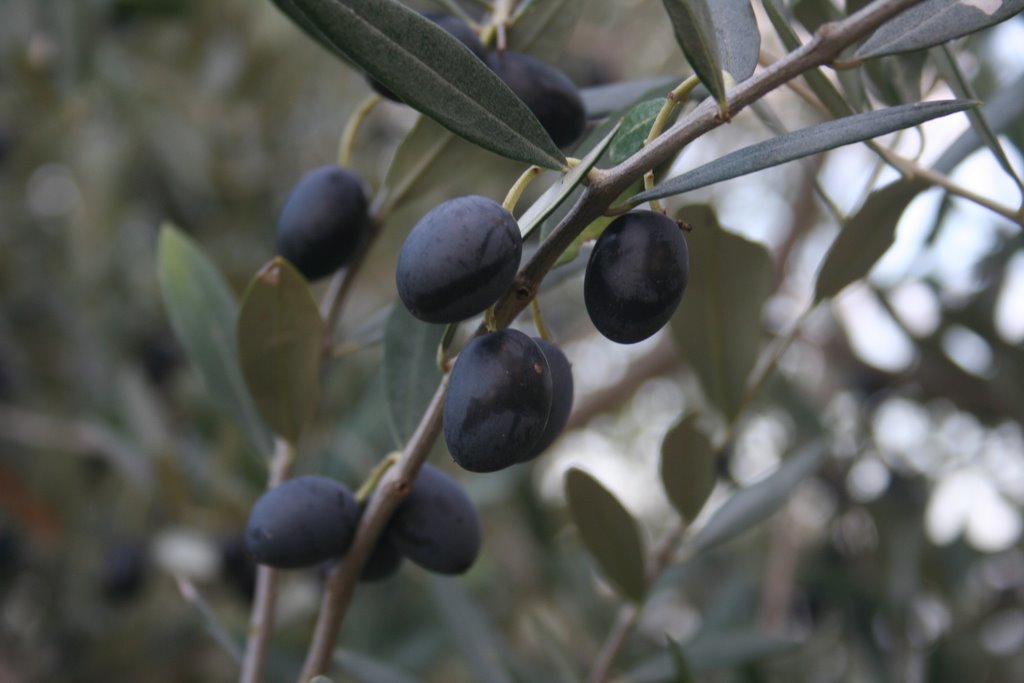
The goal – almost always accomplished – is to get every olive on the tree, whether black, red, multi-coloured, green, or shriveled. The machine can’t get all of them, particularly those on the “inside” of the tree, so we take to the ladders and climb.


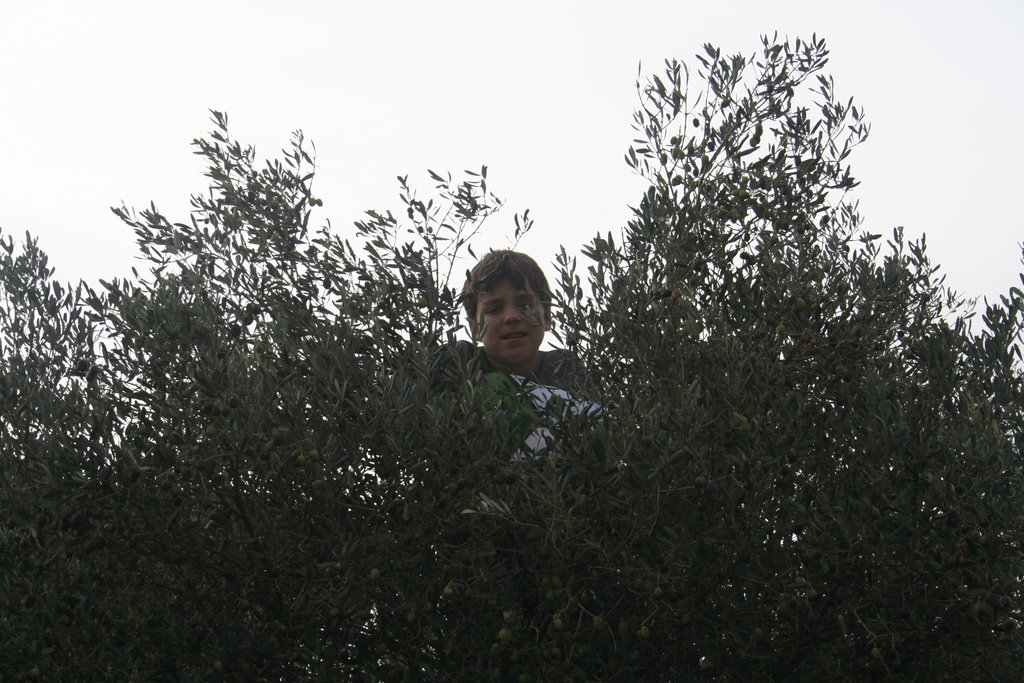
To get to some of them, you have to get up into the topmost branches. Ladders help with this … to start with. But for those out-on-a-limb rascals, you have to s-t-r-e-t-c-h. Precarious? At times, yes. Particularly for those of us that are not regular tree-climbers, which – notwithstanding my aspirations in this field – is a category I fit comfortably into.

But it’s a thrill, nonetheless. The weather was glorious – blue sky, temperatures in the
springtime ranges, the kind of day that you’d describe if you had to be outside the whole time. And climbing trees – how can it get better than this? Not earning a penny doing it, but the feel of the olive branch, the olive itself, the teetering ladder below … heaven.

Watching the family at work was a treat too, particularly the elders. Most amazing to me was Maria, climbing trees, carrying ladders, falling over under the weight of what she was carrying and just getting right on back up again, leaving to go and make lunch, returning after cleaning up and carrying on until dark. And Umberto – patriarch in his white coat (!) and black woolly-cotton cap, always out there first, silently pulling the effort forward, expecting and getting.

The big bonus of the experience was the daily pranzo with the family. Lunch being the sacred event that it is in traditional Italy, it was just assumed that we would join them. I felt simultaneously like a guest and a member of the family … special and yet one of the crew. It was wonderful. Pasta every day, of course, with a variety of meats. Wine from last year’s grapes, and a smorgasbord of last year’s olives – green, black, dried. And the focus of everyone’s attention – Leonardo, 18-month-old son/nephew/grandson, blue-eyed imp and pure charmer.

The picking seems to be all over now. It was interrupted by a bout of wet weather – olives can’t be picked when they’re wet, they rot – and then continued in a couple of locations in the vicinity until yesterday. Senior Maria stopped by the other day to ask us for glass containers to give us some olive oil. From last year’s batch, since this year’s is still “più tòrbido” (use your imagination). Our wages.

We gave her two five-liter jugs – she asked if that was all.

It’s enough – we have our reward. Perhaps best captured by a single moment – Maria (wife) and I were both on ladders, stripping th
e tree using our olive rakes under glorious skies, and I turned to her with a smile and said: “Can you believe this? We’re picking olives in Italy.” “And we don’t have the internet,” she replied.

Amen.